


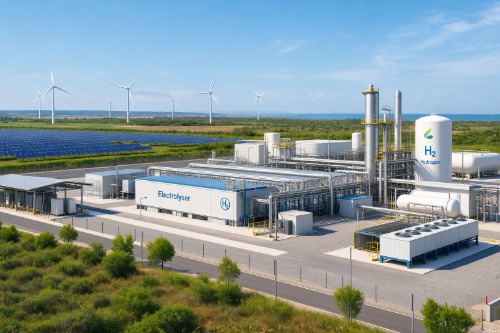
Moeve renewable hydrogen plant of 300 MW is set to begin construction in Palos de la Frontera, Huelva, Spain, on September 17, marking the first phase of its planned Andalusian Valley of Green Hydrogen.
The facility will form part of Moeve’s broader strategy to establish 2 GW of electrolysis capacity in Andalusia, split between its La Rábida Energy Park in Huelva and San Roque Energy Park in Cádiz. The company ultimately aims to produce up to 300,000 tonnes of green hydrogen per year across the planned development.
The first 300 MW facility will be built on land owned by Moeve next to the La Rábida Energy Park. A second 1 GW installation is planned within the San Roque Energy Park in the Campo de Gibraltar.
Moeve’s original development schedule envisaged the Huelva plant beginning operations in 2026 and the wider project reaching maximum capacity in 2028. The source does not provide an updated commissioning schedule beyond those original forecasts.
The company expects the overall Andalusian hydrogen initiative to require investment of up to €3 billion and estimates that it could generate approximately 10,000 jobs, including around 1,000 direct positions. More than 400 small and medium-sized enterprises and self-employed workers are also expected to be involved across the value chain, according to Moeve.
Moeve renewable hydrogen plant production aimed at industrial and transport applications
Moeve plans to use the renewable hydrogen primarily to decarbonise its own industrial operations and those of its customers.
The company also intends to supply hydrogen for the production of sustainable fuels and applications in sectors where direct electrification is more difficult. These include heavy transport, shipping and aviation, as well as selected industrial activities.
Moeve estimates that the complete Andalusian Valley of Green Hydrogen could avoid around 6 million tonnes of CO₂ emissions annually.
The emissions figure is a company estimate and is linked to the development of the full hydrogen valley rather than solely to the initial 300 MW Huelva facility.
Supplying the planned electrolysers will require substantial renewable electricity. Moeve is studying wind and solar photovoltaic projects with a combined capacity of up to 7 GW to support the hydrogen development.
The company is also considering electricity supply agreements with other renewable energy producers in Andalusia and elsewhere in Spain.
This planned power capacity is intended to provide the electricity required for the hydrogen production system while linking the project to the region’s expanding renewable energy base.
Ports could support renewable fuel exports
The Andalusian Valley of Green Hydrogen is designed not only around domestic industrial demand but also around the potential development and export of renewable fuels.
Moeve plans to leverage the proximity of the ports of Huelva and Algeciras, providing access to maritime infrastructure for future renewable fuel supply chains.
The company has also signed an agreement with the Port of Rotterdam to develop a maritime green hydrogen corridor connecting southern and northern Europe. The proposed corridor forms part of Moeve’s wider ambition to position Andalusia as a production and export hub for renewable fuels.
Moeve calls for stronger hydrogen demand signals
Moeve CEO Maarten Wetselaar said the company is establishing the foundations for large-scale projects that can contribute to the development of the hydrogen market.
Wetselaar also said the transposition of the European Union’s Renewable Energy Directive, RED III, was progressing in the right direction for stimulating demand. However, he called for greater ambition to support European decarbonisation objectives and strengthen the continent’s energy autonomy.
The policy environment will therefore remain an important factor as large renewable hydrogen projects move from development towards construction and operation.
Bioenergy Business Analysis
Moeve’s Huelva project illustrates the scale of infrastructure required to build a regional renewable hydrogen economy. The planned 300 MW first phase sits within a much larger 2 GW Andalusian development, while the proposed 7 GW of renewable generation under study highlights the electricity supply requirements associated with large-scale electrolysis.
The project also shows how hydrogen developments are increasingly being connected to industrial demand, sustainable fuels and port infrastructure rather than being developed as standalone production facilities. For developers and investors, Moeve’s approach underlines the importance of securing renewable power, industrial offtake and logistics simultaneously.
The key test will be the conversion of the planned capacity into operational projects. The availability of renewable electricity, demand for hydrogen and renewable fuels, regulatory support and the development of associated infrastructure will all influence the pace at which the Andalusian hydrogen strategy can progress.
Construction of the 300 MW Huelva facility is scheduled to begin on September 17, according to Moeve’s plans.
Read also: CIAL moves ahead with Hydrogen Bus Procurement for airport Green Hydrogen project