


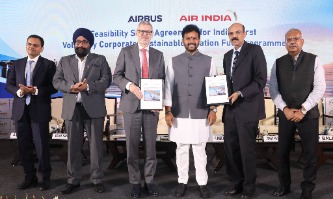
Air India and Airbus are exploring a voluntary corporate sustainable aviation fuel (SAF) programme in India, under which businesses could support the procurement and use of SAF on selected airline routes and receive associated Scope 3 SAF certificates.
The companies signed a feasibility study agreement on 17 November 2026 to assess a framework that could enable organisations across different sectors to address lifecycle emissions associated with business travel. The proposed initiative, if implemented, would become India’s first voluntary corporate SAF programme, according to Air India. The development follows government approval for Indian Oil’s commercial-scale SAF supply.
The agreement was signed by Jürgen Westermeier, President and Managing Director of Airbus India and South Asia, and P Balaji, Group Head – Governance, Risk, Compliance and Corporate Affairs at Air India. The signing took place in the presence of Union Civil Aviation Minister Rammohan Naidu Kinjarapu.
The study will examine a corporate SAF offering based on the voluntary procurement and use of the fuel on selected routes. Under the proposed arrangement, Air India could sell or transfer the associated Scope 3 SAF certificates (SAFc) to eligible corporate customers.
The model is intended to give businesses a way to support SAF adoption and address emissions linked to air travel without necessarily managing fuel procurement or physical blending themselves. The precise operating and commercial arrangements remain subject to the outcome of the feasibility study.
Proposed SAF certificates to help companies track emissions
Under the framework being evaluated, emissions reductions would be calculated by comparing the lifecycle carbon footprint of SAF with that of conventional jet fuel, using globally recognised standards.
The resulting verified savings would allow participating organisations to track and report progress towards the aviation sector’s 2050 net-zero carbon emissions ambition, as set out by the Air Transport Action Group (ATAG), the International Air Transport Association (IATA) and the International Civil Aviation Organization (ICAO).
SAF certificates are intended to connect the environmental attributes associated with SAF use to participating customers. The credibility of such a programme will depend on robust lifecycle accounting, verification and controls to ensure that emissions benefits are accurately attributed and not double-counted.
Air India and Airbus said the feasibility study would seek to establish a scalable framework capable of encouraging participation from businesses across multiple industries and supporting the development of a domestic SAF ecosystem.
Air India and Airbus outline wider aviation decarbonisation efforts
The proposed corporate programme forms part of the companies’ wider efforts to reduce aviation’s environmental footprint. These include fleet modernisation, more fuel-efficient aircraft, operational improvements, SAF adoption and market-based measures.
Air India has 600 aircraft on order, including 350 from Airbus, as part of its fleet renewal plan. The airline has also cited flight-planning and optimisation systems, route-planning software upgrades and coordination with air traffic management among its operational measures to improve fuel efficiency.
Other measures identified by the airline include reducing single-use plastics, using lighter cabin materials, more frequent engine and airframe washing, single-engine taxiing and autonomous electric-vehicle towing.
For the SAF initiative, the immediate next step is the feasibility study. The companies have not yet announced a programme launch date, participating corporate customers, SAF volumes, selected routes or a procurement schedule.



