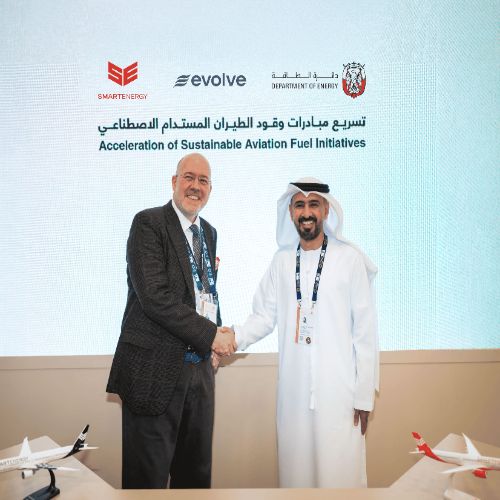
The Department of Energy – Abu Dhabi (DoE) and Evolve Fuels AG, a Smartenergy Group company, have signed a strategic collaboration agreement to assess the potential for synthetic sustainable aviation fuel (e-SAF) production in the Emirate, including investment opportunities, technology requirements and regulatory frameworks.
The agreement was signed at ADIPEC 2026 on 3 November 2026. It establishes a framework for cooperation covering access to Evolve Fuels’ international e-SAF project pipeline, the development of enabling policies and regulations, and the preparation of a potential roadmap for domestic production.
The collaboration will examine whether Abu Dhabi can support e-SAF manufacturing by leveraging its renewable energy resources, hydrogen capabilities and carbon capture potential. No production capacity, project investment value or construction timeline has been announced. Any future facility would require further technical and commercial assessment and separate investment agreements.
Three areas of cooperation under the agreement
The DoE–Evolve Fuels partnership will focus on three principal areas:
- Investment and project development: Connecting potential investors and industry partners in Abu Dhabi with Evolve Fuels’ international portfolio of e-SAF projects.
- Policy and regulation: Supporting the development of regulatory and policy frameworks required to facilitate synthetic aviation fuel production.
- Domestic production roadmap: Assessing the potential for establishing e-SAF production capabilities in Abu Dhabi.
A joint steering committee will oversee the assessment of potential initiatives and projects under the agreement.
The partners will also examine infrastructure and technology requirements, identify potential industrial collaborators and future customers, and evaluate opportunities for investment, technology transfer and local capability development.
The assessment is intended to establish the technical, commercial and regulatory conditions required for potential projects before investment decisions are considered.
Abu Dhabi evaluates its renewable energy and carbon resources for e-SAF
The proposed assessment will draw on Abu Dhabi’s renewable electricity, hydrogen and carbon capture resources to evaluate the feasibility of producing synthetic aviation fuel locally.
E-SAF is produced using renewable electricity to generate hydrogen, which is combined with captured carbon dioxide through synthetic fuel production processes. Unlike conventional bio-based SAF, this pathway does not depend on biomass feedstocks.
The technology is generally associated with Power-to-Liquid (PtL) production, in which renewable hydrogen and a carbon source are converted into liquid hydrocarbon fuels suitable for aviation.
Developing an industrial-scale e-SAF facility would require an assessment of renewable power availability, hydrogen production costs, access to suitable carbon dioxide sources, conversion technology, infrastructure and fuel certification requirements.
The agreement does not establish that these requirements have already been met. Instead, the partners will evaluate the resources and conditions needed to determine whether production could be commercially viable.
European and UK e-SAF requirements create investment opportunities
The collaboration comes as aviation fuel suppliers and producers face increasing pressure to reduce the carbon intensity of air transport.
Regulatory requirements in Europe and the UK are expected to support demand for synthetic aviation fuels over the coming years, creating opportunities for companies developing production technologies and project pipelines.
For Abu Dhabi, the agreement provides a route to explore participation in this emerging market through international project partnerships, potential domestic manufacturing and the development of supporting regulatory frameworks.
Evolve Fuels will bring its international project pipeline and investment platform to the collaboration. According to Smartenergy CEO and Executive Chairman Horst H. Mahmoudi, the company is focused on aggregating and accelerating e-SAF projects, initially in Europe.
Mahmoudi said the agreement would enable Abu Dhabi investors and partners to engage with the company’s project portfolio while both parties assess the potential for domestic production using the Emirate’s renewable energy, Power-to-X and carbon capture resources.
He also identified European and UK e-SAF mandates as important drivers of future market development.
DoE focuses on regulatory and commercial foundations
Abdulaziz Mohammed Al Obaidli, Director-General of Regulatory Affairs at the Department of Energy – Abu Dhabi, said the agreement would help assess how the Emirate’s energy resources and industrial capabilities could contribute to the sustainable aviation fuel market.
He highlighted the importance of developing suitable regulatory and commercial conditions to support investment, technology partnerships and the long-term competitiveness of potential projects.
The next phase of cooperation will concentrate on identifying priority opportunities and evaluating the technical, commercial and regulatory requirements for possible developments.
Any investment commitments or production facilities will remain subject to further assessment and separate agreements.
Bioenergy Business Analysis
Abu Dhabi’s agreement with Evolve Fuels represents an exploratory step towards entering the synthetic aviation fuel market. Its significance lies in the combination of three elements – access to an international project pipeline, assessment of domestic production potential and cooperation on the regulatory framework needed to support investment.
For Abu Dhabi, a domestic e-SAF industry could potentially support investment in renewable hydrogen, carbon capture, synthetic fuel technologies and associated industrial infrastructure. However, the agreement does not yet demonstrate that a commercially viable production project is ready for development.
The next important milestones will be the identification of potential production partners, access to renewable power and carbon feedstocks, assessment of technology and infrastructure requirements, and clarity on prospective customers and offtake arrangements.
Related: Shell secures long-term offtake agreement for SAF from planned Morocco Facility