

Chinese renewable energy company Jiaze New Energy has partnered with French technology provider Axens to advance a proposed 100,000-tonne-per-year sustainable aviation fuel (SAF) project in Jixi, Heilongjiang Province. The agreement covers the deployment of Axens’ Jetanol® Alcohol-to-Jet (ATJ) technology, which converts renewable ethanol into aviation fuel.
The cooperation agreement was signed on 18 November 2026 in Beijing. The project is designed to use biomass-derived feedstocks, including cellulosic ethanol produced from agricultural and forestry residues, to develop a domestic supply of bio-based SAF.
The facility has a planned annual production capacity of 100,000 tonnes. Jiaze New Energy’s project subsidiary is developing the facility, with the total investment estimated at approximately RMB 1.2 billion.
Axens to deploy Jetanol® Alcohol-to-Jet technology
Under the agreement, the project will use Axens’ Jetanol® technology, developed jointly with IFP Energies Nouvelles. The process converts renewable or cellulosic ethanol into SAF through an Alcohol-to-Jet pathway.
The ATJ process generally involves converting ethanol into ethylene through dehydration, followed by hydrocarbon chain formation and upgrading through oligomerisation and hydrogenation. The resulting fuel can be processed to meet aviation fuel specifications.
Jetanol® has been developed specifically for SAF production, drawing on Axens’ experience in industrial and petrochemical process technologies. The technology is designed to support the conversion of ethanol from different renewable feedstocks, including cellulosic sources.
For the Jixi project, this provides a route to use ethanol produced from non-food biomass rather than relying exclusively on conventional agricultural feedstocks.
Project to use agricultural and forestry residues
Located in Jixi City, Heilongjiang Province, the proposed facility forms part of Jiaze New Energy’s wider strategy to expand from renewable power generation into green chemical fuels.
The company is developing a biomass-based value chain that uses agricultural and forestry residues, including crop straw and corn cobs, to produce cellulosic ethanol. This ethanol can then be converted into SAF through the ATJ pathway.
Jiaze New Energy’s October project filing identifies non-grain biomass ethanol and green methanol among the proposed feedstocks. It also lists SAF, renewable diesel and several hydrocarbon streams among the planned products. The project is therefore designed as more than a standalone aviation fuel production unit.
Using agricultural and forestry residues could help reduce competition with food crops and arable land, although the project’s actual sustainability performance will depend on feedstock sourcing, processing emissions and lifecycle verification.
Engineering and sustainability certification agreements signed
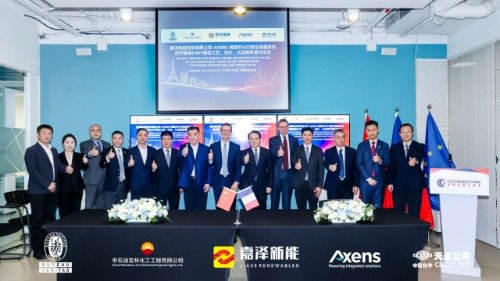
The 18 November signing involved several agreements covering the project’s technology, engineering and certification requirements.
Alongside the agreement with Axens for process technology licensing and engineering design, Jiaze New Energy’s subsidiary signed agreements with PetroChina Jilin Chemical Engineering for construction engineering design and China Tianchen Engineering for integrated design services.
Bureau Veritas Certification (Beijing) also signed an agreement to establish an International Sustainability and Carbon Certification (ISCC) system covering the project’s feedstock procurement, production and finished-product stages.
The certification framework is intended to support traceability and sustainability compliance across the supply chain. The project announcement also refers to alignment with international aviation fuel requirements, including ASTM D7566 Annex A5 for the Alcohol-to-Jet pathway. This should be understood as a project compliance objective, rather than confirmation that the facility or its fuel has already received certification.
Construction targeted for 2027, production capacity by 2028
Jiaze New Energy’s subsidiary, Heilongjiang Jiarun Pengyuan Green Sustainable Fuel Co., is responsible for developing the project in Jixi’s Jidong Economic Development Zone.
The company’s October 2026 investment disclosure estimated the total project investment at RMB 1,201.366 million. Funding is expected to come from the subsidiary’s own resources and financing from financial institutions, with investment to be provided in stages according to project progress.
The project had completed preliminary feasibility work and local project filing at the time of the disclosure. The company was preparing the required approvals, land arrangements, detailed engineering and procurement of long-lead equipment.