


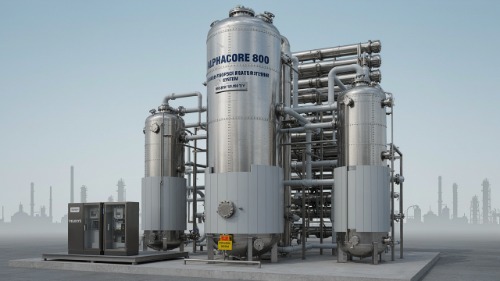
Velocys has expanded its Fischer-Tropsch (FT) reactor portfolio with the launch of AlphaCore 800 reactor designed to produce up to 800 barrels per day (bpd), equivalent to 30,000 tonnes per year, of FT fluids from a single reactor.
The new reactor is the highest-capacity unit in Velocys’ AlphaCore range and is intended particularly for larger sustainable aviation fuel (SAF) and e-fuels projects. The company said the technology is designed for SAF facilities targeting around 100,000 tonnes per year or more.
AlphaCore range expands to 800 bpd
AlphaCore 800 is a microchannel reactor that doubles the capacity of Velocys’ AlphaCore 400 and extends the company’s throughput-based reactor family from approximately 50 to 800 bpd per reactor, corresponding to around 2 to 30 kt/a.
The company said the new reactor retains the underlying chemistry and design approach used across the AlphaCore platform while increasing FT capacity per unit.
Fischer-Tropsch technology converts synthesis gas, or syngas, into liquid hydrocarbons that can subsequently be processed into fuels and other products. In SAF projects, FT synthesis can form part of pathways using different sources of syngas, depending on the project’s feedstock and process configuration.
For developers building larger FT plants, increasing reactor capacity can reduce the number of reactors required to achieve a given production level.
Fewer reactors for larger FT plants
Velocys said the larger reactor format can simplify the FT section of a plant by reducing reactor numbers and associated equipment. As an example, the company said an FT facility requiring approximately 1,600 bpd, or 60 kt/a, of FT liquids could use two AlphaCore 800 reactors.
That configuration would reduce the reactor count by 75% compared with an FT unit using eight AlphaCore 200 reactors for the same FT liquids capacity, according to Velocys.
The company said a lower reactor count could also reduce associated equipment requirements and FT unit costs. These are company-stated benefits of the new configuration rather than independently verified project-level cost reductions.
Reactor platform targets larger SAF and e-fuels projects
AlphaCore 800 joins the existing AlphaCore 50, AlphaCore 200 and AlphaCore 400 reactors in Velocys’ portfolio. The range is intended to give project developers different reactor capacities while retaining the same core technology across multiple project scales and syngas pathways.
Velocys CEO Matthew Viergutz said customers are seeking to apply the company’s microchannel FT technology to larger projects with simpler configurations.
“AlphaCore 800 is a direct response,” Viergutz said, adding that the company is increasing reactor capacity as SAF projects move towards 100,000 tonnes per year and beyond.
The expansion comes as project developers explore larger-scale production configurations for SAF and e-fuels. For FT-based projects, reactor sizing is one element that can influence plant configuration, equipment requirements and the complexity of the FT island.
Scaling Fischer-Tropsch capacity
Velocys’ AlphaCore roadmap moves from smaller reactors designed for lower-throughput applications to an 800 bpd unit aimed at larger facilities.
The company’s stated objective is to provide a scalable reactor platform that can be applied across projects of different sizes while retaining a common technological foundation. For developers, the ability to select larger individual reactors could allow plant configurations to be adapted as production requirements increase.
The company said the AlphaCore roadmap reflects demand for scalable SAF and e-fuels production, with developers seeking to reduce plant complexity, improve repeatability and strengthen the commercial case for larger FT projects.
Bioenergy Business Analysis
The AlphaCore 800 launch highlights an important engineering consideration for larger FT-based SAF projects: reactor scale can influence overall plant complexity as production capacity increases. Moving from smaller individual units to an 800 bpd reactor gives developers another configuration option and can reduce the number of reactors required for a given FT liquids capacity.
The commercial significance will ultimately depend on how the larger reactor performs in actual project deployments, including its integration with upstream syngas production and downstream fuel processing. For SAF developers considering 100,000-tonne-per-year-scale facilities and above, reactor standardisation and equipment reduction could become relevant to project design and execution, but the source does not provide independent cost or performance data for AlphaCore 800.