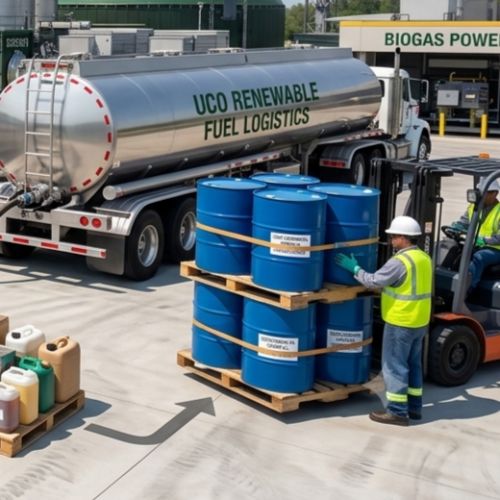
Thailand-based energy company Bangchak Corporation has received a second-runner-up award for its Smart Circular Used Cooking Oil (UCO) Ecosystem, a collection and logistics initiative designed to support the supply chain for sustainable aviation fuel (SAF).
The award, announced on 2 October 2026, recognises a commercial pilot that collected 10,129 kilograms of used cooking oil from six collection points between March and June 2026. Bangchak reported that the initiative reduced logistics costs by up to 26%, providing an initial operational benchmark for its efforts to develop a more efficient used-oil collection network.
The recognition comes as the company reports higher second-quarter revenue and net income, while securities analysts have raised their price target for its shares. These developments provide financial and operational context for Bangchak’s wider strategy, although the award itself does not establish the scale of future SAF production or the project’s contribution to earnings.
Smart Circular UCO Ecosystem targets collection efficiency
Used cooking oil is an established feedstock for producing renewable fuels, including SAF made through pathways such as hydroprocessed esters and fatty acids (HEFA). However, the availability of suitable feedstock depends on effective collection, traceability, quality control and transport logistics.
Bangchak’s Smart Circular UCO Ecosystem pilot focused on collecting used cooking oil through six collection points over a four-month period. The company reported a total collection volume of 10,129 kg and logistics cost reductions of up to 26%.
The initiative addresses an important part of the SAF supply chain: aggregating relatively dispersed volumes of waste oil into a feedstock stream that can be managed more efficiently.
For projects relying on used cooking oil, collection costs and the consistency of feedstock supply can influence overall economics. A more efficient collection network could help improve the economics of procurement, although the pilot’s results should not automatically be extrapolated to a larger network.
The announcement does not disclose the total investment required, the baseline used to calculate the logistics savings, the number of participating suppliers beyond the six collection points, or the volume of SAF that could ultimately be produced from the collected oil.
Second-quarter revenue and net income increase
Bangchak reported revenue of THB 176.55 billion for the second quarter of 2026, compared with THB 131.19 billion in the first quarter. Net income rose to THB 12.24 billion from THB 6.14 billion over the same period, according to the figures cited in the supplied source and its reference to Investing.com.
The figures indicate a sequential increase in both reported revenue and net income. Revenue rose by approximately 34.6%, while net income almost doubled.
The improvement provides context for the company’s broader business position, but the available figures do not establish that the used cooking oil initiative contributed materially to earnings. Bangchak’s financial performance should be assessed separately from the pilot, including the influence of refining margins, energy prices and other business segments.
The reported results and the company’s SAF-related activity represent different measures of performance: one reflects overall financial outcomes, while the other provides an operational indicator for a potential low-carbon fuel supply chain.
Securities analyst raises Bangchak price target
Kiatnakin Phatra Securities raised its target price for Bangchak shares from THB 44.60 to THB 69.70 on 23 September 2026, while retaining a Buy recommendation, according to Kaohoon International as cited in the supplied material.
The revised target reflects the analyst’s assessment of the company’s investment outlook and expected performance. It should not be interpreted as a guaranteed future share price or as evidence that the SAF award alone drove the change.
The supplied source also reports a market capitalisation of THB 74.97 billion and a 52-week trading range of THB 24.20–60.75 as of 12 October 2026. These market figures should be checked against the relevant exchange or financial-data provider before publication.
A separate Lang & Schwarz quote put Bangchak shares at EUR 1.36 at 10:58 p.m. Central European Summer Time on 12 October 2026. Because this is a time-specific quote from a different market-data source, it should be presented with its timestamp rather than as a current or universal share price.
For readers following the company, the analyst target, the trading data and the operating results are distinct indicators and should be considered on their respective terms.
Leadership transition scheduled for January 2027
Bangchak has also announced a planned change in group leadership. According to MarketScreener, the board approved Bundit Hansapaiboon as the next group chief executive and president, with his appointment scheduled to take effect on 1 January 2027.
Chaiwat Kovavisarach is scheduled to leave those roles when his employment term ends on 31 December 2026.
The transition will take place as Bangchak continues to manage its existing energy business and develop initiatives related to lower-carbon fuels. The available information does not establish whether the incoming leadership will change the company’s SAF investment plans, feedstock procurement strategy or project development timetable.
The leadership change is therefore relevant corporate context, rather than evidence of a specific change in the company’s renewable fuels strategy.
Bioenergy Business Analysis
Bangchak’s Smart Circular UCO Ecosystem award highlights a practical challenge for the sustainable aviation fuel industry: securing reliable supplies of waste-based feedstocks at commercially viable collection and transport costs.
Used cooking oil can contribute to SAF production, but the availability of suitable material is constrained by collection infrastructure, competing uses, quality requirements and traceability. Bangchak’s reported 10.1-tonne pilot collection and logistics savings of up to 26% offer an initial measure of the initiative’s operating performance. The results are encouraging as a pilot benchmark, but a larger deployment would need to demonstrate that the savings persist as collection volumes, supplier numbers and transport distances increase.