


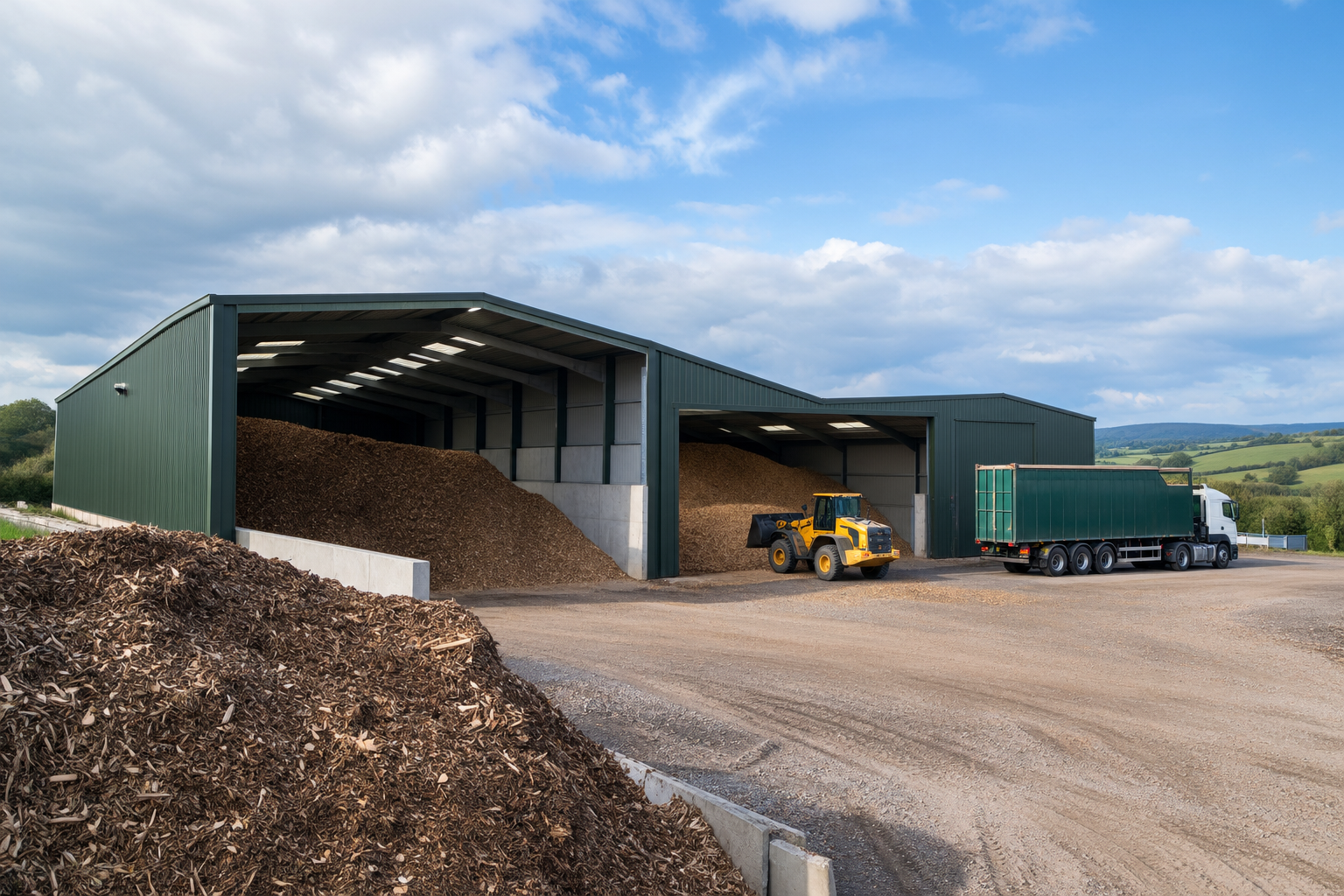
PBE Fuels Ltd has submitted plans for two new biomass fuel storage sheds at New House Farm in Canaston Bridge, Pembrokeshire, to expand drying and storage capacity for wood chips, sawdust and agricultural products as demand from local heat users continues.
Key Takeaways
- PBE Fuels Ltd is seeking permission for two new biomass fuel storage sheds at Pembrokeshire.
- The sheds will support both drying and storage of biomass fuels and cereals.
- The company currently employs 14 people at New House and says it lacks sufficient facilities for wood-chip and sawdust storage.
- The operation supplies biomass fuels to major local users including Bluestone’s Blue Lagoon Water Park, as well as schools, hospitals, hotels and leisure facilities.
The Context
The planning application has been submitted to Pembrokeshire County Council by PBE Fuels Ltd through planning agent Hayston Developments & Planning Ltd. The proposal forms part of a farm diversification project at the 600-acre New House Farm, which has grown from its original 250 acres.
The proposed sheds would have a dual purpose, supporting the drying and storage of cereals and biomass. According to the supporting statement, biomass feedstock includes forestry material as well as “wet” wood from sawmills and smaller operations, which is dried on-site before being converted into wood chips and pellets.
PBE Fuels says its existing facilities are insufficient for storing wood chips and sawdust and for drying wet wood and sawdust delivered to the site. The proposed expansion is therefore intended to address an existing operational constraint rather than simply add storage capacity.
Biomass Supply to Local Heat Users
PBE Fuels supplies biomass fuel to a range of customers across Pembrokeshire and adjoining counties. The supporting statement identifies larger users including Bluestone and the Bluestone Lagoon, Aberglasney Gardens, Folly Farm and Bug Farm, alongside care homes, schools, hospitals, hotels and Haverfordwest Leisure Centre.
Bluestone has also played a significant role in the development of the biomass operation. The statement says an agreement was reached in 2005 with Bluestone, which was seeking a partner to provide an environmentally and economically sound solution for the substantial heat demand of its Blue Lagoon Water Park.
Planning permission for biomass fuel storage was subsequently granted in 2007. The application states that nearly 20 years later, Mr Ratcliffe, one of the applicants, continues to manage the supply of dry wood chips used to heat the Blue Lagoon.
PBE Fuels Expansion Plans
The company says the New House operation currently employs 14 staff and describes the proposed development as an expansion of an established enterprise.
The new sheds would give PBE Fuels additional capacity to manage biomass feedstock through the supply chain, particularly material that arrives wet and requires drying before it can be used as fuel.
The proposal also highlights the increasing integration of biomass production with agricultural activity at New House Farm, with the same proposed facilities intended to accommodate both cereals and biomass.
Bioenergy Business Analysis
The application is significant because it illustrates how local biomass heat markets are driving investment in feedstock handling and drying infrastructure, rather than only in combustion equipment. PBE Fuels’ stated shortage of storage and drying facilities indicates that biomass supply logistics can become a limiting factor as commercial, leisure and public-sector users rely on wood-based fuels for heat.
The proposed expansion could also strengthen the operational link between regional forestry and sawmill residues and local heat demand. However, the immediate development remains subject to planning approval, so the application should be viewed as a proposed capacity expansion rather than confirmed new biomass capacity.
Read Also: US Biofuel Alliance sets sail to power global shipping with American renewables



[…] PBE fuels plans two new biomass storage sheds in Pembrokeshire […]