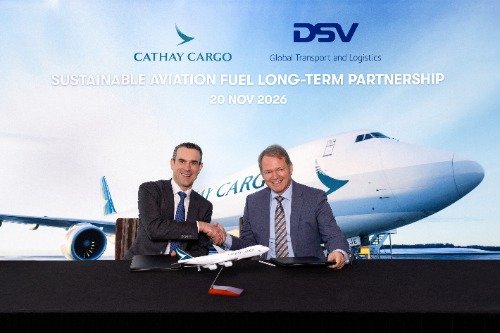
Global transport and logistics company DSV has signed a three-year sustainable aviation fuel (SAF) agreement with Cathay Cargo covering 4.5 million US gallons (approximately 13,155 tonnes) of fuel produced in Asia. The partnership is expected to support at least 45,000 tonnes of carbon dioxide equivalent (CO2e) emissions reductions associated with air freight shipments.
Announced on 24 November 2026, the agreement marks the first long-term SAF partnership between the two companies and makes Cathay Cargo DSV’s first airline partner in Asia for expanding SAF use across its regional network.
The agreement aims to strengthen demand for regionally produced SAF by sourcing the entire contracted volume from Asia. According to the companies, the multi-year commitment is intended to provide greater demand certainty for regional fuel producers and support the development of the Asian SAF supply chain.
Agreement Targets Long-Term Demand for Asian SAF
The three-year partnership covers 4.5 million US gallons of SAF, equivalent to approximately 13,155 tonnes. Neither company has disclosed the individual fuel suppliers, delivery locations or annual allocation schedule for the contracted volume.
For DSV, the agreement forms part of its efforts to address emissions associated with its air freight activities. Cathay Cargo, meanwhile, is seeking to expand SAF adoption through partnerships with logistics companies and other participants across the aviation value chain.
Stefan Krikken, Senior Vice President, Global Air Product at DSV, said the partnership would create sustained demand for SAF produced in Asia and support the regional production and supply required to expand its use.
Cathay Cargo Director Dominic Perret said collaboration across the aviation and logistics value chain would be important for increasing SAF adoption.
Emissions Reductions to Be Allocated Through Cathay’s Corporate SAF Programme
The agreement is part of Cathay’s Corporate SAF Programme, in which DSV participates as a Diamond member.
Under the arrangement, verified emissions reductions associated with the SAF will be allocated to DSV independently of where the fuel is physically used. Cathay Cargo will provide documentation covering the fuel’s journey from sourcing through to aircraft uplift to support the verification and allocation process.
This arrangement allows DSV to claim the associated verified emissions reductions for its air freight activities without requiring the SAF to be physically uplifted on the specific aircraft carrying its shipments.
The companies expect the partnership to support at least 45,000 tonnes of CO2e emissions reductions. However, the announcement does not provide the detailed emissions accounting methodology, lifecycle emissions intensity or baseline assumptions behind this estimate.
Regional SAF Supply Gains Importance for Air Freight Decarbonisation
The agreement comes as aviation and logistics companies seek to increase the availability and use of lower-lifecycle-emission aviation fuels.
SAF can reduce lifecycle greenhouse gas emissions compared with conventional fossil-based jet fuel, depending on its production pathway, feedstock and processing methods. However, limited supply remains a barrier to wider adoption.
By committing to fuel produced entirely in Asia, DSV and Cathay Cargo aim to support regional production and supply development rather than relying exclusively on SAF sourced from other markets.
Multi-year purchasing commitments can provide producers with greater visibility of future demand, potentially supporting investment and expansion across the supply chain.
The partnership adds to Cathay Cargo’s efforts to expand its Corporate SAF Programme and DSV’s broader decarbonisation activities in air freight. Its longer-term contribution to the regional SAF market will depend on actual fuel production, delivery and verified emissions performance over the agreement period.