


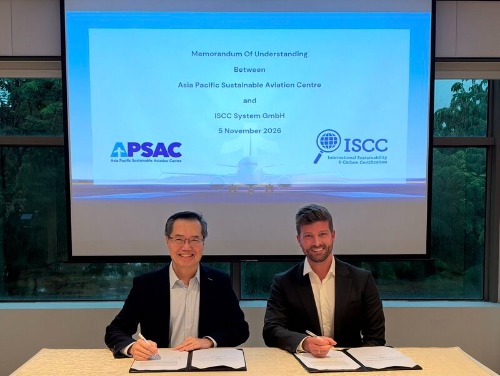
The Asia Pacific Sustainable Aviation Centre (APSAC) and ISCC System GmbH (ISCC) have signed a Memorandum of Understanding (MoU) to strengthen sustainable aviation fuel (SAF) sustainability certification, industry education and stakeholder engagement across the Asia-Pacific region.
The MoU was exchanged in Singapore on 5 November 2026 by Philip Goh, Chief Executive Officer of APSAC, and Adam Kirby, Head of Aviation and Maritime at ISCC. The signing took place on the sidelines of APSAC’s Growing Aviation Sustainably training programme.
The three-year agreement will focus on helping regional stakeholders understand SAF certification requirements and prepare for the certification of sustainable feedstock pathways. The organisations intend to combine APSAC’s regional policy and stakeholder engagement capabilities with ISCC’s experience in sustainability certification and supply-chain traceability.
Four areas of cooperation
The collaboration will initially cover four areas:
- Capacity building: Workshops, training programmes and technical exchanges to familiarise stakeholders with SAF certification processes and requirements.
- Regional development: Technical knowledge exchange to support policy and regulatory frameworks for certified SAF supply chains in Asia-Pacific.
- Joint events and stakeholder dialogue: Cooperation around events including APSAC’s Sustainable Aviation Forum and Growing Aviation Sustainably programme, as well as ISCC’s Global Sustainability Conference and regional stakeholder committee meetings.
- Knowledge sharing: Joint publications, guidance materials, case studies and other educational resources.
The partnership is intended to support airlines, fuel producers, regulators and other supply-chain participants as the region prepares for increased SAF demand and the associated need for credible sustainability documentation.
Dr Norbert Schmitz, Managing Director of ISCC, said:
“Certification builds the trust that SAF markets need to grow. Asia-Pacific has enormous potential for sustainable feedstocks and SAF production, and we are delighted to work with APSAC to strengthen knowledge and capacity throughout the region,”
Philip Goh, Chief Executive Officer of APSAC, said:
“As demand for SAF in Asia Pacific grows, airlines, producers, and regulators need assurance that the fuel they buy, supply, and regulate is sustainable and traceable. Building understanding of sustainability certification is essential for Asia Pacific to scale up SAF supply and adoption. We are pleased to collaborate with ISCC to help stakeholders across the region build knowledge to prepare for certified SAF supply chains,”
Strengthening SAF certification readiness in Asia-Pacific
APSAC was established by Singapore’s Civil Aviation Authority in 2025 to advance sustainable aviation in the Asia-Pacific region through policy research, collaboration and capacity building. Its work includes supporting regional stakeholders through training and knowledge exchange.
ISCC operates sustainability certification systems covering supply chains for renewable fuels and other products. Its work in aviation fuels includes certification under the International Civil Aviation Organization’s Carbon Offsetting and Reduction Scheme for International Aviation (CORSIA).
The MoU adds to ongoing regional efforts to develop the policy, technical and certification capabilities needed to support SAF supply chains. In October 2026, the ASEAN Centre for Energy and Airbus also signed a three-year cooperation agreement covering SAF research, capacity building and policy dialogue across ASEAN.
Bioenergy Business Analysis
The APSAC–ISCC agreement addresses an important part of SAF market development: the ability to demonstrate the sustainability and traceability of fuel feedstocks and supply chains.
Certification readiness can help producers, airlines and other market participants understand the documentation and verification requirements associated with SAF supply. This is particularly relevant in Asia-Pacific, where the development of feedstock resources and production capacity will need to be accompanied by credible sustainability assurance.
However, the MoU is a cooperation and capacity-building agreement, not a SAF supply contract or production investment. It does not announce new SAF volumes, production facilities, feedstock procurement commitments or certification approvals. Its impact will depend on the training, technical exchanges and stakeholder activities delivered during the initial three-year term.



