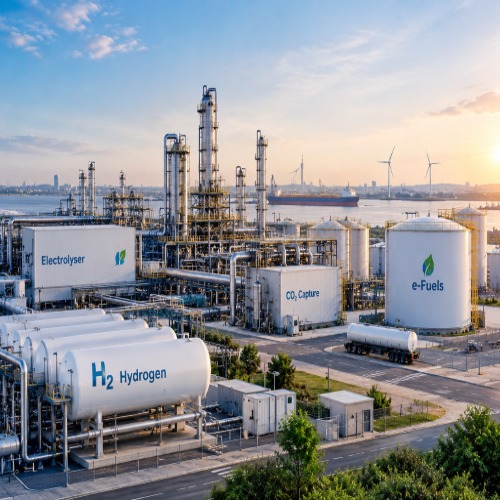
The eFuels Rotterdam project developed by Power 2x has been selected for a grant under the European Union’s Innovation Fund 2025 Net-Zero Technologies call, marking a step forward for plans to scale up the production of synthetic sustainable aviation fuel (eSAF) in Europe.
The project team said the funding recognition supports its ambition to advance synthetic aviation fuel production, contribute to aviation decarbonisation and strengthen Europe’s energy resilience.
The project will now progress through the grant agreement process with the European Climate, Infrastructure and Environment Executive Agency (CINEA). The announcement does not disclose the grant amount, the project’s planned production capacity or the expected timeline for completing the agreement.
EU Innovation Fund Supports eSAF Development
The EU Innovation Fund supports the development and deployment of innovative low-carbon technologies. Its 2025 Net-Zero Technologies call provides the funding context for the selection of eFuels Rotterdam.
Synthetic sustainable aviation fuel is produced using synthesis pathways rather than relying exclusively on conventional biological feedstocks. Depending on the production route, eSAF can combine hydrogen produced using low-carbon electricity with a carbon source to create synthetic hydrocarbons suitable for aviation fuel production.
The potential emissions benefits depend on factors including the source of electricity, hydrogen production, carbon feedstock, conversion efficiency and the fuel’s lifecycle emissions. Project selection for a grant does not, by itself, establish the emissions reductions that a facility will ultimately achieve.
Rotterdam Project Targets Europe’s Synthetic Aviation Fuel Market
The eFuels Rotterdam project is intended to contribute to the expansion of synthetic aviation fuel production in Europe. Scaling up eSAF is relevant to the aviation sector’s efforts to reduce emissions, particularly for routes and aircraft for which direct electrification is difficult.
However, the commercial viability of synthetic aviation fuels depends on several factors, including access to competitively priced renewable electricity, the availability of low-carbon hydrogen and sustainable carbon sources, project financing, fuel certification and long-term offtake agreements.
Bioenergy Business Analysis
The selection of eFuels Rotterdam for an EU Innovation Fund grant highlights the continued policy interest in developing synthetic aviation fuels as part of Europe’s industrial decarbonisation strategy. For the eSAF sector, public funding can help advance capital-intensive projects, although the precise contribution of the grant to this project’s financing remains undisclosed.
Three considerations will shape the project’s significance for the wider market.
First, grant selection is an early milestone, not confirmation of project delivery. The next step is the grant agreement process with CINEA. The final funding terms, eligible costs and associated project commitments will help clarify the support available to the development.
Second, production economics will be central to commercial deployment. Synthetic aviation fuels require hydrogen and a suitable carbon source, alongside energy-intensive conversion processes. The project’s eventual competitiveness will depend on its electricity supply, production efficiency, capital costs and ability to secure buyers.
Third, the project’s contribution to aviation decarbonisation will depend on measurable lifecycle emissions performance. The use of synthetic fuels does not automatically guarantee a particular emissions reduction. Assessment will require information on the production pathway, energy inputs, carbon sourcing and applicable sustainability criteria.
For European renewable fuels markets, the announcement is a development to watch as funding moves towards implementation. Further details on grant value, production capacity, project milestones and fuel offtake arrangements will be necessary to assess the project’s potential contribution to Europe’s eSAF supply