


Spain’s Castilla y León regional government has granted Priority Industrial Project status to the eM-Numancia renewable methanol project in Garray, Soria, clearing an important administrative step for an industrial development expected to attract more than €320 million in investment between 2026 and 2030.
Promoted by ELYSE EM-NUMANCIA S.L.U., the project will combine renewable hydrogen, forest biomass and carbon dioxide capture to produce renewable e-biomethanol. The facility is expected to establish a new industrial value chain around renewable energy, sustainable biomass and renewable fuels in Soria and the wider Castilla y León region.
The declaration was approved by the Governing Council of the Junta de Castilla y León on October 1, 2026. The regional government said the project’s investment scale, employment potential, technological content and expected impact on economic activity supported its recognition as a project of general and strategic interest.
eM-Numancia to combine renewable hydrogen and forest biomass
The proposed plant will integrate two main feedstocks.
Renewable hydrogen will be produced through water electrolysis using renewable electricity. In parallel, synthesis gas will be produced through the oxygen gasification of forest biomass, principally pine wood.
The resulting process will combine the hydrogen and carbon-containing gas streams to produce renewable methanol. The project will also incorporate systems for the capture and recovery of CO₂.
This configuration places biomass and renewable hydrogen within the same industrial production chain, with the carbon component derived from biogenic sources rather than relying solely on externally supplied fossil-derived carbon.
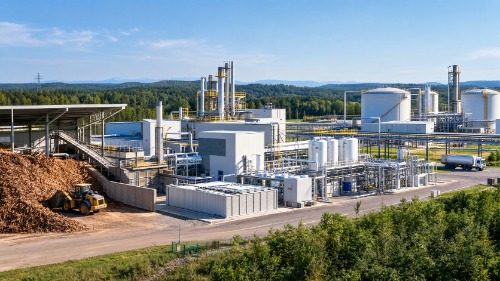
The facility will include units for biomass treatment and gasification, renewable hydrogen production, catalytic methanol synthesis, gas conditioning, product storage and road dispatch.
The project will operate exclusively with renewable electricity, supported by long-term power purchase agreements. A 132 kV underground electricity connection is planned between the facility and the Soria substation.
Production capacity could reach 200,000 tonnes annually
The latest project details indicate an initial nominal production capacity of up to 100,000 tonnes of renewable e-biomethanol per year.
A second phase could increase production to 200,000 tonnes annually, subject to the availability of electricity supply.
The higher-capacity phase is therefore linked not only to the expansion of the methanol plant itself but also to the availability of additional grid capacity for industrial consumption.
The project is being developed at the Parque Empresarial del Medio Ambiente (PEMA) in Garray, where it is intended to form part of a broader industrial ecosystem around renewable energy and green industry.
Project expected to support nearly 900 jobs during construction
The development is expected to generate significant employment during construction.
Around 900 direct and indirect jobs are projected during the construction phase. Once operational, the plant is expected to sustain at least 50 stable direct positions and approximately 125 indirect jobs.
The regional government expects a substantial proportion of the permanent roles to involve technical and highly skilled profiles.
Beyond direct employment, the project is expected to generate activity for construction companies, engineering firms, transport operators, logistics providers and industrial service companies. Local suppliers are also expected to participate in different stages of the development.
Renewable methanol aimed at hard-to-electrify sectors
Renewable methanol can serve as a feedstock and fuel in applications where direct electrification can be more difficult.
For eM-Numancia, the planned product is intended primarily for sectors including the chemical industry and heavy-duty, maritime and aviation transport.
The project therefore links renewable hydrogen and biogenic carbon with applications that require energy-dense molecules or chemical feedstocks rather than direct electricity.
Elyse Energy describes eM-Numancia as a project for producing e-methanol from renewable hydrogen and biogenic CO₂ in Garray. Earlier project information from the company had described a smaller production configuration, while the latest regional project documentation reflects the expanded production pathway now being advanced.
eM-Numancia integrated into Castilla y León Hydrogen Valley
The project forms part of the strategic pilot projects within the Hydrogen Valley of Castilla y León, supporting the region’s efforts to develop renewable hydrogen production, decarbonise industrial activity and establish new value chains around renewable fuels.
The project’s industrial configuration also connects the hydrogen economy with the region’s forest biomass resources. Rather than treating hydrogen, biomass and carbon capture as separate systems, eM-Numancia is designed around their integration into a single renewable-fuel production process.
The project has also received support through Spain’s renewable hydrogen funding framework. An IDAE project document lists a maximum award of approximately €43.9 million for the renewable hydrogen component, linked to a 60 MW electrolyser configuration described in the funding documentation.
Priority status accelerates industrial development
The Priority Industrial Project designation is intended to facilitate the administrative processing of qualifying industrial developments in Castilla y León.
The regional framework allows such projects to benefit from coordinated and accelerated administrative procedures, while the designation does not remove the requirement to obtain applicable environmental, planning and sector-specific authorisations.
For eM-Numancia, the designation covers investments planned for the 2026–2030 period and formally recognises the project’s industrial, technological and economic relevance to Soria and Castilla y León.
With more than €320 million of planned investment and a potential production capacity of up to 200,000 tonnes of renewable e-biomethanol annually, the project represents an attempt to connect renewable electricity, hydrogen, forest biomass and biogenic carbon within a single industrial value chain.
Bioenergy Business Analysis
The eM-Numancia project is notable because its renewable methanol pathway combines bioenergy and power-to-X technologies rather than relying on renewable hydrogen alone. Forest biomass provides the carbon-containing synthesis gas, while renewable electricity supplies the hydrogen pathway and the wider plant’s energy requirements.
From a bioenergy perspective, the model could create an additional industrial outlet for sustainably sourced forest biomass by integrating it into the production of a renewable molecule that can serve chemical and transport markets. However, the eventual scale of the project will remain linked to electricity availability, permitting, biomass supply and the ability to develop the associated infrastructure required for the larger 200,000-tonne annual production phase.