


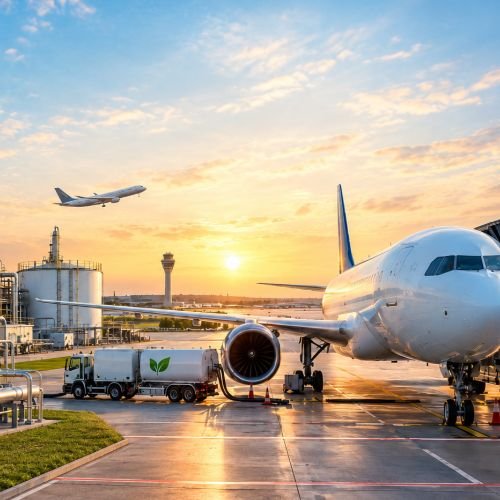
The Middle East energy crisis is accelerating the adoption of biofuel blending mandates in several countries, particularly in Southeast Asia, but the high cost of sustainable aviation fuel (SAF) is expected to constrain its share of the aviation fuel market to nearly 5% by 2035, according to the International Energy Agency (IEA).
The findings were highlighted in the IEA’s World Energy Outlook 2026, published on 19 November. Five countries have strengthened their biofuel blending requirements since March 2026 as governments respond to energy security concerns and seek to diversify transport fuel supplies.
The United States finalised new Renewable Fuel Standards in March, Vietnam brought forward its E10 ethanol programme in June, and Indonesia began implementing its B50 biodiesel mandate in July. The IEA said the crisis had accelerated regulatory action, particularly across Southeast Asia. A total of 49 countries now have biofuel blending mandates in their transport sectors.
Biofuel consumption rises as countries strengthen blending requirements
The expansion of biofuel mandates builds on growth recorded before the latest energy crisis. Higher blending requirements and energy security priorities increased biofuel consumption in 2025 by approximately 50% in India, 40% in Japan, 10% in Southeast Asia and 5% in Europe, the IEA reported.
Global liquid biofuel production reached around 2.6 million barrels of oil equivalent per day (mboe/d) in 2025, with almost all output used in road transport. Biofuel use displaced more than 2.5 mboe/d of oil demand during the year.
The IEA expects biofuels to displace a further 0.25 mboe/d of oil demand in 2026, mainly through increased consumption in the United States, Indonesia and India.
The United States accounted for 25% of global liquid biofuel production in 2025, making it the largest producer. Brazil followed with 15%, while Southeast Asia and Europe each accounted for 9%.
Under the IEA’s Stated Policies Scenario, which reflects existing policy settings, global liquid biofuel production is projected to increase to 3.9 mboe/d by 2035. In its Current Policies Scenario, annual investment in low-emissions fuels is expected to more than triple to above US$40 billion, with biofuels accounting for most of the expansion.
SAF remains expensive compared with conventional jet fuel
Despite the expansion of biofuel use in road transport, aviation is expected to remain a major source of global oil demand growth. The IEA projects jet fuel demand to increase by 185,000 barrels per day annually through 2035, while passenger travel grows by 45%.
SAF currently accounts for less than 1% of aviation fuel consumption. Its production costs are estimated to be three to 10 times higher than those of conventional jet fuel, creating a significant barrier to wider adoption.
Under the IEA’s Stated Policies Scenario, SAF is projected to account for nearly 5% of aviation fuel by 2035 and approximately 10% by 2050. European Union and UK blending requirements are expected to be important drivers of this growth.
Biofuels are projected to supply around 80% of SAF demand in 2035, with synthetic fuels expected to become more significant over the longer term. The IEA identifies Brazil, China, Europe, Japan, South Korea and North America among the principal regions expected to supply SAF.
The agency also highlighted the potential role of energy security priorities in increasing SAF adoption. Greater attention to supply diversification could support demand and help reduce production costs over time.
Airline fuel expenditure and SAF prices highlight the cost challenge
The energy crisis has exposed the aviation industry’s dependence on conventional jet fuel. Airline fuel expenditure is projected to reach US$350 billion in 2026, compared with US$252 billion in 2025, according to figures cited by the IEA from the International Air Transport Association (IATA).
Recent market assessments also illustrate the price difference between SAF and conventional aviation fuel.
On 19 November, Platts, part of S&P Global Energy, assessed the price of SAF HEFA-SPK at US$2,070 per tonne on a free-on-board (FOB) Straits basis, down US$15 per tonne from the previous week. Its premium over the Platts Jet Kero FOB Singapore forward curve was assessed at US$969 per tonne, an increase of US$82.25 per tonne week on week.
The SAF HEFA-SPK FOB China assessment stood at US$2,020 per tonne, also down US$15 per tonne from the previous week. Its premium over the Singapore jet kerosene benchmark increased by US$82.25 per tonne to US$919 per tonne.
The assessments indicate that, despite a weekly decline in outright SAF prices, the premium over conventional jet fuel widened in both markets.
Malaysia delays SAF blending mandate amid higher fuel costs
The cost challenge is also influencing national SAF policies. Malaysia has deferred its proposed 1% SAF blending mandate for international flights departing from Kuala Lumpur International Airport (KLIA) from January 2027 to 2030.
The country’s Plantation and Commodities Ministry said the revised timeline would give airlines and other industry participants more time to prepare their operations and allow the Civil Aviation Authority of Malaysia to develop the necessary regulatory framework. The government also cited geopolitical developments and higher jet fuel prices as factors contributing to increased operating costs and financial pressure on airlines.
The postponement illustrates the tension between developing domestic SAF markets and managing the additional costs faced by aviation operators.
Biofuels gain a larger role in aviation and shipping outlook
Although most liquid biofuel consumption currently takes place in road transport, the IEA expects its use in aviation and shipping to increase over the longer term.
Under the agency’s outlook, liquid biofuel consumption in these two sectors rises from marginal levels today to 1.4 mboe/d by 2050. More than 60% of that consumption is projected to take place in the European Union, supported by the ReFuelEU Aviation and FuelEU Maritime frameworks.
The outlook points to a widening role for biofuels in transport decarbonisation, but the pace of adoption will depend on policy requirements, production capacity, feedstock availability and fuel economics. While the energy crisis is encouraging governments to strengthen biofuel mandates, the cost of SAF remains a significant constraint on its near-term contribution to aviation fuel supply.