South African power utility Eskom has moved towards testing renewable hydrogen production through a planned pilot facility in Johannesburg, while Norwegian energy company Statkraft has halted the development of new green hydrogen projects amid market uncertainty and financial risks. The contrasting moves highlight the gap between hydrogen’s long-term decarbonisation potential and the commercial challenges facing project developers.
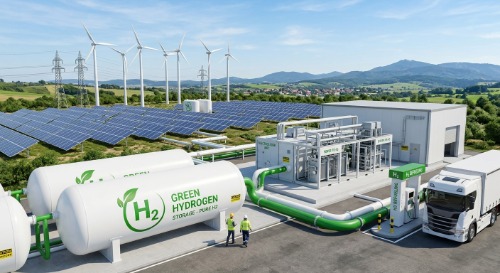
Eskom’s proposed facility will use water electrolysis and integrate with an existing 400-kilowatt (kW) solar photovoltaic (PV) system at the utility’s Eskom Research and Innovation Centre in Rosherville, Johannesburg. The project is intended to support research into renewable hydrogen production and its potential role in South Africa’s future energy system.
Eskom’s planned hydrogen facility
According to Eskom’s tender documentation, the proposed project will be delivered under a three-year contract. Its scope covers the engineering, procurement and construction of a water-electrolysis hydrogen generation plant integrated with the site’s existing renewable power infrastructure.
The planned facility will comprise five interconnected subsystems:
- Electrical configuration
- Energy management
- Hydrogen storage
- A hydrogen end-use workstation
- The hydrogen production process, including water demineralisation and storage
The pilot is intended to help Eskom assess renewable hydrogen technology and develop the technical knowledge required for potential future deployment. The utility has also operated a grey hydrogen pilot at the Matimba coal power station, providing a different production pathway for comparison.
The initiative aligns with South Africa’s wider interest in renewable hydrogen under the South African Renewable Energy Masterplan and the priorities of the Ministry of Electricity and Energy. However, a pilot facility is an early-stage research and demonstration project, not evidence of commercial-scale green hydrogen production.
Statkraft halts development of new green hydrogen projects
The investment environment presents a contrasting picture in Europe. Statkraft announced in May 2025 that it would stop developing new green hydrogen projects across its markets, citing heightened uncertainty and financial risks.
The company said it would prioritise growth opportunities in other technologies and market operations while continuing to advance selected projects from its existing portfolio before seeking investors to take them forward.
Among the projects previously under consideration was a planned 200 MW electrolyser in Emden, Germany, associated with potential annual production of up to 20,000 tonnes of renewable hydrogen and up to €107 million in support from the European Union’s Innovation Fund. The funding was announced as support for the planned project; it should not be interpreted as confirmation that the facility has been built or is operating.
In September 2026, Statkraft announced that it had completed the divestment of its UK green hydrogen development portfolio, marking the conclusion of the process announced the previous year. The company has said that hydrogen-related market activities will remain part of its portfolio, even as it redirects development priorities.
Green hydrogen costs remain a commercial hurdle
The challenges facing project developers include the cost of producing renewable hydrogen, the time required to develop projects, uncertain demand and the need to secure buyers and financing.
In December 2024, BloombergNEF revised its long-term green hydrogen cost outlook. It estimated that production costs, then ranging from US$3.74 to US$11.70 per kilogram, could decline to between US$1.60 and US$5.09 per kilogram by 2050. The revised forecast was substantially higher than earlier expectations of costs reaching around US$2 per kilogram in many major markets by the early-to-mid-2030s.
The projections underline the difficulty of achieving cost competitiveness with conventional hydrogen, which is typically produced from fossil fuels. Actual costs will vary by region and depend on electricity prices, electrolyser costs, utilisation rates, financing and available policy support.
For green hydrogen to scale beyond pilot projects, developers also need reliable access to renewable electricity, suitable infrastructure, sustained industrial demand and long-term offtake agreements. Public funding can improve project economics, but it does not remove all commercial risks.
What the developments mean for hydrogen investment
Eskom’s pilot and Statkraft’s retreat from new project development reflect different responses to the same emerging market. A research-led demonstration can help a utility understand technical requirements and possible applications before committing to larger investments. For a commercial developer, however, uncertain returns and long development timelines can make it difficult to justify additional project spending.
Eskom’s proposed facility could generate useful evidence about renewable hydrogen production and integration with solar power. Its eventual significance will depend on project implementation, technical results and whether the findings support a credible route to wider deployment.
Statkraft’s decision, meanwhile, illustrates how even large energy companies with access to renewable generation and public funding may reassess hydrogen investment when market conditions weaken. Its position does not mean that all hydrogen activity has stopped: the company has retained hydrogen-related market operations and previously sought investors to advance selected projects.
Research-led hydrogen development is also the focus of MMMUT’s planned green hydrogen centre and startup programme in India.
Bioenergy Business Analysis
The two developments point to a more selective phase for green hydrogen. Public-sector pilots such as Eskom’s can build technical capability, test integration with renewable electricity and clarify the requirements for future projects. Commercial expansion, however, will depend on whether production costs fall sufficiently, demand becomes more predictable and developers can secure financing and long-term customers.
For South Africa, the proposed facility represents a research step rather than a near-term measure of hydrogen’s contribution to the national energy mix. For the wider market, Statkraft’s decision is a reminder that ambitious decarbonisation targets alone do not guarantee project viability. The next phase of green hydrogen development will depend on demonstrable performance, credible economics and a clear pathway from pilot projects to bankable industrial applications.