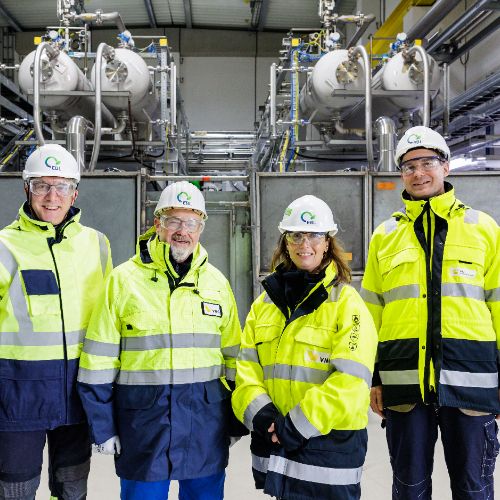
Energiepark Bad Lauchstädt in Germany has produced its first green hydrogen using a 30-megawatt (MW) electrolyser powered by electricity from a connected wind farm, marking a key milestone in the development of an integrated hydrogen production and supply system.
The facility, jointly developed and operated by Uniper and VNG Handel & Vertrieb GmbH (VNG H&V) through their joint venture Elektrolyse Mitteldeutschland GmbH (EMG), uses renewable electricity to split water into hydrogen and oxygen.
With initial hydrogen production achieved, the project is moving into the next phase of testing, focusing on the integration of electricity generation, electrolysis, gas processing, storage and transportation. Completion of commissioning for the integrated hydrogen system is planned for 2027.
30 MW electrolyser begins hydrogen production
The Bad Lauchstädt facility uses a pressurised alkaline electrolyser supplied by Sunfire. It comprises three modules, each with a capacity of 10 MW, and each module contains two electrolysis stacks where water is converted into hydrogen and oxygen.
Construction of the large-scale electrolyser began in June 2023. The first production milestone follows the gradual commissioning of the project’s components and the completion of supporting infrastructure.
The electrolyser receives renewable electricity from a connected wind farm with an installed capacity of approximately 50 MW. The project is designed to demonstrate the operation of an integrated green hydrogen value chain, linking renewable power generation with industrial hydrogen production and consumption.
The energy park received Renewable Fuels of Non-Biological Origin (RFNBO) certification in August 2026. The certification confirms that its hydrogen production meets the European requirements for renewable hydrogen, supporting its eligibility for commercial marketing under the relevant framework.
Around 3,000 tonnes of hydrogen planned for industrial use
The hydrogen produced at Bad Lauchstädt is intended for industrial use at the TotalEnergies refinery in Leuna, which is the project’s anchor customer and offtaker.
Konstantin von Oldenburg, Managing Director of VNG H&V, said:
“With the production of the first hydrogen, we are moving closer to our shared goal of converting renewable energy into an energy carrier that can be used industrially. The first hydrogen molecules are harbingers of the approximately 3,000 tonnes of hydrogen that our anchor customer will purchase and use industrially next year. The test operation now getting underway is an important step towards bringing the individual components together and preparing the way for future supply.”
The planned purchase of approximately 3,000 tonnes in 2027 represents a key step towards establishing an industrial market for renewable hydrogen in the region. The project partners are now working to ensure that the different stages of the supply chain operate reliably together before regular industrial deliveries begin.
Holger Kreetz, COO of Uniper, said:
“The hydrogen economy needs more than electrolysers: it needs functioning connections between renewable electricity generation and industrial customers. That is precisely what we are working on in Bad Lauchstädt. The first hydrogen produced is an important milestone. What matters now is ensuring that the entire process chain functions reliably during operation.”
Repurposed gas pipeline connects the project to Leuna refinery
The project combines hydrogen production with dedicated transportation infrastructure. A former natural gas pipeline operated by ONTRAS Gastransport GmbH, approximately 25 kilometres long, has been converted for hydrogen transport.
The pipeline will connect the energy park with the hydrogen network serving the chemical industry in Central Germany and facilitate supply to the TotalEnergies refinery in Leuna.
The project also incorporates underground hydrogen storage in a purpose-prepared salt cavern. This is intended to provide temporary storage before hydrogen is transported through the converted pipeline.
Hans-Joachim Polk, CTO of VNG AG and head of the real-world laboratory consortium, said:
“The development of the hydrogen economy begins where production, infrastructure and industrial demand come together within a limited geographical area. Such regional clusters can form the starting point for a growing hydrogen market. Energiepark Bad Lauchstädt has all the essential prerequisites for this. Here, we can test how the different stages of the value chain work together in practice and gain experience that will also be valuable for establishing other regional hydrogen clusters.”
€210 million investment supports integrated hydrogen value chain
Energiepark Bad Lauchstädt is being developed as a large-scale real-world laboratory to test the production, storage, transportation, marketing and industrial use of green hydrogen.
The project partners are investing approximately €210 million, including €44 million in funding under the German Federal Government’s 7th Energy Research Programme through its Real-World Laboratory of the Energy Transition initiative.
The consortium brings together companies involved in renewable power generation, electrolysis, gas infrastructure, storage, research and hydrogen marketing. Uniper and VNG H&V jointly manage the electrolyser through EMG, while VNG H&V is responsible for marketing the hydrogen produced at the site.
The project is intended to demonstrate how renewable electricity, hydrogen production, storage infrastructure and industrial demand can be integrated at an industrial scale. Completion of the integrated system’s commissioning is planned for 2027.
Bioenergy Business Analysis
The first hydrogen production at Bad Lauchstädt marks progress beyond the construction and installation phase for one of Germany’s integrated green hydrogen projects. Its significance lies not only in the 30 MW electrolyser, but also in the infrastructure connecting renewable power generation to storage, transportation and an industrial offtaker.
The use of a repurposed natural gas pipeline is particularly relevant to the development of hydrogen infrastructure. Converting existing gas networks for hydrogen transport could help connect production sites with industrial consumers, although pipeline suitability, technical requirements and operating conditions must be assessed for each project.
The planned purchase of approximately 3,000 tonnes of hydrogen by TotalEnergies in 2027 also provides an important demand-side element. Securing an industrial offtaker can help establish the commercial basis for production, while the RFNBO certification provides a recognised framework for marketing the hydrogen as renewable.
Related: Read about the Dakhla green ammonia project in Morocco.