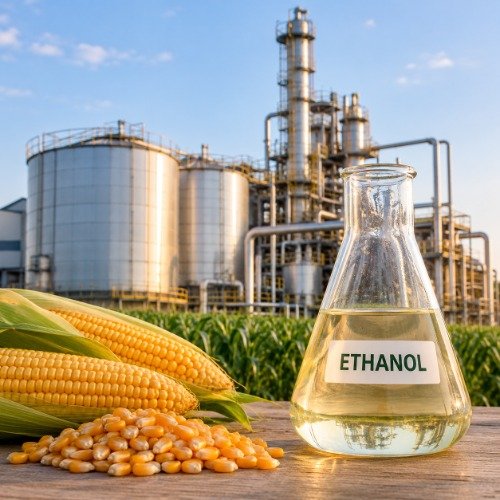
India recorded an average ethanol blending level of 19.99% during Ethanol Supply Year (ESY) 2025–26, effectively reaching the government’s 20% target, according to provisional data released by the All India Distillers’ Association (AIDA) on 20 November 2026.
The data, covering the period up to 31 October 2026, shows that 1,134.36 crore litres of ethanol were blended during the supply year, compared with an estimated requirement of 1,050 crore litres. Ethanol allocations stood at 1,196.90 crore litres, while recorded supplies totalled 1,088.91 crore litres.
Grain-based feedstocks accounted for 800.53 crore litres, or 73.52% of total ethanol supplies. Sugar-based feedstocks contributed 288.38 crore litres, representing the remaining 26.48%. Maize was the largest individual feedstock, supplying 489.71 crore litres.
Grain-based ethanol accounts for 73.52% of supplies
The growing contribution of grain-based ethanol was a defining feature of the 2025–26 supply year. Maize supplied 489.71 crore litres, accounting for approximately 45% of total ethanol supplies.
Surplus rice procured by the Food Corporation of India (FCI) contributed 233.95 crore litres, while damaged foodgrains accounted for 76.87 crore litres.
The allocation figures show differences in supply performance across grain feedstocks. Maize supplies reached around 80% of its allocated 614.12 crore litres. Supplies of surplus FCI rice marginally exceeded its allocation of 233.19 crore litres, while damaged foodgrain supplies were higher than the allocated 60.37 crore litres.
The figures underline the increasing importance of grain-based feedstocks in India’s ethanol supply chain, with maize emerging as the largest individual contributor.
Sugar-based feedstocks supply 288.38 crore litres
Sugar-based feedstocks contributed 288.38 crore litres of ethanol during ESY 2025–26. Sugarcane juice accounted for 153.36 crore litres, followed by B-Heavy molasses at 118.04 crore litres and C-Heavy molasses at 16.98 crore litres.
The provisional data also recorded approximately 32.45 lakh tonnes of sugar diverted towards ethanol production. This included 23 lakh tonnes attributed to sugarcane juice and 9.44 lakh tonnes to B-Heavy molasses.
Although grain-based feedstocks represented nearly three-fourths of total supplies, sugar-based sources continued to contribute more than one-quarter of the ethanol supplied during the year.
AIDA calls for policy stability and continued investment
Commenting on the figures, AIDA President Vijendra Singh said the growing contribution of grain-based feedstocks, particularly maize and surplus FCI rice, had diversified India’s ethanol supply chain.
He identified policy predictability, timely procurement and continued investment in manufacturing capacity as important requirements for sustaining the programme.
AIDA Vice President Kushal Mittal highlighted the need for technology adoption, operational efficiency and manufacturing infrastructure. He also pointed to timely pricing decisions, logistics and coordination with oil marketing companies as factors influencing the long-term viability of investments in the ethanol sector.
Bharati Balaji, AIDA’s Deputy Director General, said grain-based feedstocks now accounted for more than 73% of ethanol supplies, increasing the role of maize, surplus FCI rice and other agricultural resources in domestic ethanol production.
Feedstock diversification shapes India’s ethanol supply outlook
The ESY 2025–26 figures indicate a substantial contribution from grain-based feedstocks alongside continued supplies from the sugar sector. The distribution also highlights the importance of procurement, feedstock availability, pricing and logistics in maintaining ethanol supply to oil marketing companies.
With the blending level reaching 19.99%, the provisional data places India close to its 20% target for the supply year. AIDA’s comments point to policy continuity and investment in manufacturing capacity as key considerations for the sector’s next phase.
The reported blending and supply volumes are separate measures in the provisional dataset and should be interpreted accordingly.