


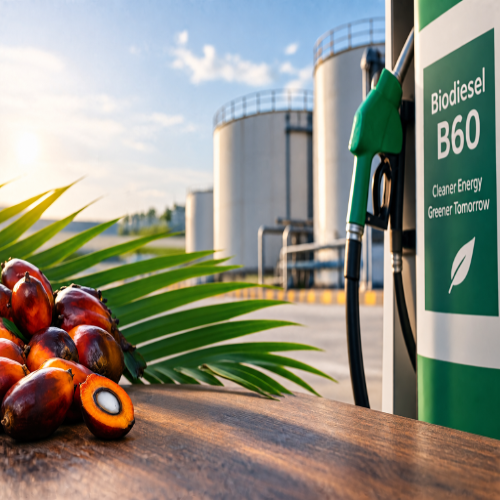
Indonesia’s B60 biodiesel expansion programme in 2027 is unlikely to cause a major vegetable-oil supply shock for India, despite the potential for tighter global palm oil availability and higher prices.
Indonesia launched its mandatory B50 biodiesel programme in July 2026, requiring a 50% biodiesel blend in diesel fuel, with the biodiesel component primarily derived from palm oil-based fatty acid methyl ester (FAME). The government is now assessing crude palm oil (CPO) availability and other requirements ahead of a potential B60 programme next year.
The policy is part of Indonesia’s strategy to strengthen energy security, reduce diesel imports, increase domestic consumption of palm oil and lower emissions. However, greater domestic use of CPO could reduce the volume available for export, potentially affecting major buyers such as India.
Indonesia’s B60 biodiesel expansion tightens palm oil outlook
Indonesia and Malaysia dominate global palm oil production and exports, making changes in their domestic policies important for international vegetable-oil markets.
Indonesia’s move from B30 and B35 to B40 and now B50 has progressively increased the amount of palm oil absorbed by the domestic biodiesel sector. A further increase to B60 would place additional pressure on CPO supplies if production and productivity do not rise sufficiently.
Indonesian authorities are already examining whether available CPO supplies can support B60 and whether additional planting or productivity improvements will be required.
The issue has become more significant amid volatility in global energy and agricultural markets. Higher crude oil prices can improve the economics of domestic biodiesel blending by making petroleum diesel relatively more expensive, while weather risks could simultaneously constrain vegetable-oil production.
India is already diversifying vegetable-oil imports
For India, the impact of tighter Indonesian palm oil exports may be less severe than initially expected because the country has several alternative sources and vegetable-oil options.
India is the world’s largest vegetable-oil importer and has historically relied heavily on palm oil because of its price advantage over soybean and sunflower oils. However, the narrowing price discount for palm oil has encouraged refiners to increase purchases of alternative soft oils.
Recent import data illustrates this shift. India’s July 2026 imports included around 719,470 tonnes of crude palm oil, 498,881 tonnes of crude soybean oil and 251,639 tonnes of sunflower oil, according to data from the Solvent Extractors’ Association of India.
Reuters also reported that India’s July edible-oil imports reached a 10-month high, with purchases of palm, soybean and sunflower oils all increasing as refiners prepared for festival-season demand.
This diversification gives Indian buyers greater flexibility if Indonesian palm oil availability becomes tighter.
India can expand alternative supply sources
India’s vegetable-oil supply chain is also geographically diversified. Palm oil is primarily sourced from Indonesia and Malaysia, while soybean oil comes mainly from Argentina and Brazil.
This means a reduction in Indonesian export availability does not automatically translate into a shortage of vegetable oil in India. Instead, changes in relative prices are likely to influence the composition of India’s import basket.
Recent data shows that India’s palm oil imports have already been responding to changing price economics. In June, crude palm oil imports fell as the price discount over competing oils narrowed, while sunflower oil imports increased.
The market therefore has mechanisms to adjust to tighter supplies from individual origins, although such adjustments could come with higher procurement and freight costs.
Global vegetable-oil supply provides additional buffer
The broader global vegetable-oil market is another reason India may be able to absorb Indonesia’s higher domestic biodiesel consumption.
Global production includes palm, soybean, sunflower, rapeseed and other vegetable oils, giving large importing markets multiple sources of supply. India’s growing use of soybean and sunflower oils provides an additional buffer against a potential reduction in Indonesian palm oil exports.
However, that does not mean Indonesia’s B60 plans will have no impact. Higher domestic palm-oil consumption could keep pressure on palm prices and reduce the discount that traditionally makes the oil attractive to Indian refiners.
For India, the key issue is therefore likely to be price rather than physical availability.
Diplomacy could help protect Indonesian supplies
India also has an important commercial relationship with Indonesia, making diplomatic engagement another potential tool for managing supply risks.
India imports substantial quantities of palm oil, alongside commodities such as coal, timber and nickel, from Indonesia. Continued dialogue could help reduce the risk of abrupt disruptions as Indonesia increases domestic CPO consumption.
Bioenergy Business Analysis
Indonesia’s B50 rollout and possible move to B60 reinforce how quickly biofuel mandates can reshape global agricultural commodity flows. Because Indonesia uses palm-based FAME for biodiesel, higher domestic blending directly increases CPO consumption and can reduce the quantity available for export. Indonesia’s energy ministry is already assessing CPO availability and upstream requirements for B60, indicating that feedstock availability will remain a central constraint.
For India, however, the bigger risk appears to be higher palm-oil prices rather than an outright supply shortage. India’s ability to switch between palm, soybean and sunflower oils, together with multiple international suppliers, provides a degree of resilience. July import data already shows substantial volumes of all three oils entering the Indian market.
The development is nevertheless important for the global biofuels market. Indonesia’s policy demonstrates the growing competition between food and fuel demand for vegetable oils, while also showing how national biodiesel programmes can influence international commodity prices even when their primary objective is domestic energy security.
Read also: ORSL hits major biogas milestone with Rs 167 crore twin BPCL wins, accelerating India-wide expansion