


Key Takeaways
- Nova Pangaea Technologies and NorSAF will collaborate on an advanced ethanol plant in Latvia using locally sourced wood waste.
- The ethanol will supply NorSAF’s planned SAF production facility in Latvia.
- EU SAF requirements rise from 2% in 2025 to 6% in 2030 and 20% in 2035.
- Nova Pangaea says its REFNOVA® technology converts waste biomass into ethanol and biochar, with the process designed to be carbon negative.
Lead
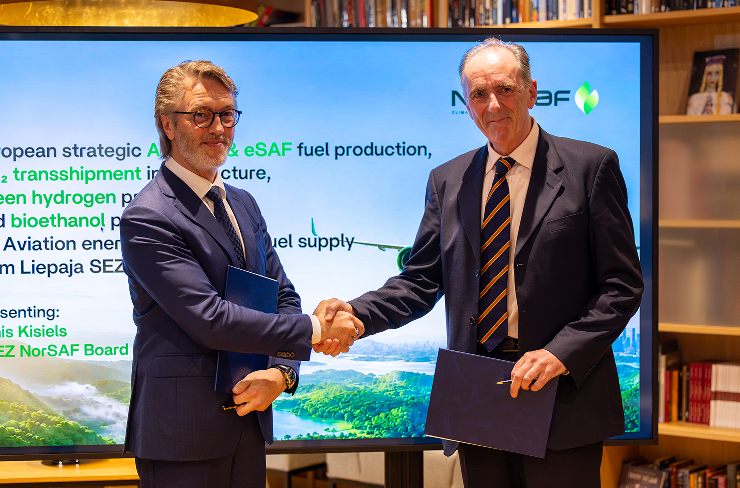
SAF production in Latvia is set to gain a locally sourced ethanol supply chain as UK cleantech company Nova Pangaea Technologies partners with NorSAF to develop a wood-waste-to-ethanol plant whose output will feed NorSAF’s planned Sustainable Aviation Fuel facility.
Context
The partnership comes as Europe faces rapidly increasing demand for Sustainable Aviation Fuel under EU regulations. Aviation fuel suppliers are required to increase SAF’s share at EU airports from 2% in 2025 to 6% in 2030 and 20% by 2035.
Europe currently produces a significant share of its SAF domestically, but the industry remains heavily dependent on imported waste fats and used cooking oil. According to the source, approximately 85% of Europe’s SAF feedstocks come from overseas, with China accounting for 61%.
Nova Pangaea and NorSAF are targeting waste biomass as an alternative feedstock. Latvia has significant forestry and agricultural resources that can potentially support a more locally sourced supply chain.
Waste Wood to Ethanol for SAF
The planned Latvian plant will use locally sourced wood waste to produce ethanol using Nova Pangaea’s proprietary REFNOVA® technology.
The technology converts waste biomass into ethanol, which can then be used as a feedstock for SAF production. It also produces biochar as a co-product, which the company says permanently captures carbon and allows the overall process to be carbon negative.
The ethanol from the planned plant will be supplied to NorSAF’s proposed SAF production facility in Latvia.
According to the International Air Transport Association, sufficient waste biomass is available across Europe to produce enough SAF to meet Europe’s 2050 SAF targets.
Quotes
Speaking about the collaboration, Jonathan Wood, CCO of Nova Pangaea Technologies, said the partnership would provide carbon-negative ethanol for NorSAF’s SAF project using locally sourced biomass waste.
“This strategic collaboration will ensure we have carbon-negative ethanol to feed NorSAF’s SAF project, using locally sourced biomass waste.”
Wood said the model could support the development of domestic SAF supply chains while also creating opportunities for UK cleantech companies to commercialise their intellectual property internationally.
NorSAF founder and board member Janis Kisiels said Europe’s energy-security challenge extends beyond fossil-fuel imports and includes the supply of feedstocks required to produce replacement fuels.
“We also need to build the industrial capacity to produce the clean fuels that will replace them.”
Kisiels said using Europe’s waste resources, particularly those available in the Baltic region, could help establish a more locally anchored supply chain for SAF production.
Latvia’s Role in the Technology
The collaboration also has a direct Latvian connection. Nova Pangaea’s REFNOVA® technology is based on research conducted at the Latvian State Institute of Wood Chemistry (LSIWC) in Riga before further development work was carried out in the UK.
Nova Pangaea is headquartered in Teesside and operates a demonstration plant. The company has also worked with British Airways and LanzaJet on Project Speedbird, a UK government-supported initiative focused on producing SAF from non-food agricultural and woody biomass.
NorSAF operates a liquid oil and chemical product storage and transshipment terminal in Liepāja. It is developing a SAF and eSAF production facility, with production currently expected to begin in 2031.
Bioenergy Business Analysis
The Nova Pangaea-NorSAF partnership creates a potential biomass-to-ethanol-to-SAF supply chain in Latvia, connecting locally available wood waste with a planned aviation-fuel production facility. That model directly addresses one of Europe’s current SAF supply-chain constraints: dependence on imported waste-based feedstocks.
For the bioenergy and SAF sectors, the project also illustrates how ethanol can serve as an intermediate feedstock for advanced aviation fuel rather than being limited to road-fuel applications. However, the source does not disclose the planned ethanol plant’s production capacity, investment value, construction schedule or the volume of ethanol required by NorSAF’s future SAF facility.
With EU SAF blending requirements scheduled to reach 20% by 2035, the development of domestic waste-biomass feedstock pathways could become increasingly important for European producers seeking to build supply chains around locally available resources.