


Indonesia is preparing to develop a domestic ethanol industry as the government targets E20 fuel within two years and outlines a longer-term pathway towards E50 blending.
The development plan was discussed at a limited meeting chaired by President Prabowo Subianto at the Presidential Palace Complex in Jakarta on September 16, according to Coordinating Minister for Food Zulkifli Hasan.
Hasan said Danantara would be responsible for developing the ethanol processing industry, while the Ministry of Agriculture would prepare plans covering feedstock requirements and land availability.
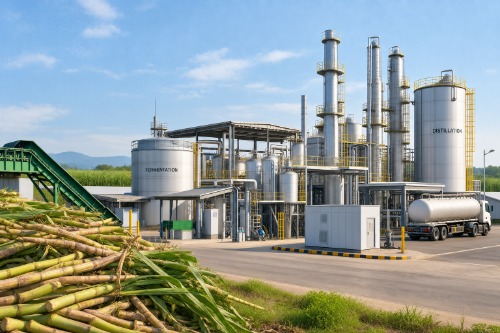
Sugarcane identified as main ethanol feedstock
The government expects sugarcane to be the most likely source of ethanol for the planned fuel-blending programme.
Hasan said the ethanol required for the initial E20 target is intended to come entirely from domestic production. The government therefore plans to develop the necessary industrial and agricultural base alongside the fuel-blending policy.
The Ministry of Agriculture’s role will include planning for the raw materials and land needed to support ethanol production, while Danantara will take responsibility for developing the processing industry.
Indonesia E20 ethanol planned as first stage towards E50
The government is positioning E20 as the first stage of a gradual increase in ethanol blending.
Hasan said Indonesia would initially focus on achieving a 20% ethanol blend before progressively increasing the share, with E50 identified as the longer-term direction.
The approach mirrors the government’s broader strategy of gradually increasing biofuel blending rather than moving directly to the higher target.
For ethanol producers, the proposed transition would require domestic production capacity to expand sufficiently to supply the targeted blend levels. The source does not provide a specific ethanol production capacity for the planned industry.
Land availability emerges as major constraint
The government estimates that around 2 million hectares of sugarcane land would be required to support the planned ethanol production programme.
Land availability was identified as the biggest obstacle that needs to be addressed. This places agricultural development alongside industrial investment as a central component of Indonesia’s ethanol strategy.
The source does not specify how the required land would be allocated, developed or distributed among producers.
The requirement also highlights the dependence of a domestic fuel-ethanol programme on securing sufficient feedstock before processing capacity can be fully utilised.
Danantara assigned industrial development role
Danantara has previously been involved in the government’s efforts to accelerate downstream development and manage strategic projects.
Under the latest division of responsibilities, its role would extend to development of the ethanol processing industry, while agricultural authorities would address the feedstock and land requirements.
The government is seeking to establish a domestic supply chain in which sugarcane provides the raw material and locally developed processing capacity produces ethanol for fuel blending.
Bioenergy Business Analysis
Indonesia’s proposed E20-to-E50 pathway places ethanol production capacity and sugarcane development at the centre of its fuel strategy. The immediate E20 target creates a near-term requirement for domestic ethanol supply, while the longer-term E50 ambition would increase the scale of the agricultural and industrial challenge.
The proposed requirement for around 2 million hectares of sugarcane land also shows that ethanol policy cannot be separated from feedstock planning. For developers and investors, the availability and development of suitable agricultural land will be an important factor alongside construction of processing facilities.
The division of responsibilities between Danantara and the Ministry of Agriculture provides a framework for addressing the industrial and agricultural sides of the programme. However, the source does not yet provide details on specific projects, ethanol production capacity, investment levels or implementation arrangements.
The government’s immediate objective remains E20, with E50 described as a longer-term direction.
Read also: US bioenergy jobs rise in ethanol, biodiesel and biomass in 2025