Indonesia has presented 30 carbon projects to international investors at the 31st United Nations Climate Change Conference (COP31) in Antalya, Türkiye, as the government seeks to expand climate finance and accelerate project development. The initiative also saw the signing of a biomethane development agreement between state-owned gas company PT Perusahaan Gas Negara Tbk (PGN) and PT Unilever Indonesia Tbk.
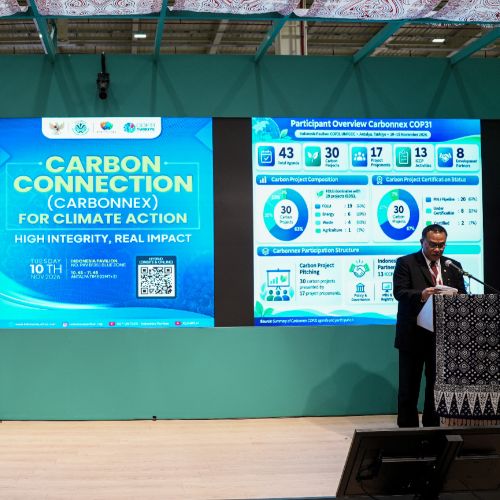
The projects were introduced through the Carbon Connection for Climate Action initiative, known as Carbonnex, launched at the Indonesian Pavilion on 10 November. Organised by Indonesia’s Ministry of Environment and Environmental Control Agency (KLH/BPLH), the forum is scheduled to run from 10 to 19 November 2026.
The initiative brings together 17 Indonesian carbon project developers with prospective buyers, investors, financial institutions, corporations and international development partners. According to the ministry, two of the 30 projects have received full certification, eight are undergoing certification and the remaining 20 are at the development stage.
Indonesia presents carbon investment opportunities across sectors
The 30 projects cover multiple sectors, including forestry and land use, energy, waste management and agriculture. A sector breakdown reported by Indonesian publication Katadata identifies 19 projects in forestry and other land use, six in energy, four in waste management and one in agriculture.
Through Carbonnex, the government aims to connect project developers with potential sources of financing and facilitate discussions that could lead to investment and commercial commitments.
Indonesia’s Environment Minister and Head of the Environmental Control Agency, Moh Jumhur Hidayat, described the initiative as a platform for presenting projects, facilitating transactions and developing partnerships between domestic developers and international stakeholders.
The programme builds on Indonesia’s participation in a similar initiative at COP30 in Brazil in 2025. According to the ministry, 44 projects with a potential of 53.2 million tonnes of carbon dioxide equivalent (CO₂e) were presented at that event. Twelve projects attracted interest from global buyers, representing potential demand for more than 2.75 million tonnes of CO₂e.
Following the COP30 initiative, five projects had progressed to transaction or commitment stages, three additional projects had entered certification and two had obtained certification, the ministry reported.
Indonesia and Norway have also agreed to carbon cooperation covering 12 million tonnes of CO₂e over ten years, according to the ministry’s announcement.
PGN and Unilever agree to develop biomethane
A key development for the renewable gas sector at the Carbonnex forum was the signing of a biomethane development agreement between PGN and Unilever Indonesia.
The collaboration was among the commercial agreements highlighted during the event and was witnessed by Hashim S. Djojohadikusumo, Indonesia’s Special Presidential Envoy for Climate and Energy.
The agreement brings together PGN, Indonesia’s state-owned natural gas company, and Unilever Indonesia, a consumer goods manufacturer, for the development of biomethane.
Biomethane is produced by upgrading biogas generated from the anaerobic digestion of organic materials, such as agricultural residues, food waste, wastewater and other biodegradable feedstocks. The upgrading process removes impurities and increases methane concentration, allowing the renewable gas to be used in suitable applications and, where infrastructure and specifications permit, distributed through gas networks.
The agreement could provide a basis for collaboration between the gas infrastructure sector and industrial energy consumers. However, the companies have not disclosed the project’s proposed capacity, feedstock sources, investment requirements, development schedule or intended gas-use arrangements in the announcement.
The agreement should therefore be viewed as a project-development collaboration rather than confirmation of a commissioned facility or a contracted volume of biomethane.
Carbon market governance and international cooperation
Alongside the project offering, Indonesia introduced the Indonesia Climate and Carbon Partnership (ICCP), which includes 13 activities involving eight international development partners.
The programme covers institutional capacity building, digital infrastructure, measurement, reporting and verification (MRV), carbon market integrity, sectoral readiness, project preparation and market development.
The government also highlighted its regulatory framework for carbon trading, including Presidential Regulation No. 110 of 2025 and the Carbon Unit Registry System (SRUK), developed with the Financial Services Authority (OJK).
The ministry said these measures are intended to improve the transparency, traceability and credibility of carbon units. It also referred to work on waste and forestry roadmaps and mutual recognition arrangements aligned with Article 6 of the Paris Agreement.
Other agreements announced at the forum included cooperation between Pertamina Power Indonesia, also known as Pertamina New & Renewable Energy, and PT Inhutani I for the Rangkong Basaken conservation landscape project.
Bioenergy Business Analysis
Indonesia’s COP31 initiative combines carbon project investment promotion with agreements covering specific areas of climate action. While most of the 30 projects are associated with forestry and land use, the inclusion of waste-sector projects and the PGN–Unilever biomethane agreement creates a direct link to the country’s renewable gas development plans.
For the biomethane sector, collaboration between a gas infrastructure operator and an industrial consumer could help establish potential routes for renewable gas production, distribution and consumption. PGN’s existing gas network may be relevant to future biomethane integration, subject to gas quality, technical compatibility and project economics.
However, the commercial significance of the PGN–Unilever agreement will depend on details that have not yet been made public, including feedstock availability, production capacity, financing, delivery infrastructure and the intended use of the biomethane.
Similarly, the 30-project offering should not be interpreted as 30 investment-ready or fully certified carbon projects. With only two fully certified and 20 still under development, the next steps will involve project preparation, verification, financing and the conversion of investor interest into implemented projects.
The progress of these initiatives will provide a clearer indication of how Indonesia intends to translate its carbon market ambitions and renewable gas partnerships into measurable climate and energy outcomes.