


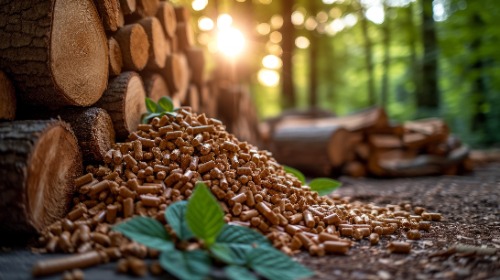
Japan’s rapidly increasing demand for Indonesian wood pellets is raising concerns over deforestation, biodiversity loss and impacts on Indigenous communities, according to new satellite analysis by environmental organisations Earth Insight, Auriga Nusantara and the Indigenous Peoples’ Alliance of the Archipelago.
The analysis indicates that expanding Indonesia’s wood pellet and wood chip industry could put further pressure on natural forests, including areas identified as important habitats for vulnerable and endangered species. Researchers and environmental groups also warn that growing biomass demand could affect Indigenous territories where communities depend on forests for livelihoods and cultural practices.
Indonesia’s biomass industry expands into forest areas
Indonesia’s biomass sector remains relatively small in terms of operating mills, but environmental groups say the pipeline of concessions is growing. Auriga Nusantara director Timer Manurung said at least 45 concessions have been granted for biomass-related activities, covering more than 750,000 hectares of natural forest.
The organisations involved in the analysis said the potential impacts extend beyond forest loss. Concession areas include habitats supporting species such as tarsiers, endemic buffalo and pigs, while Indigenous communities living within or around affected areas could face the loss of forest resources.
Manurung specifically highlighted the Polahi community, saying the expansion could remove natural forest cover that is integral to the community’s livelihood and culture.
Indonesia’s ministries responsible for environment and forestry, and energy and mineral resources, did not respond to requests for comment cited in the source material.
Japan becomes a major market for Indonesian wood pellets
The concerns are closely linked to Japan’s expanding biomass power sector. Japan imported a record 8.64 million tonnes of wood pellets in 2025, up 35% from the previous year, according to the Global Trade Algorithmic Intelligence Center.
Indonesian supplies have increased particularly sharply. Japan’s imports of wood pellets from Indonesia rose from 66,460 tonnes in 2023 to 402,310 tonnes in 2025, an increase of more than five times.
Japan has supported biomass development in Indonesia through research, policy, construction and other forms of assistance, according to a review of publicly available business and government agreements cited by the source material.
However, Japan has stopped subsidies for future large-scale biomass projects. Existing certified projects can continue receiving support for as long as 20 years after beginning operations, according to Katsuhiro Suzushima of Japan’s Global Environmental Forum.
Forestry specialist Sayoko Iinuma, also of the Global Environmental Forum, said weaknesses in Japan’s biomass due-diligence system could allow wood pellets associated with deforestation to continue entering the market.
Japan’s Forestry Agency declined to comment on the connection between imported Indonesian biomass and deforestation or on measures designed to prevent deforestation-linked biomass from entering the Japanese market.
Biomass growth creates a sustainability challenge
The debate comes as bioenergy expands internationally. According to the International Energy Agency, global bioenergy use increased by more than 55% between 2015 and 2024.
Japan’s biomass contribution to electricity generation remains relatively modest, accounting for less than 6% of generation in 2024, according to the Institute for Sustainable Energy Policies. Nevertheless, its growing wood-pellet imports have created a significant international supply-chain issue for Indonesia.
Environmental groups argue that biomass should prioritise genuinely residual materials, such as agricultural waste and other residues, rather than creating incentives to harvest natural forests for energy.
The issue is particularly important because the climate benefits of forest-based biomass depend on the origin of the feedstock, how forests are managed and the time required for harvested carbon stocks to recover. Critics argue that burning wood can produce substantial emissions while removing trees also reduces the capacity of forests to absorb carbon.
Deforestation can additionally contribute to erosion, biodiversity loss and increased vulnerability for communities and wildlife dependent on forest ecosystems.
South Korea provides a recent regional example of how policy can influence the biomass trade. It was previously Indonesia’s largest wood-pellet market, but substantially reduced biomass subsidies following criticism over the sector’s links to deforestation.
Bioenergy Business Analysis
The Indonesian case highlights a central challenge for the international biomass market: renewable-energy demand does not automatically guarantee a sustainable feedstock supply chain. Japan’s rising wood-pellet imports demonstrate how energy policy in one country can create land-use and environmental consequences in another.
For biomass developers, investors and policymakers, the key issue is therefore feedstock traceability. The distinction between genuinely residual biomass and material originating from natural forests becomes commercially and environmentally significant as governments tighten sustainability expectations around renewable energy.
The situation also shows why subsidy design and supply-chain due diligence matter alongside renewable-energy targets. If support continues for projects already approved while verification systems remain weak, concerns over the environmental credentials of imported biomass could persist even as the sector seeks to expand its role in the energy transition.
Read also: MOA Foodtech raises €3.3M to scale AI-Powered biomass fermentation platform