


Jain Irrigation Systems Limited has entered into an agreement with carbon removal marketplace Supercritical for the supply of up to 19,000 tonnes of biochar carbon removal credits over 2026 and 2027. The credits will be generated from the Indian agribusiness company’s industrial biochar facility in Jalgaon, Maharashtra, which has been producing since early 2026.
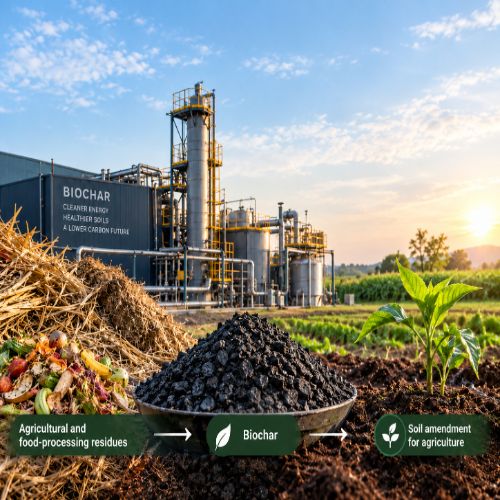
The agreement brings Jain Irrigation into the growing market for durable carbon removal, while linking its agricultural and food-processing residue streams to biochar production. The facility uses gasification to convert residues from food processing operations and agricultural crops into biochar, a carbon-rich material intended for long-term storage in soil.
The project is undergoing verification through Puro.earth, with an independent rating by BeZero Carbon also underway. The companies have not disclosed the financial value of the agreement or a detailed annual delivery schedule. The contracted volume is an upper limit of 19,000 tonnes across the two-year period, rather than confirmation that all credits have already been issued or delivered.
Jain Irrigation integrates biochar into agricultural operations
The Jalgaon facility is designed to use agricultural residues and byproducts from Jain’s food-processing operations as feedstock. Through gasification, the process produces biochar and syngas, with both outputs being utilised within the company’s operations.
Syngas replaces fossil fuels at Jain’s industrial facilities, while the biochar is directed to its downstream agricultural businesses and supplied to farmers as a soil amendment. This creates a link between the company’s manufacturing and food-processing activities, residue management and agricultural product portfolio.
Jain has worked with farmers since 1963 and reports serving more than 10 million farmers. Its operations include mango processing and tissue culture nurseries, which produce approximately 150 million plants annually.
The company plans to use its agricultural research capabilities and established farmer network to develop biochar products for wider commercial application in agriculture.
Executives highlight established feedstock and farmer networks
Steve Morrin, Supply Senior Manager at Supercritical, said Jain’s existing agricultural operations and supply chains were important factors in the agreement.
“Most biochar projects we evaluate are building their supply chains from scratch. Jain has had theirs for 60 years. The facility is running, the feedstock comes from their own operations, and the farmer network already exists. That’s the delivery profile our buyers look for, and it’s hard to find when most of this year’s high-quality supply is already spoken for.”
Ajit Jain, Joint Managing Director of Jain Irrigation Systems Limited, said the company’s agricultural expertise and established distribution network could support the expansion of biochar deployment.
“Our reach across millions of farmers and our scale in irrigation and tissue culture give us a strong foundation for developing biochar at scale. We understand farming systems, we have decades of experience developing agricultural technology, and we already have established channels to work with growers. Biochar creates value from agricultural residues and connects our work in water management, planting material, manufacturing, and food processing with durable carbon removal. Our partnership with Supercritical helps us scale biochar deployment.”
Biochar credit market sees earlier supply commitments
The agreement comes as corporate demand for durable carbon removal credits increases competition for high-quality biochar supply.
According to Supercritical’s H2 2026 biochar market report, 81% of high-quality biochar supply for 2026 had already been committed by July. The report said this threshold was reached three months earlier than at the same point in 2025, reflecting a shift among corporate buyers towards multi-year procurement agreements rather than one-off spot purchases.
For Jain Irrigation, the agreement creates a commercial route for the carbon removal attributes associated with its biochar operations. For Supercritical, it adds supply from an operating industrial facility with access to agricultural and food-processing residues and an established network for deploying the resulting product.
Bioenergy Business Analysis
The Jain Irrigation–Supercritical agreement shows how biochar can connect industrial residue utilisation with agricultural applications and the carbon removal market. Unlike projects that need to establish feedstock sourcing and farmer distribution networks from the ground up, Jain can draw on its existing food-processing operations and agricultural relationships.
The up-to-19,000-tonne agreement is a procurement commitment, not proof that the full volume has already been independently verified, issued or delivered. Puro.earth verification and the BeZero Carbon rating will be important in assessing the project’s carbon removal claims, including feedstock traceability, production emissions, biochar stability and long-term carbon storage.


