


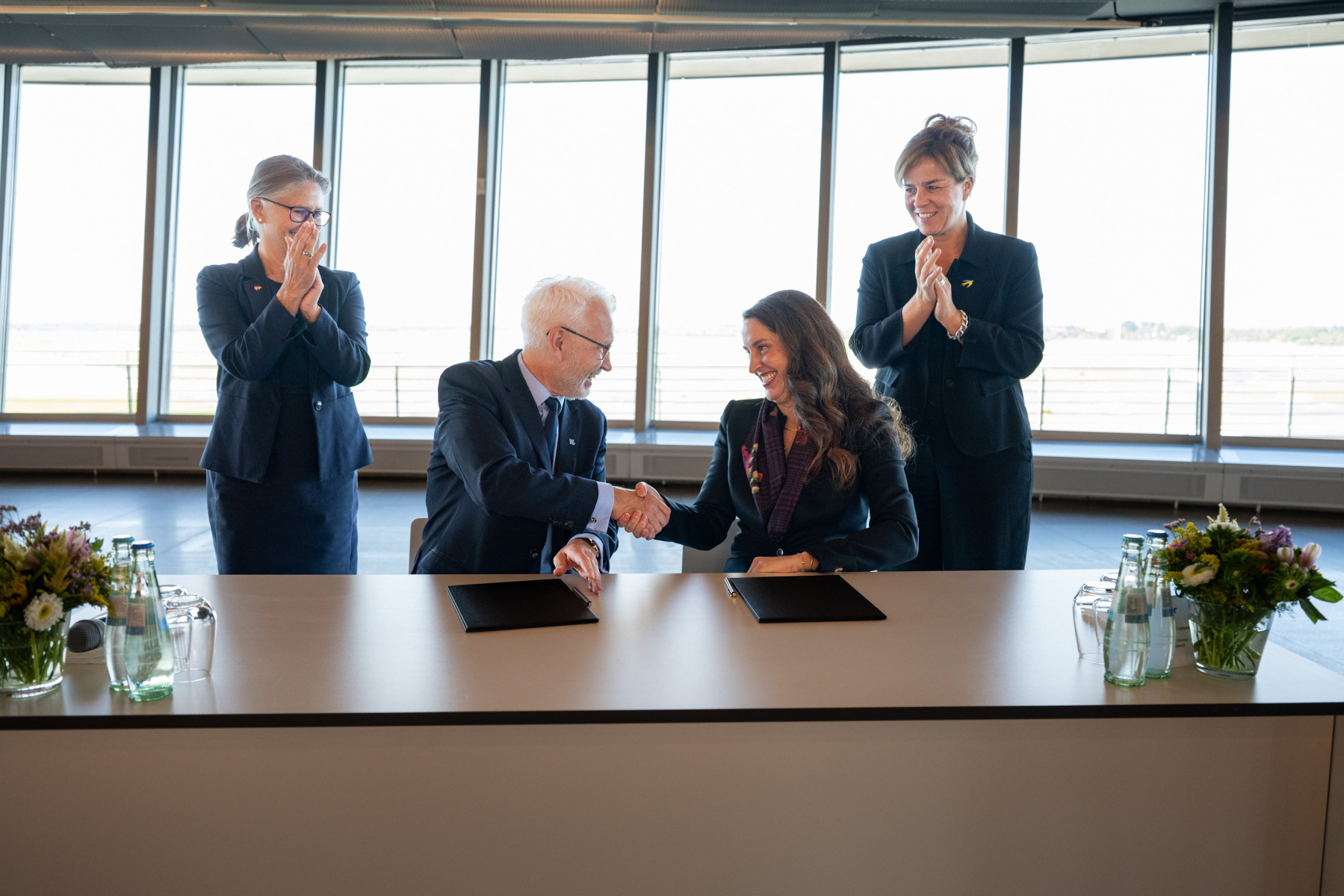
Uniper has signed a long-term offtake agreement to purchase 40,000 metric tonnes of synthetic sustainable aviation fuel (eSAF) each year from Arcadia eFuels’ Project Endor in Vordingborg, Denmark, in a deal that could help advance one of Europe’s larger announced Power-to-Liquid aviation fuel projects towards commercial-scale production.
The legally binding agreement covers more than 10 years, with deliveries currently planned to begin in the early 2030s, subject to agreed conditions and Project Endor reaching commercial operation. Uniper and Arcadia described the agreement as one of the largest announced eSAF offtake deals to date.
The companies signed the agreement in Düsseldorf on September 23, with representatives of the German state of North Rhine-Westphalia and Denmark present. For Arcadia, securing a long-term buyer provides a commercial anchor for its planned Vordingborg facility, while Uniper is positioning itself in the emerging European market for synthetic aviation fuels.
Uniper secures long-term eSAF supply from Project Endor
Under the agreement, Uniper will purchase 40,000 tonnes of eSAF annually from Project Endor for more than a decade.
The contracted volume is equivalent to the fuel required for approximately 1,000 Boeing 787-9 flights between Düsseldorf and Abu Dhabi each year, according to the companies.
The agreement is legally binding, but deliveries will only commence once the stipulated conditions precedent have been met and the Vordingborg facility has entered commercial operation. Current plans point to the beginning of the 2030s for initial supplies.
For Arcadia, the deal represents its first announced industrial-scale offtake agreement for Project Endor. The company said separately that the 40,000-tonne commitment represents around 60% of the project’s planned annual production capacity.
Project Endor targets 80,000 tonnes of e-fuels annually
Arcadia’s Vordingborg project is designed as a large-scale Power-to-Liquid facility producing e-fuels from renewable electricity, water and captured carbon dioxide.
The company has said Project Endor is designed to produce approximately 80,000 tonnes of e-fuels annually. Its production route includes water purification, electrolysis for green hydrogen production, Fischer-Tropsch synthesis and final fuel refining.
Arcadia completed front-end engineering design (FEED) for the project in 2024 and subsequently secured an environmental permit covering the full production process, according to company disclosures. Project Endor was also selected for support from the EU Innovation Fund in 2026.
The long-term offtake agreement now adds a significant commercial commitment to the project’s development pathway.
Renewable power, hydrogen and captured CO₂
Unlike conventional SAF produced from biomass feedstocks such as used cooking oil or agricultural residues, eSAF is produced through a Power-to-Liquid pathway.
Arcadia says its fuel will use renewable electricity, self-produced green hydrogen and captured CO₂. The hydrogen is combined with carbon-derived intermediates before synthesis and upgrading into aviation fuel.
The company says the resulting eSAF can deliver up to 98% lower lifecycle greenhouse gas emissions compared with conventional jet fuel, although the actual lifecycle reduction depends on the project’s inputs, production pathway and applicable accounting methodology.
Uniper expands position in synthetic aviation fuels
For Uniper, the agreement provides long-term access to eSAF as Europe develops a regulatory market for lower-carbon aviation fuels.
The company described the transaction as a strategic step into a market expected to expand over the coming decades, while identifying SAF as one of the available routes for reducing aviation emissions where direct electrification is difficult.
Uniper CEO Michael Lewis said the challenge is moving SAF projects from development into industrial-scale production and that the agreement combines long-term demand with new supply.
The company also said the fuel secured under the agreement is intended to comply with the requirements applicable to Renewable Fuels of Non-Biological Origin (RFNBO) and European SAF regulations.
EU rules create demand for eSAF
The agreement comes as Europe’s aviation fuel market moves towards progressively higher SAF requirements.
Under the EU’s ReFuelEU Aviation framework, the minimum SAF share in fuel supplied at EU airports rises from 2% in 2025 to 6% in 2030. A separate sub-mandate for synthetic aviation fuels, including relevant RFNBO pathways, starts at 1.2% in 2030 and rises to 5% in 2035, according to Reuters’ reporting on the agreement.
These requirements are intended to create demand for both bio-based and synthetic aviation fuels. However, eSAF projects face additional challenges around renewable electricity availability, hydrogen production, sustainable carbon sourcing, infrastructure and project financing.
Against this backdrop, long-term offtake agreements can provide developers with greater visibility over future revenues before plants reach commercial operation.
Agreement links German demand with Danish eSAF production
The deal also establishes a cross-border supply relationship between Denmark and Germany.
Project Endor is being developed at Vordingborg in Denmark, while Uniper is headquartered in Düsseldorf. The agreement was signed in Düsseldorf in the presence of North Rhine-Westphalia Economic Affairs, Industry, Climate Action and Energy Minister Mona Neubaur and Denmark’s Consul General in Hamburg, Anette Galskjøt.
The two governments have broader interests in developing renewable fuels and strengthening energy cooperation. For the eSAF sector, cross-border arrangements such as this one could connect emerging production hubs with European energy companies and fuel markets.
The immediate commercial milestone, however, remains the development and commissioning of Project Endor.
Bioenergy Business Analysis
The Uniper-Arcadia agreement illustrates the importance of bankable offtake demand for capital-intensive eSAF projects. Securing 40,000 tonnes a year—roughly half of Project Endor’s planned 80,000-tonne annual output according to the companies’ disclosures—gives Arcadia a substantial committed market while leaving part of the project’s capacity available for other customers or uses.
The agreement does not, by itself, eliminate the project’s development risks. Commercial operation remains a condition for deliveries, and the plant still needs to progress through construction, financing and commissioning. eSAF economics also remain highly dependent on the cost and availability of renewable electricity, green hydrogen and qualifying CO₂, as well as the regulatory value attached to synthetic fuels.
Its significance therefore extends beyond the contracted tonnes. If Project Endor reaches commercial operation as planned, the agreement would provide a concrete example of how long-term buyer commitments can connect European eSAF development with the regulatory demand emerging under ReFuelEU Aviation. The project’s eventual performance will offer a useful indication of how effectively Power-to-Liquid SAF can move from project development into sustained industrial production.