Japan’s JERA and India’s AM Green Ammonia have signed a binding Heads of Agreement (HoA) for the long-term supply of approximately 70,000 tonnes of green ammonia annually over five years, advancing plans to use renewable-based ammonia as a marine fuel in Japan.
Announced on 27 October 2026, the agreement envisages supplies from AM Green’s planned green ammonia facility in Kakinada, Andhra Pradesh. The project is targeted for commissioning in 2028–29 and is expected to use renewable electricity, pumped-hydro energy storage and alkaline electrolysis technology.
The agreement includes the potential to extend the supply term and add further volumes. However, deliveries will depend on the development and readiness of the production and import infrastructure required to support the supply chain.
Green ammonia planned for maritime bunkering in Japan
Under the proposed arrangement, the green ammonia would be supplied through receiving, storage and distribution facilities being developed adjacent to JERA’s Hekinan Thermal Power Station in Aichi Prefecture, Japan.
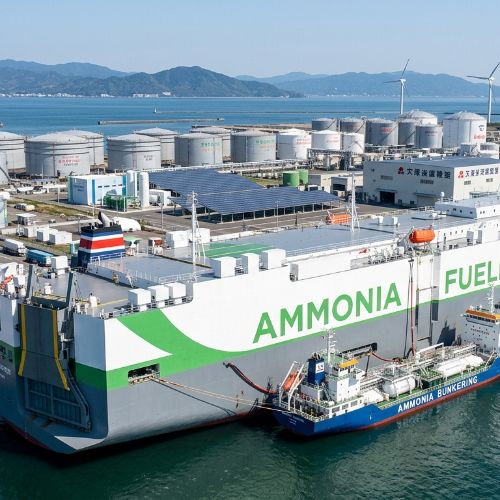
The ammonia is intended primarily for a business venture planned by Kawasaki Kisen Kaisha and Nippon Yusen Kabushiki Kaisha. The venture plans to use an ammonia bunkering vessel to supply fuel to ammonia-fuelled car carriers.
The arrangement would connect green ammonia production in India with import infrastructure and marine fuel distribution in Japan. It is also intended to support the development of the infrastructure needed for broader ammonia use across Japanese industrial and commercial sectors.
JERA said the initiative is among the first large-scale green ammonia-based bunkering initiatives globally. The companies said the ammonia would meet internationally recognised low-carbon standards and be benchmarked against European market requirements.
Kakinada project to use renewable power and energy storage
AM Green’s planned Kakinada facility in Andhra Pradesh is expected to produce the green ammonia for the agreement. The project’s energy system is designed to combine round-the-clock renewable power with pumped-hydro storage, supporting the electricity requirements of its alkaline electrolysis process.
Electrolysis uses electricity to separate water into hydrogen and oxygen. When the electricity is renewable and the hydrogen is combined with nitrogen to produce ammonia, the resulting fuel can offer lower lifecycle emissions than conventional fossil-based production, subject to the project’s energy sources, production methods and emissions accounting.
The planned use of energy storage is intended to help manage the variability of renewable electricity and support more consistent production. The facility’s planned commissioning date of 2028–29 means the proposed supply arrangement is not yet equivalent to operational ammonia deliveries.
JERA expands its lower-carbon ammonia supply strategy
JERA said the agreement would add another source of renewable-based ammonia to its planned low-carbon ammonia portfolio, strengthening supply diversification and allowing customers to match fuel supplies to their decarbonisation requirements.
The company has been developing an ammonia value chain spanning production, transportation, storage and use. The proposed maritime application would extend ammonia’s role beyond power generation to shipping fuel.
Irtiza Sayyed, JERA’s Senior Managing Executive Officer and CEO of JERA Global Energy Solutions, said the agreement would help develop an end-to-end lower-carbon ammonia value chain for Japan by connecting the company’s domestic generation and infrastructure platform with global supply capabilities.
For AM Green, the agreement represents one of its first delivered-basis supply contracts in the Asian market, according to the company. Group President and Joint Managing Director Mahesh Kolli said the arrangement would support the Kakinada project’s role in supplying renewable-based fuels to international markets.
Green ammonia and shipping decarbonisation
Ammonia is being considered as an alternative marine fuel because it contains no carbon and therefore does not produce carbon dioxide directly through combustion. Its overall climate impact, however, depends on how it is manufactured, transported and used, as well as the management of other emissions associated with its use.
Green ammonia produced using renewable electricity could reduce emissions associated with conventional ammonia production. For shipping, adoption will also require suitable vessels and engines, bunkering infrastructure, fuel-handling procedures and robust safety standards.
The proposed JERA–AM Green supply chain would bring several of these elements together: renewable-based production in India, import and storage infrastructure in Japan, and an ammonia bunkering vessel intended to serve ammonia-fuelled car carriers.
Bioenergy Business Analysis
The JERA–AM Green agreement points to a potential expansion of India’s role in supplying lower-carbon fuels to Asian markets, while demonstrating how green ammonia could serve sectors beyond conventional energy generation.
The proposed annual volume of 70,000 tonnes provides a defined target for the planned supply relationship. Yet its commercial significance will depend on execution: the Kakinada plant must reach commissioning, the production system must deliver ammonia that meets the agreed specifications, and Japanese import and bunkering infrastructure must be ready to receive and distribute the fuel.
The agreement also highlights the importance of integrating renewable electricity and storage into energy-intensive fuel production. For green ammonia projects, the availability, cost and carbon intensity of electricity will be central to both production economics and environmental performance.
In maritime markets, ammonia adoption will depend on more than fuel availability. Shipowner investment decisions, engine technology, port infrastructure, safety requirements and the relative economics of competing marine fuels will influence the pace of deployment.
The next milestones to watch are progress at the Kakinada facility, development of the Hekinan receiving infrastructure, establishment of the planned bunkering venture and confirmation of the timeline for initial deliveries. Until those steps are completed, the agreement represents a significant planned supply arrangement rather than an operating green ammonia shipping-fuel chain.