


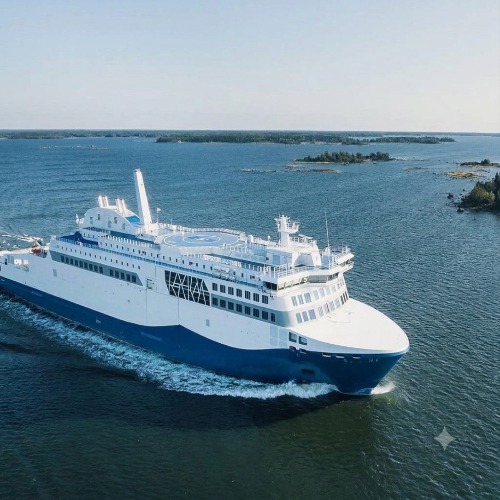
Wasaline has signed a two-year agreement with St1 Biokraft for the annual supply of 42 GWh of liquefied biogas (LBG), with deliveries scheduled to begin in January 2028 to support the ferry operator’s emissions-reduction efforts between Vaasa, Finland, and Umeå, Sweden.
The agreement is designed to strengthen regional renewable-fuel supply chains, with Wasaline aiming to source most of its biogas from a new facility operated by Suomen Lantakaasu in Nurmo, approximately 80 kilometres from Vaasa. The fuel will be delivered by tanker truck to the Port of Vaasa for bunkering aboard Aurora Botnia.
The deal combines renewable-fuel production, regional agricultural waste utilisation and maritime transport, while giving Wasaline a planned supply arrangement for the next two years.
Wasaline and St1 Biokraft establish regional biogas supply chain
Under the agreement, St1 Biokraft will supply 42 GWh of liquefied biogas annually. Deliveries are due to start in January 2028 and will coincide with the bunkering of Aurora Botnia at Vaasa.
Wasaline intends to use primarily locally produced biogas from Suomen Lantakaasu’s new Nurmo plant. The facility is part of a joint venture between St1 Biokraft and Finnish dairy company Valio.
The planned supply route connects regional biogas production with a maritime fuel consumer. Liquefied biogas will be transported from St1 Biokraft’s production facilities and terminals by tanker truck to the port, where it will be transferred to the vessel.
Wasaline has already been using biogas for several years. The new agreement is intended to expand access to renewable fuel while increasing the role of locally produced supplies in its operations.
St1 Biokraft identifies shipping as a market for renewable gas
The agreement marks St1 Biokraft’s first major marine biogas supply contract, according to Johan Zakrisson, the company’s head of business development.
“Shipping is a sector where biogas can already contribute to significant emission reductions, and we are very pleased with the confidence Wasaline has placed in us.”
Zakrisson said the agreement also demonstrates how the company’s expanding Nordic production capacity and infrastructure can support new applications for biogas.
For St1 Biokraft, supplying marine customers creates another potential outlet for liquefied biogas beyond established applications. For Wasaline, the contract provides a planned annual supply volume and the opportunity to increase the use of fuel produced closer to its operating region.
Locally produced biogas supports regional circularity
Wasaline Technical Director Jonas Teir said access to biogas produced in the surrounding region was an important consideration in the agreement.
“Being able to use locally produced biogas is an important step forward for us.”
Teir said regional sourcing could strengthen energy security and support the circular economy by improving opportunities to utilise manure and other organic residual streams. He also linked the agreement to Wasaline’s efforts to reduce the climate impact of its operations.
The planned supply from Suomen Lantakaasu’s Nurmo plant connects agricultural by-products with maritime fuel demand. The project illustrates how organic waste and manure can become feedstocks for renewable gas production, creating a potential commercial link between agriculture, energy infrastructure and shipping.
However, the actual climate benefit will depend on factors including feedstock management, methane leakage, processing energy and the emissions associated with transporting and using the fuel.
Aurora Botnia combines biogas, batteries and shore power
The agreement builds on the existing energy system aboard Aurora Botnia, which already uses biogas alongside batteries and shore power.
These technologies serve complementary functions. Biogas can provide energy through the vessel’s fuel system, batteries can support electrical operation and load management, and shore power allows a vessel to draw electricity from the port while berthed, potentially reducing the need to run onboard engines.
The combination reflects a multi-technology approach to reducing emissions in maritime transport. The environmental outcome depends on how each energy source is used, the carbon intensity of electricity and fuel, and the vessel’s operating conditions.
The new supply contract does not, by itself, establish the proportion of the vessel’s total energy demand that will be met by liquefied biogas or quantify the resulting emissions reductions.
Bioenergy Business Analysis
Wasaline’s agreement with St1 Biokraft illustrates how regional biomethane production can connect agricultural waste management with the decarbonisation of maritime transport. The planned annual supply of 42 GWh provides a defined commercial framework for expanding the use of liquefied biogas, while the intended sourcing from Nurmo could strengthen links between local agriculture and marine fuel demand.
The agreement’s significance lies in connecting production, distribution and fuel consumption. Locally produced biogas can create value from manure and other organic residual streams, while liquefaction enables renewable gas to be transported to customers that are not directly connected to gas distribution networks. In this case, tanker-truck deliveries provide the link between production facilities and the Port of Vaasa.
For the wider bioenergy sector, the agreement offers a practical example of how renewable gas can serve transport applications through existing logistics infrastructure. Its longer-term significance will depend on reliable fuel deliveries, competitive costs, verified emissions performance and the ability of regional production facilities to meet contracted demand.


