


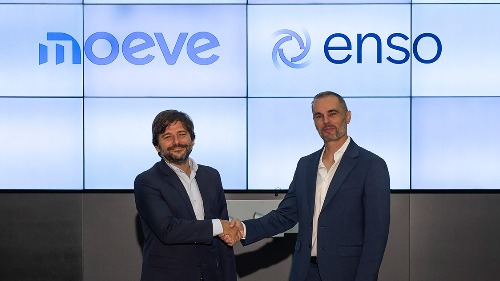
Moeve and ENSO have agreed to collaborate on industrial decarbonisation projects that combine biomass-based energy, renewable gases and carbon utilisation to help energy-intensive manufacturers reduce their reliance on fossil fuels.
The partnership will target industrial facilities in sectors including chemicals, paper and board, and food and beverages, where production depends heavily on steam, process heat and cogeneration systems fuelled by coal, natural gas and other fossil fuels.
The companies plan to develop alternatives based on advanced biomass and explore opportunities to convert biogas into biomethane and produce renewable fuels of non-biological origin (RFNBOs) using biogenic carbon dioxide captured at bioenergy facilities. Moeve could act as a potential offtaker for the resulting renewable fuels and other green molecules, according to the announcement.
The agreement brings together ENSO’s capabilities in developing, financing, building and operating bioenergy infrastructure with Moeve’s energy supply business and its development and marketing of lower-carbon energy products. Financial terms, project-specific investment commitments and implementation timelines were not disclosed.
Biomass and renewable gases to support industrial energy transition
The collaboration will focus on industrial operations that require substantial amounts of thermal energy and may face technical or economic barriers to electrifying their processes.
Under the proposed approach, facilities could transition from fossil-fuel-based cogeneration towards systems using advanced biomass and renewable energy sources. Cogeneration, also known as combined heat and power (CHP), produces electricity and useful heat from the same energy input.
For industries with continuous heat and steam requirements, replacing existing generation equipment can involve significant capital expenditure and operational changes. Moeve and ENSO aim to develop projects tailored to individual facilities, potentially combining heat, electricity and renewable gases rather than relying on a single decarbonisation technology.
Biomethane and e-fuels expand the partnership’s scope
Beyond biomass-based heat and power, the companies intend to explore renewable gas production and the utilisation of biogenic CO₂.
Biogas produced through the anaerobic digestion of organic material typically contains methane and carbon dioxide. Upgrading removes much of the CO₂ and other impurities to produce biomethane, a higher-methane renewable gas that can potentially be used in applications served by natural gas, subject to gas-quality requirements and infrastructure access.
Moeve and ENSO plan to explore the conversion of biogas plants to biomethane production as part of their broader industrial decarbonisation strategy. The announcement does not specify the number of plants involved, their locations or their prospective production capacity.
The partnership also identifies potential opportunities to use biogenic carbon dioxide captured at bioenergy facilities as a feedstock for renewable fuels of non-biological origin, or RFNBOs.
Such fuels can be produced by combining qualifying hydrogen, commonly generated through renewable-powered electrolysis, with a carbon source to synthesise fuel molecules. Their classification as RFNBOs depends on meeting applicable regulatory requirements, including those governing renewable energy inputs and lifecycle greenhouse gas emissions.
Using captured biogenic CO₂ could connect biomass-based power generation and carbon capture with downstream fuel production. However, the companies have not announced a specific e-fuel project, its technology configuration, its capacity or a production schedule.
Moeve may participate as a potential offtaker for the resulting products, creating a possible link between ENSO’s renewable generation and carbon-capture capabilities and Moeve’s fuel development and marketing activities.
ENSO’s Garray plant provides an existing carbon-utilisation example
ENSO already operates a biomass-based power facility in Garray, in Spain’s Soria province, where it has integrated biogenic CO₂ capture and recovery into its operations.
According to ENSO, the facility was the first biomass plant in Spain to incorporate a system for capturing and recovering biogenic carbon dioxide. The company’s facility information identifies an installed electrical capacity of 17 megawatts electric (MWe) and a CO₂ recovery capacity of up to 50,000 tonnes annually. These are facility-level figures, not announced production targets for the new Moeve partnership.
The plant’s existing configuration demonstrates how biomass-based electricity generation can be integrated with carbon recovery for industrial applications. Captured CO₂ can be purified for use in sectors such as food and beverages, depending on the required specifications.
The companies have not confirmed whether the Garray facility will supply CO₂ to a new e-fuels project under the agreement. Its existing infrastructure is relevant as an example of ENSO’s technical experience, but it should not be treated as a confirmed component of the partnership’s future project pipeline.
Partnership aims to combine decarbonisation with industrial competitiveness
Moeve and ENSO say their collaboration will focus on projects designed to reduce emissions, improve energy security and help industrial customers manage energy costs.
The companies also intend to explore investment structures that could allow industrial businesses to modernise their energy systems without funding the entire transformation from their own balance sheets. Potential approaches include asset co-investment, although the announcement does not specify the proposed financing structures, ownership arrangements or allocation of project risks.
Elías Hernández, ENSO’s chief executive officer, said the partnership would combine ENSO’s ability to invest in, construct and operate bioenergy infrastructure with Moeve’s capabilities and market reach. He described the objective as developing projects that improve competitiveness while supporting decarbonisation.
Carlos Aguilera, head of business development at Moeve decarbonize, said the agreement would expand the energy solutions available to industrial customers by combining heat, electricity and renewable gases for processes where electrification may not always be feasible.
The comments reflect the companies’ stated strategy; actual cost savings and emissions reductions will depend on individual project designs, operating conditions, fuel availability and investment requirements.
Spanish cogeneration market presents an investment opportunity
The partnership comes as Spain anticipates a new investment cycle for cogeneration, with auctions for the technology planned, according to the companies’ announcement.
Cogeneration systems can provide both electricity and useful thermal energy, making them important to industrial facilities with continuous process-heat requirements. Replacing or upgrading fossil-fuel-based installations could offer an opportunity to improve efficiency and reduce emissions, depending on the technology selected and the characteristics of each facility.
The potential role of biomass will depend on access to sustainable feedstocks, transport logistics, boiler compatibility, emissions controls and the availability of suitable infrastructure. Biomethane and other renewable gases may provide additional options, but their competitiveness will depend on supply, prices and the requirements of each industrial application.
No auction dates, project awards or specific cogeneration capacity commitments were detailed in the announcement.
Bioenergy Business Analysis
The Moeve–ENSO agreement points to a broader approach to industrial decarbonisation: combining renewable heat and power with renewable gases and carbon utilisation, rather than treating each technology as a separate solution.
Its potential significance lies in the integration of several parts of the energy value chain. ENSO brings experience in biomass infrastructure and biogenic CO₂ recovery, while Moeve brings energy-supply capabilities and a potential route to market for renewable fuel products. If translated into viable projects, this combination could help industrial customers access integrated energy solutions without developing every component independently.
The partnership establishes a framework for collaboration, not yet a quantified reduction in industrial emissions. Its significance will ultimately depend on the projects secured, the energy and fuel volumes delivered, the capital deployed and the verified emissions savings achieved.


