


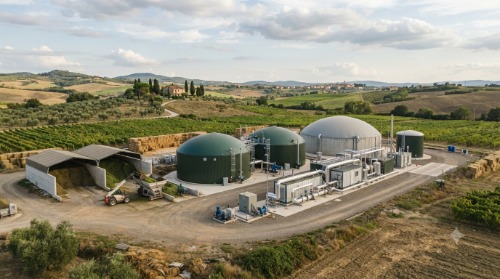
Copenhagen Infrastructure Partners (CIP) has entered Italy’s biomethane market through an investment in Via Verde, an Italian development platform with a pipeline of 20 biomethane projects across the country.
The investment represents the first deployment from CIP’s Advanced Bioenergy Fund II (ABF II), which was launched earlier this year to support the development of biomethane and advanced bioenergy projects across Europe.
Via Verde’s projects span several Italian regions, including Lombardy, Abruzzo and Campania. Once fully developed and operational, the platform is expected to produce approximately 1 TWh of biomethane annually.
Via Verde develops 20-project biomethane pipeline
The Via Verde platform comprises 20 projects at different development stages across Italy.
Each planned plant is expected to process approximately 60,000 to 100,000 tonnes of agricultural waste per year, creating a large-scale feedstock base for biomethane production.
Across the full portfolio, the projects are expected to produce around 1 TWh of biomethane annually once operational. CIP said this would be equivalent to the annual gas consumption of approximately 60,000 Italian households.
The projects will use agricultural waste as a primary feedstock, linking biomethane production with the management and valorisation of organic residues.
CIP’s ABF II targets European biomethane growth
The Via Verde investment is the first investment from CIP’s Advanced Bioenergy Fund II, which is focused on scaling biomethane and other advanced bioenergy technologies across Europe.
ABF II launched with a €200 million commitment from the European Investment Fund (EIF), part of the EIB Group, and has a target size of €1.5 billion.
The target fund size is approximately twice that of CIP’s predecessor bioenergy fund, reflecting the investor’s broader focus on expanding advanced bioenergy infrastructure.
Biomethane is produced from organic materials including agricultural, industrial and household waste. After upgrading, it can be used as renewable gas and can enter existing natural-gas infrastructure.
This compatibility gives biomethane potential applications in areas where direct electrification or variable renewable electricity can be more difficult to deploy, including heavy transport and certain industrial processes.
Investment marks CIP’s entry into Italy
The Via Verde transaction establishes CIP’s presence in Italy’s biomethane market as the investment firm expands its European bioenergy portfolio.
CIP said the projects are expected to contribute to the production of domestically sourced renewable gas, potentially reducing reliance on imported fossil natural gas.
The development of the projects is also expected to generate local employment and support regional waste-management and agricultural supply chains.
Andreas F. Brandt, Partner at CIP, said the firm would use its advanced bioenergy experience to support Via Verde’s local team and project pipeline.
He said biomethane could contribute to Italy’s energy independence while supporting the country’s transition towards a lower-carbon energy system.
Biomethane links waste management with renewable gas
The Via Verde portfolio illustrates the potential for biomethane projects to combine waste management with renewable-energy production.
Agricultural residues that would otherwise require treatment or disposal can serve as feedstock for anaerobic digestion, with the resulting biogas upgraded to biomethane for use as a natural-gas substitute.
For Italy, a larger domestic biomethane industry could also create a renewable-gas supply base alongside continued electrification and renewable-power deployment.
The commercial performance of the Via Verde portfolio will ultimately depend on factors including project development, feedstock availability, plant performance, biomethane offtake arrangements and the regulatory and market environment.
Bioenergy Business Analysis
CIP’s investment in Via Verde is significant because it combines institutional capital with a sizeable, geographically distributed Italian biomethane pipeline. The 20-project portfolio provides an immediate development platform rather than a single-asset entry into the market, while the use of agricultural waste links renewable-gas production with Italy’s agricultural and waste-management sectors.
The projected 1 TWh annual output also illustrates the potential scale of the platform. If all projects reach operation as planned, the portfolio would establish a substantial renewable-gas production base. However, the figure remains a development target rather than current production, and the timeline for bringing all 20 facilities online has not been disclosed.
For CIP, the transaction also demonstrates the intended role of ABF II: deploying capital across European biomethane and advanced-bioenergy assets while building platforms capable of scaling beyond individual projects. The success of the Via Verde strategy will depend on converting the development pipeline into operating plants and securing reliable feedstock and markets for the resulting biomethane.