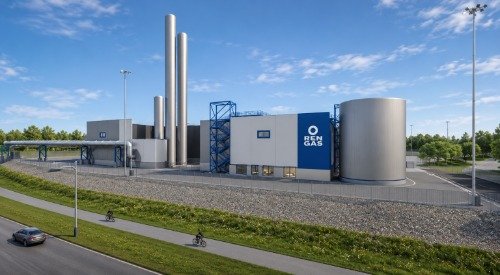
Nordic Ren-Gas has reached final investment decision (FID) on its renewable e-methane production facility in Tampere, Finland, securing financing for a project valued at more than €300 million and preparing to move into full-scale construction.
The facility is scheduled for completion in 2029 and will produce approximately 190 GWh of renewable e-methane annually at full capacity. The project will use biogenic carbon dioxide captured from a local waste-to-energy plant and recover process heat for Tampere’s district heating network.
The development is expected to connect renewable fuel production in Finland with demand in Germany, where the e-methane will be delivered through the European gas network and used primarily in heavy-duty road transport.
Allianz, Tesi and Japan Hydrogen Fund among equity investors
The Tampere project is financed through a project finance structure involving institutional equity investors and international lenders.
Equity funding comes from Allianz, Tesi (Finnish Industry Investment), Japan Hydrogen Fund and Schroders Greencoat. Debt financing is provided by the European Investment Bank (EIB), Societe Generale, Standard Chartered, Nordea and Finnvera.
The EIB is providing a €60 million loan backed by the InvestEU programme. Societe Generale is acting as the project’s underwriter, structuring bank, technical bank, mandated lead arranger and hedging bank, while Standard Chartered is participating as mandated lead arranger and bookrunner.
The financing follows technical, commercial, regulatory and financial due diligence. The investment structure and long-term offtake arrangements have helped secure commitments from a group of institutional investors and lenders, advancing the project towards construction.
Facility to produce 190 GWh of e-methane annually
At full production capacity, the Tampere plant is expected to produce approximately 190 GWh of renewable e-methane annually, using around 40,000 tonnes of biogenic CO₂ captured each year from a local waste-to-energy facility.
The process will combine captured carbon dioxide with renewable hydrogen produced using renewable electricity to generate synthetic methane, also known as e-methane. The resulting gas can be transported through existing gas infrastructure and used in applications where decarbonisation is challenging.
The project will also recover up to 200 GWh of process heat annually for supply to Tampere’s district heating network. The integration of fuel production, carbon capture and heat recovery is intended to improve resource utilisation while providing renewable fuel and heating benefits.
Finnish production linked to German heavy transport demand
The renewable e-methane produced at Tampere will be transported through the European gas network to Germany, with heavy-duty road transport identified as its primary end-use market.
The project connects Finland’s renewable electricity resources and locally captured biogenic carbon with European transport fuel demand. It is also expected to support energy security by increasing the supply of renewable gas produced within Europe and reducing reliance on imported fossil fuels.
EIB Vice-President Karl Nehammer said: “Producing more e-fuels at home can help reduce both emissions and Europe’s dependence on fossil fuel imports”.
He added that the project combines renewable fuel supply for heavy transport with heat recovery for homes in Tampere, with the bank’s long-term financing helping to bring the infrastructure into operation.
Construction to begin following investment decision
Nordic Ren-Gas CEO Saara Kujala said reaching FID marked a significant achievement for the company, following years of technical, commercial and financial development.
“Reaching FID is an extraordinary achievement for the entire Ren-Gas team. We set out to make industrial-scale e-methane production a reality, and today that vision is becoming a project under construction,” Kujala said.
The project is scheduled to be completed in 2029. Once operational, it will demonstrate the integration of renewable hydrogen, biogenic carbon capture, synthetic methane production and district heating within a single industrial energy system.