


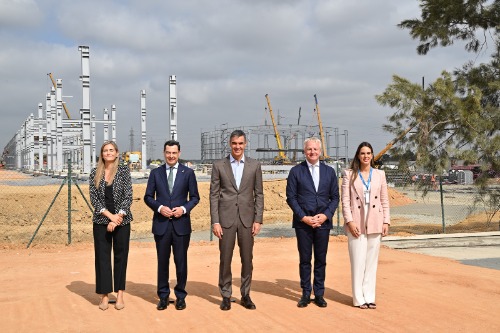
Moeve has begun construction of the Onuba green hydrogen project at its Energy Park in Palos de la Frontera, Huelva, marking the first phase of the Andalusian Green Hydrogen Valley and a major step towards large-scale renewable hydrogen production in Spain.
The project will initially deploy 300 MW of electrolysis capacity, with an option to add a further 105 MW. Moeve said the development represents a joint investment of more than €1 billion, including associated infrastructure and a dedicated photovoltaic plant for self-consumption.
The start of construction was marked by an event attended by Spanish Prime Minister Pedro Sánchez, Third Deputy Prime Minister and Minister for the Ecological Transition Sara Aagesen, Andalusian President Juanma Moreno Bonilla and European Commission Executive Vice-President Teresa Ribera, alongside project partners and local representatives.
Onuba targets 45,000 tonnes of renewable hydrogen annually
Once operational, the facility is expected to produce approximately 45,000 tonnes of renewable hydrogen per year.
Moeve said the hydrogen will be used to support lower-carbon fuel production for road, aviation and maritime transport, while also contributing to the decarbonisation of other industrial sectors.
The company estimates that the plant could avoid approximately 250,000 tonnes of CO₂ emissions annually.
The project is also expected to generate more than 8,000 direct, indirect and induced jobs across development, construction and commissioning, while supporting economic activity involving more than 400 local SMEs and self-employed businesses, according to Moeve.
Digital systems integrated into plant design
Onuba will incorporate digital technologies from the design stage, including a digital twin and a unified data and Internet of Things platform.
Moeve said the facility is being developed as its first digitally native plant, with these systems intended to support safer, more efficient and predictive operations.
The project is being developed with Moeve holding a 51% majority stake. Hy24 and COFIDES hold a combined 29%, while Enagás Renovable and Alter Enersun jointly hold the remaining 20%.
The shareholder structure brings together industrial and financial participants as the project moves into construction.
Spain and EU support renewable hydrogen development
The Onuba project has been designated a Project of Common Interest (PCI) by the European Union.
It has also secured €304 million in Spanish government funding under the Recovery, Transformation and Resilience Plan, financed through the EU’s NextGenerationEU programme. The funding forms part of the Renewable Hydrogen Valleys support programme and is intended to support development of 405 MW within the wider Andalusian Green Hydrogen Valley.
Spanish Prime Minister Pedro Sánchez said the government had allocated more than €3 billion to more than 120 renewable hydrogen projects, while noting that Moeve’s project had received more than €300 million in public funding.
European Commission Executive Vice-President Teresa Ribera described the project’s PCI status as reflecting its strategic importance to Europe’s energy-system transition.
Andalusian Green Hydrogen Valley targets 2 GW
Onuba forms the first phase of a much larger development. The Andalusian Green Hydrogen Valley is designed to reach 2 GW of electrolysis capacity across Moeve’s Energy Parks in Palos de la Frontera and San Roque, Cádiz.
The development is intended to establish Andalusia as a major production and export region for renewable hydrogen and other green molecules.
Moeve said the region benefits from available land, port infrastructure and renewable electricity generation conditions that can support hydrogen production.
The company is investing a total of €2.4 billion in Andalusia in energy-transition projects, including the Onuba hydrogen facility and a second-generation biofuels plant that is expected to produce sustainable aviation fuel (SAF) and renewable HVO diesel.
Together, the projects are intended to establish Palos de la Frontera as a major green-molecules production hub.
Green hydrogen moves towards larger-scale deployment
The construction start marks a transition from pilot-scale renewable hydrogen initiatives towards larger industrial projects.
Moeve CEO Maarten Wetselaar said the Onuba project represents a move towards large-scale construction and described it as a step in the company’s wider strategy to develop sustainable energy production.
The project also links renewable hydrogen with other green-molecule pathways, including 2G biofuels and biomethane, which Moeve and PwC identify as potential contributors to reducing Europe’s dependence on fossil fuels.
According to a report by Moeve and PwC cited in the announcement, green molecules could replace up to 50% of Europe’s current fossil fuel demand by 2050, potentially account for one-third of Europe’s energy mix and reduce CO₂ emissions by 22%.
These figures are projections from the cited report and should not be treated as independently established market outcomes.
Bioenergy Business Analysis
The Onuba construction start is significant because it moves a major renewable hydrogen development from project planning into construction while linking hydrogen production with SAF, renewable diesel and other industrial applications. Its 300 MW initial electrolysis capacity, with a potential 105 MW expansion, also provides a substantial industrial-scale deployment within the wider 2 GW Andalusian Green Hydrogen Valley.
For the wider green-molecules market, the project illustrates the importance of integrating renewable electricity, hydrogen production, industrial demand and transport-fuel applications within the same regional ecosystem. Its eventual commercial significance will depend on construction and commissioning, renewable power availability, hydrogen utilisation and the ability of associated downstream projects to develop as planned. The source provides project targets and company estimates but does not yet provide operational performance data.