


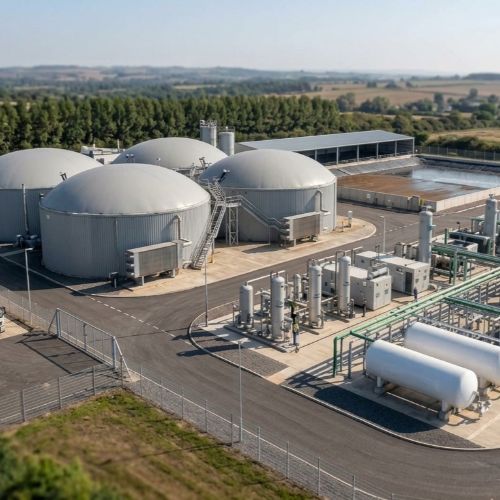
Organic Recycling Systems Limited (ORSL) has secured four engineering, procurement, construction, operation and maintenance (EPCOM) contracts from Bharat Petroleum Corporation Limited (BPCL) for municipal solid waste-based compressed biogas (CBG) plants in Mysuru, Raipur, Kozhikode and Hubli, marking another step in the company’s expansion across India’s bioenergy infrastructure market.
The awards have been secured through Solapur Bioenergy Systems Private Limited (SBESPL), ORSL’s wholly owned subsidiary, according to a company announcement dated 12 October 2026. The four projects are expected to provide an aggregate CBG processing capacity of approximately 20 tonnes per day (TPD), although the announcement does not specify the individual capacity of each plant.
The contracts add to a series of BPCL-backed project awards received by SBESPL over the preceding month. They also highlight the importance of combining plant construction with long-term operations and maintenance (O&M) as India seeks to translate its growing CBG project pipeline into operational capacity.
Four municipal waste-to-CBG projects across three states
The new contracts cover two locations in Karnataka and one each in Chhattisgarh and Kerala.
Under the EPCOM model, SBESPL will be responsible for the projects’ engineering, procurement and construction, followed by five years of operations and maintenance, according to the announcement.
This arrangement places construction and early operating responsibilities under a single contractual framework. It differs from a conventional engineering, procurement and construction (EPC) contract, under which the developer’s construction responsibilities may end when the facility is handed over to its owner or operator.
For BPCL, integrating these activities could help reduce coordination risks between construction contractors and plant operators. For SBESPL, it creates a longer-term service commitment alongside the initial project execution work.
India’s CBG pipeline faces a delivery challenge
India’s CBG sector is supported by government programmes intended to encourage the production of renewable gas from agricultural residues, organic waste, cattle dung and other biodegradable materials.
The Sustainable Alternative Towards Affordable Transportation (SATAT) initiative has generated a substantial project pipeline. ORSL’s announcement cites more than 1,200 letters of intent (LoIs) for CBG plants by mid-2026, reflecting the scale of proposed development.
However, letters of intent represent project interest or preliminary commitments rather than proof that a facility has reached financial closure, construction completion or commercial operation. The number of LoIs therefore should not be treated as equivalent to commissioned plants or available CBG supply.
The four new BPCL contracts illustrate one part of the development process: moving from a project pipeline towards contracted construction and operational responsibilities. Their ultimate contribution to India’s renewable gas supply will depend on execution, commissioning, reliable feedstock availability and sustained plant performance.
Policy support and demand-side measures
The policy environment described in the company announcement includes a phased CBG blending obligation, an excise duty exemption for the biogas component of blended compressed natural gas (CNG), and central financial assistance for eligible projects.
The announcement states that the blending obligation is intended to increase from 1% to 5% by financial year 2028–29. It also cites financial assistance of up to ₹10 crore per plant under the Ministry of New and Renewable Energy (MNRE).
These policy details should be checked against the applicable government notifications and scheme guidelines before publication, particularly the precise implementation dates, eligibility criteria and conditions attached to financial assistance.
Oil marketing companies (OMCs), including BPCL, Indian Oil Corporation Limited (IOCL) and Hindustan Petroleum Corporation Limited (HPCL), are important potential buyers of CBG. The announcement describes 15-year offtake arrangements as a typical feature of such projects, although the terms and duration of the agreements applicable to these four plants have not been disclosed.
Long-term offtake commitments can support project financing by providing greater visibility over future revenue. Their effectiveness, however, depends on the contractual terms, plant performance, gas quality, delivery arrangements and the ability to meet agreed supply volumes.
EPCOM contracts offer longer-term operating revenue
ORSL’s management has highlighted the operating phase of these contracts as a potential source of more predictable revenue than construction work alone.
Pankaj Tanwar, CEO – Bioenergy at ORSL, said the four BPCL awards were intended to turn the industry’s project pipeline into operating capacity. He also emphasised that the contracts cover the full project lifecycle, including five years of O&M.
Jigar Gudka, CFO of ORSL, said the EPCOM structure could improve revenue visibility once projects move from construction into operations. He described the contracted O&M component as annuity-like, reflecting its longer-term nature compared with revenue earned from individual construction projects.
These are management assessments rather than evidence of realised financial performance. The extent of any improvement in earnings visibility will depend on commissioning schedules, operating costs, contract terms and the plants’ ability to meet performance requirements.
The latest contracts follow ORSL’s earlier BPCL awards for projects in Mysuru, Raipur and Kozhikode. Separately, the company has reported the renewal of an O&M contract for a CBG plant in Gorakhpur with Indian Oil Corporation Limited.
Together, these developments indicate that ORSL is seeking to expand its role beyond plant construction into the operation of waste-to-energy infrastructure. The financial contribution of the new contracts, however, cannot be assessed fully without disclosed project-level economics and commissioning timelines.
Execution remains the key test for India’s CBG sector
The gap between announced projects and operational plants remains a central issue for India’s CBG ambitions. A project must progress through several stages, including feedstock assessment, technology selection, financing, construction, regulatory approvals, commissioning and sustained commercial operation.
Municipal solid waste projects face additional operational considerations. Feedstock segregation and consistency, contamination, collection logistics, digestate management and the reliability of gas upgrading systems can all influence plant performance and operating costs.
An integrated EPCOM arrangement can place more responsibility on a single contractor, potentially reducing the coordination challenges associated with separate construction and operating entities. It does not, by itself, guarantee successful commissioning or commercially sustainable operations.
For BPCL and other fuel-market participants, the performance of projects under such contracts will be important in determining whether waste-based CBG facilities can deliver dependable volumes at commercially viable costs.
The four ORSL-linked projects represent a modest addition to India’s national bioenergy ambitions, but they provide a concrete example of the type of project-level contracting needed to advance the sector from proposals to operating infrastructure.
Bioenergy Business Analysis
ORSL’s four BPCL contracts highlight a significant distinction in India’s CBG market: a large project pipeline does not automatically translate into operational renewable gas capacity. The more meaningful indicators of sector progress are projects reaching construction completion, commissioning on schedule and sustaining reliable output over time.
The EPCOM model may help address part of this challenge by aligning construction and early-stage operational responsibilities within one contract. For developers, five-year O&M commitments could provide a longer revenue horizon and opportunities to build operational expertise. For project owners, the model may simplify accountability for plant performance. These benefits remain conditional on contract design, risk allocation and execution quality.
The policy framework also matters. India’s phased CBG blending obligation establishes a demand-side mechanism, while financial assistance and offtake arrangements can support project economics. However, policy support cannot eliminate the underlying challenges of collecting suitable organic waste, controlling capital costs, managing digestate and maintaining consistent gas production.
The scale of the new awards should be kept in perspective. Approximately 20 TPD of aggregate capacity is meaningful for the company, but it is not sufficient evidence of a material change in India’s national CBG supply position. The more useful test will be whether these projects are commissioned, achieve their intended output and operate reliably throughout their contractual periods.
For investors and industry participants, the key milestones to monitor are contract execution, project commissioning, actual CBG production, O&M performance and the contribution of operating contracts to revenue and earnings. These measures will provide a stronger basis for evaluating the sector’s progress than LoI totals or contract announcements alone.


