


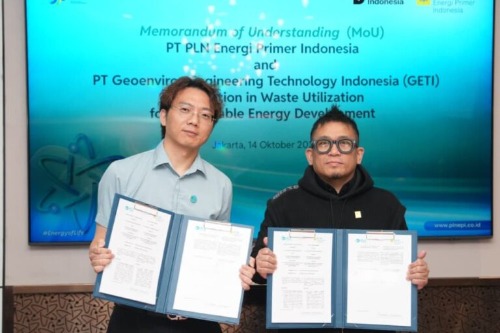
Indonesia’s PT PLN Energi Primer Indonesia (PLN EPI) has signed a memorandum of understanding (MoU) with PT Geoenviron Engineering Technology Indonesia (GETI) to assess opportunities for converting waste into energy, including through refuse-derived fuel (RDF) and waste-to-energy (WtE) technologies.
The agreement establishes an initial framework for evaluating waste resources, suitable conversion technologies and potential project opportunities. The companies will also examine supply chain development, business models and supporting infrastructure, with any future projects subject to technical, commercial and regulatory assessments.
GETI is a subsidiary of China’s Beijing Geoenviron Engineering & Technology Inc. (BGE), a company involved in environmental technology and services, including waste management, RDF and WtE solutions.
PLN EPI and GETI to assess waste feedstocks and conversion technologies
Under the MoU, the companies will assess the characteristics and availability of potential waste feedstocks and identify technologies suited to their conversion into energy. The initial work will also consider the infrastructure and supply chains required to support possible projects.
The assessment is intended to establish which opportunities could be developed jointly. The companies have not announced specific project locations, processing capacities, investment values or construction timelines.
PLN EPI Biomass Director Hokkop Situngkir described the agreement as an initial framework for collaboration to make better use of waste as a resource for sustainable energy development.
In a statement issued by PLN EPI, Situngkir said the MoU provides a legal foundation and shared commitment for cooperation between the two companies.
GETI targets potential progression from assessment to implementation
GETI Technical Director Li Chenyi said the company hoped the cooperation would advance from preliminary assessments towards project implementation.
GETI Business Development Manager Alif Zulviqar Syahroni said the partnership also aligned with the company’s efforts to develop collaborations with Indonesian state-owned enterprises. The companies will further evaluate identified opportunities before deciding which initiatives may proceed.
The agreement therefore marks an exploratory stage rather than a commitment to build a specific waste-to-energy facility. Progress will depend on the results of feedstock assessments, technology selection, commercial viability and compliance with applicable regulations.
RDF and waste-to-energy offer different conversion pathways
Refuse-derived fuel is produced by processing suitable waste into a fuel fraction that can be used in compatible industrial or energy facilities. Depending on its composition and preparation, RDF can provide an alternative fuel for applications such as industrial heat generation.
Waste-to-energy is a broader term covering technologies that recover usable energy from waste. The appropriate process depends on the waste stream, its characteristics, local infrastructure and the intended energy output.
For PLN EPI and GETI, evaluating these options will be an important part of determining which waste streams could support commercially and technically viable projects.
Bioenergy Business Analysis
The PLN EPI–GETI MoU signals interest in developing waste as an energy resource in Indonesia, while bringing together a domestic energy-supply company and an environmental technology provider with Chinese parent-company links. The immediate opportunity is to determine whether suitable waste streams can be collected, processed and supplied consistently enough to support viable energy projects.
Feedstock availability alone will not determine project success. Waste composition, collection logistics, processing requirements, transport costs, technology performance and the availability of suitable end users will all influence project economics. Regulatory approvals and the allocation of responsibilities across the supply chain will also matter.
The next indicators to watch are the identification of specific waste sources, the selection of conversion technologies, project-level feasibility findings and any subsequent investment or construction announcements. Until these details emerge, the partnership should be understood as a preliminary assessment initiative—not a confirmed waste-to-energy build-out.


