


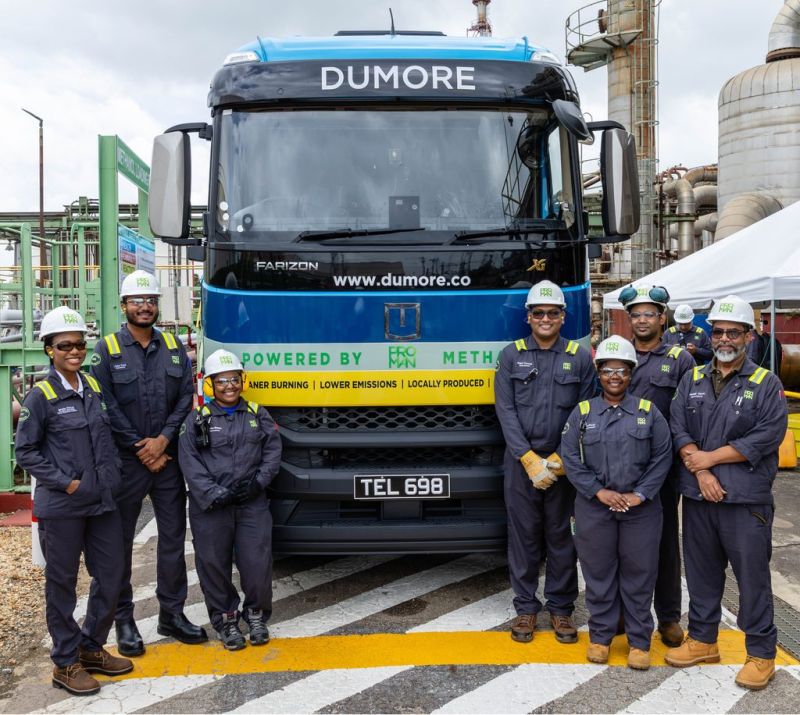
Proman and Dumore Enterprises have launched four 100% methanol-powered trucks in Trinidad and Tobago, marking the first deployment of such vehicles on roads outside China.
The pilot is testing methanol as a fuel for heavy-duty road transport while creating a domestic use case for methanol produced in Trinidad. Following approval from the Transport Commission, Dumore Enterprises began operating the trucks on public and private roads in mid-July 2026 to transport industrial goods across Trinidad and Tobago.
The four Farizon G2 trucks have already travelled more than 17,000 km, with 41 refuelling stops at Proman’s production facilities at the Point Lisas Industrial Estate in Couva. They have consumed more than 20 tonnes of methanol during the pilot, with Proman and Dumore estimating that this has avoided approximately 3.7 tonnes of CO₂e emissions compared with conventional diesel trucks.
Dumore plans to continue the trial, with the trucks expected to accumulate approximately 100,000 km on the country’s roads.
Methanol Trucks Put Trinidad Fuel Production to Road-Test
Proman Chief Executive David Cassidy said the deployment demonstrates that methanol produced in Trinidad can be used to power vehicles on the country’s roads.
He described the project as an important milestone for Trinidad and Tobago and the wider adoption of methanol as a cleaner fuel for road transport.
According to Cassidy, the pilot could reduce emissions, create additional domestic demand for methanol and potentially open opportunities for the fuel across the wider Caribbean.
The project brings together fuel production and vehicle deployment in a single demonstration, allowing operators to collect practical performance data under commercial road conditions.
Pilot Targets Heavy-Duty Transport
Dumore’s four Farizon G2 trucks are being used to deliver industrial goods, providing an opportunity to evaluate 100% methanol fuel in heavy-duty transport.
Dumore Enterprises CEO Alex Jodhan said the transition to lower-impact transport technologies would require incremental adoption and real-world testing.
He said the data generated through the pilot would help establish commercial understanding of the technology and provide information that could support future policy and regulatory development.
Jodhan also described the project as the first time in the Western Hemisphere that methanol has been used to power heavy cargo transport.
Methanol Already Established in Road Transport
Methanol has been used in road transportation for decades, both as 100% methanol fuel (M100) and as a component in gasoline blends.
Its use has extended across several vehicle categories, including passenger cars, buses and heavy-duty trucks.
China currently has the world’s largest methanol vehicle fleet, with more than 30,000 vehicles, supported by established methanol production, distribution and refuelling infrastructure. Geely has been identified as a major contributor to the development of methanol-powered vehicles.
The Trinidad pilot brings this established technology into a new geographic market while testing its application using locally produced methanol.
Methanol Provides a Potential Transition Fuel
Methanol burns with near-zero particulate matter, or soot, according to Proman and Dumore, while also producing significantly lower nitrogen oxide emissions and less carbon dioxide than conventional diesel in the context described by the companies.
Another potential advantage is fuel flexibility. Conventional methanol produced from natural gas can progressively be blended with lower-carbon and green methanol without requiring engine modifications, according to the companies.
This could allow existing methanol-fuelled vehicles to transition towards lower-carbon fuel supplies as production develops.
Methanol’s liquid form also allows it to be stored and distributed using established liquid-fuel handling approaches. Its octane rating is around 109, compared with approximately 91–95 for standard petrol, supporting its use as a high-octane transport fuel.
Regulatory Standards Will Determine Wider Deployment
The four trucks have received approval to operate on public roads, but wider adoption of methanol fuel in Trinidad and Tobago would require further regulatory changes.
Proman and Dumore said the Trinidad and Tobago Bureau of Standards (TTBS) would need to revise the country’s fuel standard to permit methanol blends and introduce a standard covering 100% methanol fuel.
This regulatory framework would be an important step if methanol-powered road transport is to move beyond the current demonstration project.
Pilot Could Create New Domestic Methanol Demand
Proman Trinidad Executive Director Anand Ragbir said the project could support improved air quality, reduce dependence on imported diesel and establish a new export market for Trinidad’s methanol.
The company views the transport application as an additional potential outlet for a product in which Trinidad already has an established production base.
The planned 100,000-km pilot will provide a larger operating dataset than the initial 17,000 km accumulated by the four trucks since July. Its results could help determine the practical requirements for expanding methanol-powered heavy-duty transport in Trinidad and potentially elsewhere in the Caribbean.
Bioenergy Business Analysis
The Trinidad pilot connects an existing methanol production industry with an emerging transport application, giving the country an opportunity to assess the fuel under real-world heavy-duty operating conditions. The more than 17,000 km already completed provides an initial operating record, while the planned 100,000-km trial should generate a broader dataset on fuel consumption, vehicle performance, refuelling and emissions.
The project’s expansion potential will depend not only on vehicle performance but also on fuel standards and infrastructure. The requirement for TTBS to establish standards for methanol blends and M100 means regulatory development will be as important as the technical results of the pilot. If the demonstration supports broader deployment, methanol could provide an additional pathway for Trinidad to connect domestic fuel production with lower-emission road transport.