


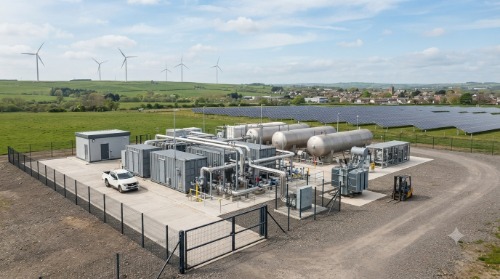
Norwegian renewable energy company Statkraft has completed the divestment of its UK green hydrogen development assets, transferring projects to new owners as part of its wider strategy to exit new hydrogen project development and concentrate capital on selected renewable energy technologies.
Statkraft began the process after announcing in May 2025 that it would stop developing new green hydrogen projects because of increased uncertainty in the hydrogen market. The company said at the time that parts of its existing portfolio would be matured before being offered to investors.
Under the completed UK transactions, Kentron Green Nordic AS has acquired Statkraft’s UK hydrogen development assets, while Statkraft’s interest in Grenian Hydrogen has transferred to the existing partners, Progressive Energy and Foresight.
The transactions mark another step in Statkraft’s strategic shift towards a smaller number of technologies and markets.
Kentron takes over Statkraft’s UK hydrogen assets
Kentron Green Nordic, a Norwegian-owned company with operations in the UK, will take forward the hydrogen assets acquired from Statkraft.
One of the projects now under Kentron’s ownership is the Shetland Hydrogen Project 2 (SHP2). Statkraft’s UK project information says the development is designed as an electrolytic hydrogen-to-green-ammonia facility with capacity of up to 400MW near Scatsta Airport on Shetland Mainland. The site is close to the Sullom Voe energy hub.
Statkraft says SHP2 was sold to Kentron in autumn 2026. Kentron is also developing the Neptun Tromsø and Neptun Glomfjord green-ammonia projects in Norway.
The transfer means the projects can continue under a new owner even though Statkraft has withdrawn from new green hydrogen development.
Statkraft exits Grenian Hydrogen
Statkraft has also exited Grenian Hydrogen, the UK green hydrogen joint venture it established with Progressive Energy and Foresight in 2023.
Grenian was originally formed to develop electrolytic hydrogen projects for industrial customers in the UK. Its initial portfolio comprised seven projects with a combined development potential of 200MWe, with 100MWe already in engineering and consenting when the joint venture was launched.
The portfolio included the 30MWe Cheshire Green Hydrogen project at Peel’s Protos site near Ince. The project was shortlisted for a 15-year Low Carbon Hydrogen Agreement, while projects in St Helens, Winnington, Middlewich and Stretford also progressed through engineering and consenting activities.
Companies House records show that Statkraft Hydrogen UK Holding Limited ceased to be a person with significant control of Grenian Hydrogen on 9 June 2026, providing a corporate record of Statkraft’s exit from the joint venture.
The remaining ownership is now with Progressive Energy and Foresight.
Statkraft changed hydrogen strategy in 2025
Statkraft announced its decision to halt new green hydrogen development on 8 May 2025.
The company attributed the decision to increased uncertainty in the hydrogen market, while maintaining that it continued to see a long-term role for green hydrogen in reducing emissions from carbon-intensive industries.
In June 2025, Statkraft formally outlined a broader strategic review focused on strengthening its core competitive advantages and prioritising near-term profitable opportunities. The company said it would focus on hydropower, market operations, and solar, wind and battery activities in selected markets.
The strategy also involved reducing the company’s exposure to technologies and markets where it saw less favourable near-term investment conditions.
By early 2026, Statkraft was continuing to execute this portfolio strategy. Its first-quarter results reported the completed divestment of a hydrogen project in Sweden, alongside other asset sales.
UK renewable investment continues outside hydrogen
Statkraft’s withdrawal from green hydrogen does not represent an exit from the UK renewable-energy market.
The company continues to develop renewable electricity and associated infrastructure in the UK. In August 2026, Statkraft secured planning consent for the 32MW Trerice Solar Farm in St Dennis, Cornwall, following a planning appeal.
The project combines solar PV with battery energy storage and is expected to generate enough renewable electricity annually to meet the equivalent needs of more than 10,000 homes, according to Statkraft.
Statkraft has said its refocused European activities will continue to include solar, wind, batteries and grid services, while concentrating investment on technologies and markets offering stronger near-term opportunities.
What the divestment means for UK hydrogen projects
The sale separates Statkraft’s corporate strategy from the future development of projects it previously originated or co-developed.
For projects such as SHP2, ownership by a specialist developer with interests in green ammonia and renewable generation provides a route for continued development. The ultimate pace of progress, however, will depend on project economics, financing, permitting, electricity supply and the development of markets for low-carbon hydrogen and ammonia.
The Grenian portfolio similarly remains with partners that were involved in its original development. Its projects were designed around industrial hydrogen demand and UK government support mechanisms, including the Low Carbon Hydrogen Agreement and Net Zero Hydrogen Fund.
The transactions therefore represent a change in project ownership rather than the cancellation of the underlying UK hydrogen development pipeline.
Read also: CAC and TPES establish Pune engineering hub for synthetic fuel projects