


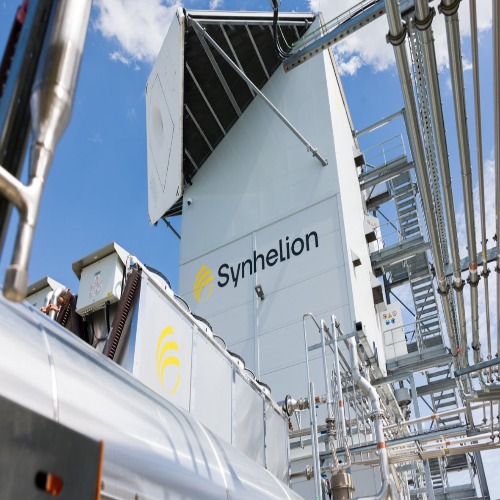
Swiss renewable fuel company Synhelion has signed a memorandum of understanding with the Moroccan government to develop a commercial-scale synthetic fuel plant in Tan-Tan province, with planned production capacity of 100,000 tonnes of renewable fuel per year.
The proposed facility will be located in the Guelmim-Oued Noun region of southern Morocco, an area Synhelion has identified for its strong renewable energy resources and potential to support an integrated renewable fuel supply chain. The company has already secured a land reservation for the project and established a local entity, Synhelion Morocco.
The MoU was signed with Morocco’s Ministry of Industry and Trade, Ministry of Energy Transition and Sustainable Development, Ministry of Investment, Convergence and Evaluation of Public Policies, and the Moroccan Agency for Investment and Export Development (AMDIE).
Synhelion moves synthetic fuel project towards commercial scale
The agreement marks a significant step in Synhelion’s plans to scale up its renewable synthetic fuel technology. According to the company, the combination of the MoU, land reservation and establishment of its Moroccan branch moves the project from evaluation towards implementation.
Synhelion’s technology is designed to produce renewable synthetic fuels using renewable energy and carbon-based feedstocks. The company’s fuel portfolio includes synthetic aviation fuel, diesel and gasoline, which are intended as drop-in alternatives compatible with existing engines and fuel infrastructure.
The company has been operating its DAWN industrial demonstration facility in Jülich, Germany, since 2024, where it has been producing renewable fuels including sustainable aviation fuel, diesel and gasoline. The Morocco project is intended to take the technology to a substantially larger commercial scale.
Morocco positions synthetic fuels within green hydrogen strategy
The proposed Tan-Tan plant fits into Morocco’s wider push to develop renewable energy, green hydrogen and downstream fuels.
Morocco’s Green Hydrogen Offer provides a framework for integrated projects combining renewable power generation, electrolysis and the conversion of green hydrogen into products such as ammonia, methanol and synthetic fuels. The country has also identified synthetic fuels among the potential derivatives that could be developed for domestic consumption and export.
The Guelmim-Oued Noun region is being positioned as a potential production hub because of its renewable energy resources and the opportunity to establish an integrated industrial value chain.
Moroccan Investment Minister Karim Zidane said the project could contribute to new value chains, create local economic opportunities and strengthen the country’s position as a platform for green industry.
100,000 tonnes a year marks major scale-up
At a planned annual capacity of 100,000 tonnes, the Tan-Tan facility would represent a major increase in scale for Synhelion’s synthetic fuel operations.
The company has been pursuing commercial-scale projects in parallel with its industrial demonstration activities. Earlier in September, Synhelion selected engineering company Saipem to conduct pre-FEED engineering work for another commercial-scale synthetic fuel plant at RWE’s Hürth-Knapsack site in Germany.
The Moroccan project therefore forms part of a broader effort by Synhelion to move renewable synthetic fuels from demonstration towards commercial production.
The company has not announced a construction or production start date for the Tan-Tan facility. It has also not disclosed a final investment decision or confirmed an investment value for the project. Recent reporting noted that an investment figure discussed by Synhelion in 2025 was not included in the latest MoU announcement.
Growing e-fuels activity in Morocco
Synhelion’s announcement adds another synthetic fuel project to Morocco’s expanding renewable energy and green hydrogen pipeline.
The country has attracted international interest in green hydrogen derivatives, including projects targeting synthetic fuels, methanol and ammonia. The development of renewable power resources alongside hydrogen and carbon-based fuel production could allow Morocco to participate in emerging international markets for lower-carbon fuels.
For Synhelion, the Tan-Tan project represents its planned first large-scale commercial synthetic fuel plant in the region and a test of whether its technology can be deployed at significantly greater production volumes.
The next major milestones will be the project’s engineering development, financing and final investment decision, followed by construction and commissioning. Until those stages are reached, the 100,000-tonne annual capacity should be viewed as a planned project capacity rather than operational production.
Read also: Norway’s BIR scales output at BREEAM-certified biogas facility powered by Valmet