


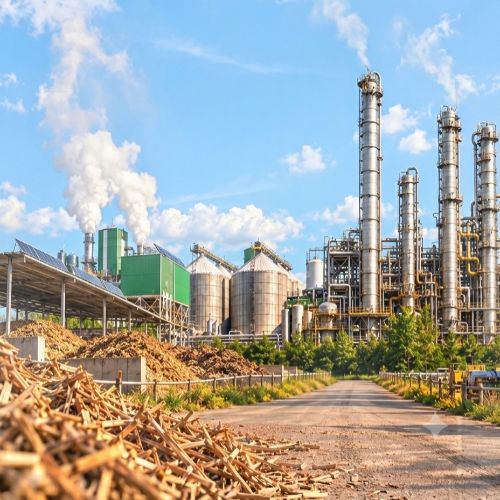
Thermax has entered into a strategic agreement with Germany-based C1 Green Chemicals AG to jointly develop a pre-commercial facility that will produce green methanol from biomass-derived syngas. Ankur Scientific Energy Technologies Pvt Ltd is also part of the initiative, bringing expertise in gasification processes.
The collaboration combines C1’s methanol catalyst technology with Thermax’s process development capabilities and Ankur Scientific’s experience in biomass gasification. The partners aim to establish a production pathway that could support the future commercial deployment of biomass-based methanol in India.
Thermax Chief Technology Officer Santanu Chaudhuri said the agreement aligns with the company’s focus on advancing sustainable energy solutions through strategic innovation. He added that the pre-commercial facility would help build the capabilities needed to move towards commercial-scale deployment.
C1 sells first technology licence to Thermax
For C1 Green Chemicals, the agreement marks the sale of its first technology licence to Thermax.
C1 CEO Christian Vollmann described Thermax as a suitable partner for deploying the company’s technology, citing its experience in building chemical plants. He said the companies intend to scale the methanol technology initially in India, with the possibility of expanding into other markets.
Vollmann also pointed to growing interest in locally produced, decentralised biomethanol as countries seek to reduce dependence on fossil fuel imports.
The agreement brings together three distinct areas of expertise: C1’s catalyst technology, Thermax’s process engineering and development capabilities, and Ankur Scientific’s gasification technology. Biomass gasification converts solid biomass into synthesis gas, or syngas, which can serve as a feedstock for producing methanol.
Biomass-derived methanol and the energy transition
Biomass-based methanol is one potential route for producing lower-carbon fuels and chemical feedstocks from renewable resources. Its production depends on the availability and quality of sustainable biomass, the efficiency of the conversion process and the emissions associated with the overall supply chain.
Methanol has applications in the chemical industry and is also being considered as an alternative fuel for sectors such as shipping. The commercial potential of biomass-derived methanol will depend on production costs, access to feedstock, technology performance and demand from end users.
The partners have not disclosed the proposed facility’s location, production capacity, investment, construction schedule or expected commissioning date. Further details will be important in assessing the project’s scale and its potential contribution to India’s green methanol market.
Thermax’s existing green methanol project in Gujarat
The new agreement follows a separate green methanol project announced by Thermax and Ankur Scientific in May 2026. The companies partnered to establish a biomass-based methanol facility at Deendayal Port Authority in Kandla, Gujarat, with a planned annual production capacity of up to 18,000 tonnes.
That project is designed to use locally sourced Ganda Baval biomass and Ankur Scientific’s gasification technology, with Thermax integrating its fuel-processing capabilities. It is intended to support the development of lower-emission marine fuel supply in India. pv magazine India+1
The C1 agreement is a distinct development in the supplied announcement. It introduces C1’s catalyst technology into a collaboration with Thermax and Ankur Scientific, but no link between the new pre-commercial facility and the Kandla project has been announced.
Bioenergy Business Analysis
The agreement adds another technology collaboration to India’s developing biomass-to-methanol landscape. Its significance lies in bringing together gasification, process engineering and catalyst technology at a pre-commercial stage, where the partners can work towards demonstrating an integrated production pathway.
However, a pre-commercial facility is not the same as a commercially operating plant. Its performance will need to be assessed against factors such as syngas quality, conversion efficiency, catalyst performance, operating costs and the consistency of biomass feedstock supply.
The project’s commercial prospects will also depend on whether it can produce methanol at a competitive cost and demonstrate credible lifecycle emissions benefits. The source announcement does not yet provide the capacity, project economics or deployment timeline needed to assess these factors.
For India’s green methanol sector, the next important milestone will be the disclosure of the facility’s technical specifications and progress towards operation. The results could help establish whether the technology partnership can move beyond pre-commercial development towards wider deployment.



