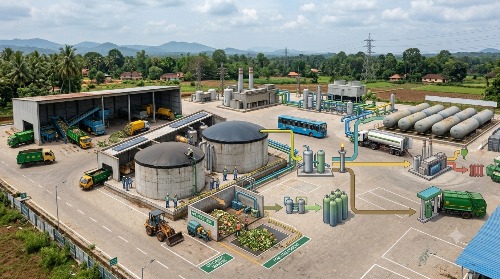
Thiruvananthapuram Municipal Corporation has dropped its proposal to establish a compressed biogas (CBG) plant on the premises of Sainik School Kazhakootam in Kerala following protests from parents, former students and nearby residents. However, the civic body intends to continue exploring a centralised waste-treatment facility at an alternative location.
According to a report by The Times of India (TOI), Mayor V V Rajesh confirmed that the corporation had no immediate plans to pursue the proposed facility at Kazhakootam. He said the civic body would continue its decentralised waste management programme while retaining the broader centralised treatment plant proposal.
The proposed facility was being explored in partnership with Bharat Petroleum Corporation Ltd (BPCL) to process municipal waste and produce compressed biogas.
Proposed CBG plant faced opposition over school location
The proposal involved seeking approximately 20 acres of land within the Sainik School Kazhakootam campus for a waste-to-energy facility.
In a letter dated 6 June 2026, Mayor V V Rajesh had requested the Union Ministry of Defence to allot the land for the proposed project.
On 3 November 2026, the ministry’s Sainik Schools Cell responded that the request had been examined and directed school and corporation officials to conduct a joint field assessment to evaluate the project’s feasibility.
The proposal attracted wider attention after a corporation delegation led by the mayor visited the school premises on 5 November to assess the suitability of the site.
The prospect of establishing a large-scale municipal waste-processing facility within a residential educational campus prompted objections from parents, alumni and local residents.
Parents and residents raise environmental and security concerns
Sainik School Kazhakootam accommodates more than 600 residential cadets. Parents expressed concerns about the potential movement of waste transportation vehicles and external personnel near the campus, citing security considerations.
They also raised concerns about possible odour, air and water pollution, and the proliferation of flies and mosquitoes associated with waste-processing activities.
Banarji Bhaskaran, a parent, expressed concern about the potential health implications for students living on campus. Manoj P, a former teacher and nearby resident, also opposed the proposed location, according to TOI.
Former students joined the opposition, arguing that a residential educational institution operating under the Ministry of Defence should not be used as a site for municipal waste processing.
School authorities declined to comment on the proposal, citing defence-related restrictions.
Corporation retains broader centralised waste-treatment proposal
Although the corporation has dropped the Sainik School location, its wider plans for centralised waste processing remain under consideration.
Mayor V V Rajesh told TOI that the civic body would continue its decentralised waste management programme but had not abandoned the centralised treatment plant proposal.
The corporation had previously explored a partnership with BPCL to establish a CBG facility modelled on the company’s Brahmapuram plant in Kochi.
BPCL’s Brahmapuram facility was inaugurated on 27 February 2026. Designed to process 150 tonnes of source-segregated biodegradable municipal solid waste daily, the plant is intended to produce compressed biogas and support organic fertiliser production.
The latest decision therefore represents a setback for the proposed Kazhakootam site rather than the cancellation of Thiruvananthapuram’s broader efforts to develop centralised organic waste-processing infrastructure.
Bioenergy Business Analysis
The developments in Thiruvananthapuram highlight the importance of site selection and community consultation in municipal waste-to-energy projects.
CBG facilities can support organic waste management by converting biodegradable municipal waste into renewable gas through anaerobic digestion. However, their implementation requires suitable land, effective waste segregation, appropriate environmental safeguards and coordination with surrounding communities.
The opposition to the Sainik School proposal demonstrates how concerns about land use, residential proximity, waste transportation and environmental impacts can influence project development, even when the underlying technology is intended to support cleaner waste management.