


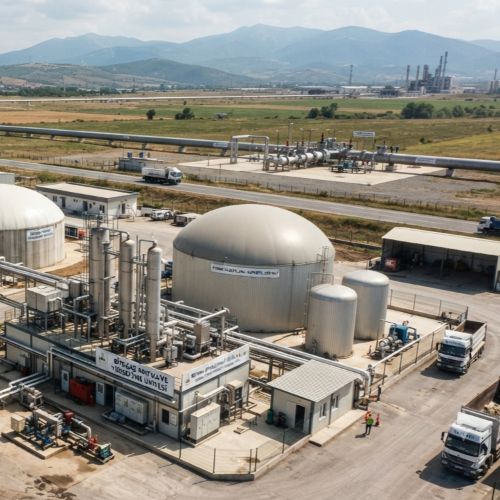
Türkiye is exploring the conversion of waste-based biogas into biomethane for potential export to European markets under a new cooperation agreement between Turkish renewable energy company Biotrend Enerji and German energy company Uniper.
The companies signed a Memorandum of Understanding (MoU) on September 30, 2026, to assess the conversion of Biotrend’s existing waste-based biogas facilities to biomethane production, evaluate new capacity and examine routes for supplying the renewable gas to Europe. Uniper said the cooperation could provide an additional source of renewable gas for European markets, subject to regulatory, certification, technical and commercial conditions.
The proposed development could connect Türkiye’s waste-management and biogas infrastructure with Europe’s growing market for renewable gases. However, the project remains at an early development stage, with no final investment decision, binding offtake agreement, defined volumes or confirmed export timeline.
Uniper and Biotrend assess waste-to-biomethane conversion
The MoU covers the assessment of Biotrend’s existing waste-based biogas plants and the potential development of new biomethane capacity.
Biotrend, a subsidiary of Doğanlar Holding, operates waste-management and energy facilities across Türkiye. Its portfolio includes integrated solid-waste management and energy-generation facilities, while the company identifies biogas and waste-derived energy as part of its core activities.
Under the proposed cooperation, the existing biogas-to-power facilities would be assessed for their suitability for conversion to biomethane production. Biotrend’s portfolio has an estimated biomethane potential of approximately 1.4 TWh per year, according to Uniper and the company. Türkiye’s broader biomethane potential is estimated at up to 50 TWh annually.
The companies will examine technical and economic factors before determining which facilities could move towards biomethane production.
Feedstock and plant suitability to be assessed
The initial assessment will consider more than the amount of biogas currently produced.
The approach is intended to prioritise facilities with stronger biomethane potential while retaining as much existing infrastructure as technically and economically practical.
This could allow selected plants to transition from generating electricity from biogas towards producing a higher-value renewable gas that can potentially enter gas networks.
Potential export route could use Türkiye’s gas grid
If the projects meet Turkish regulatory requirements and the biomethane obtains the necessary European sustainability certification, the gas could potentially be injected into Türkiye’s natural gas network.
Uniper said the companies are examining the possibility of transporting the gas towards Greece or Bulgaria, from where it could enter the European Union market. No specific pipeline route has been selected at this stage.
This route is significant because biomethane has chemical and physical characteristics that allow it to be used within existing natural gas infrastructure after appropriate upgrading and quality compliance.
Rather than requiring an entirely new dedicated gas-export infrastructure, the proposed model would seek to connect biomethane production with existing gas networks, subject to grid-entry rules, certification and cross-border recognition.
Uniper says project remains at conceptual stage
Uniper CEO Michael Lewis said the companies are examining whether biomethane produced in Türkiye can ultimately be supplied to Germany and other European markets.
He cautioned that regulatory, commercial and technical questions still need to be resolved and said the project remains at an early stage. Uniper has not disclosed a potential supply volume or timeline.
The company’s official announcement similarly states that the MoU covers the initial project-development phase and does not constitute an investment or offtake decision. Any future projects will depend on regulatory approval, certification and technical and commercial viability.
Biomethane could expand Türkiye’s waste-to-energy model
For Biotrend, the proposed shift would potentially broaden the use of its existing waste and biogas infrastructure.
Moving suitable facilities towards biomethane could create an alternative pathway for the energy contained in organic waste: instead of converting biogas primarily into electricity at the point of production, upgraded gas could potentially be supplied as a renewable gaseous fuel.
The model could also increase the value placed on feedstock quality, methane recovery, gas upgrading and sustainability certification across Biotrend’s waste-management operations.
Sustainability certification will be critical for European exports
The commercial viability of a Türkiye-to-Europe biomethane supply chain will depend not only on whether the gas can physically move through the network, but also on whether it meets the sustainability and certification requirements applicable in the destination market.
Biotrend has identified technical suitability, operating principles, legal infrastructure and sustainability certification as key requirements for potential exports.
This makes certification and traceability central to the proposed value chain. Biomethane intended for European markets would need to demonstrate the required sustainability characteristics and maintain appropriate documentation through production, upgrading and delivery.
For Uniper, this fits into a broader strategy to expand its renewable and low-carbon gas portfolio. The company says it is already developing biomethane activities in Europe, including future supplies from Spanish plants and an integrated biomethane-to-bio-LNG supply chain using infrastructure at Rotterdam’s Gate terminal.
Türkiye could become a renewable-gas supply corridor
The proposed partnership comes as Türkiye seeks to use its geographic position and existing energy infrastructure to connect domestic renewable-energy resources with European markets.
If technical and regulatory barriers can be resolved, biomethane could provide another renewable-gas pathway alongside other energy-transition opportunities. For Europe, Turkish production could potentially add a geographically closer source of renewable gas; for Türkiye, it could create a higher-value market for organic waste and existing biogas infrastructure.
The scale remains uncertain, however. The 50 TWh annual biomethane potential cited for Türkiye represents an overall potential estimate, not committed production or export capacity, while Biotrend’s 1.4 TWh figure represents estimated potential across its portfolio rather than an announced export volume.
The next milestones will therefore be the completion of plant-level feasibility studies, identification of viable facilities, clarification of regulatory and certification requirements and negotiation of any definitive commercial agreements.