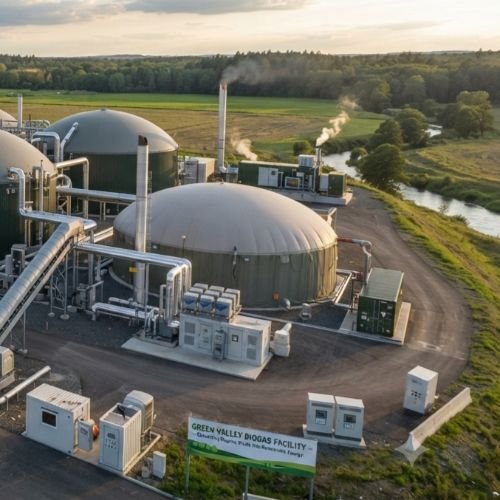
Around 70 million tons of surplus food generated annually in the United States could provide a substantial additional source of renewable energy if processed through anaerobic digestion, according to new research from the American Biogas Council (ABC). The industry association estimates that converting this material could generate approximately 181 billion cubic feet of additional biogas each year, equivalent to around 113 million MMBtu of energy.
The estimate highlights the potential to expand food waste-to-energy infrastructure in the US, where 404 operating facilities across 48 states already process food waste to produce biogas. These facilities supply renewable electricity and heat or upgrade the gas into renewable natural gas (RNG).
404 facilities currently produce biogas from food waste
ABC’s research identifies 404 operating facilities that process food waste to capture biogas. Around 200 of these are located at farms and wastewater treatment plants, where food waste is combined with manure or wastewater during anaerobic digestion.
The remaining 204 facilities process food waste as their primary feedstock. Together, these standalone facilities capture approximately 36 billion cubic feet of biogas annually and represent nearly US$3 billion in capital investment.
The association said its expanded research identified projects that were not included in its previous inventory, contributing to a 73% increase in the facility count compared with last year’s assessment. It attributed the increase to a more comprehensive picture of the existing industry rather than solely to new facilities entering operation.
Patrick Serfass, executive director of the American Biogas Council, said:
“America is literally throwing away enough renewable energy to power millions of homes. The technology to make energy from food waste is already operating, but the potential to turn more of what we routinely discard into a valuable domestic energy resource is enormous.”
Food processors and retailers supply feedstock to biogas facilities
The facilities identified by ABC receive food waste from food manufacturers, beverage producers, grocery stores, restaurants and other sources. Their feedstocks include organic waste from food and beverage processing, as well as spoiled, rejected and unsold retail food.
Of the 204 standalone food-waste facilities, 161 process pre-consumer food waste, primarily wastewater from food processing and beverage manufacturing. Another 43 facilities handle retail and consumer food waste, capturing approximately 8.2 billion cubic feet of biogas annually.
The majority of these facilities use the captured gas for energy production. ABC reports that 164 facilities generate electricity, heat or both, while another 38 upgrade biogas into RNG. The association’s fast-facts document does not specify the end use for the remaining two facilities.
Newer food waste projects account for a growing share of production
Investment in food waste-to-biogas infrastructure has increased alongside the development of larger projects. ABC reports that 42 facilities commissioned since 2020 account for 32% of the sector’s annual biogas production and 45% of its total investment.
On average, these newer facilities capture nearly twice as much biogas as earlier projects and require approximately three times the capital investment to build.
The trend continued in 2025, when seven new food-waste projects entered operation. All seven were designed to produce RNG. Together, they added more than twice the biogas capture capacity recorded in any other year since 2020, according to ABC.
Anaerobic digestion could unlock a larger energy resource
ABC estimates that processing all 70 million tons of surplus food generated in the US in 2024 through anaerobic digestion could produce approximately 181 billion cubic feet of additional biogas annually.
That volume is roughly five times the 36 billion cubic feet currently captured by the country’s 204 dedicated food-waste biogas facilities. The additional gas could provide approximately 113 million MMBtu of energy, enough to meet the annual energy needs of around 1.5 million US households, based on the association’s estimate.
The 70-million-ton figure comes from ReFED’s 2026 US Food Waste Report, which estimates that the country generated 70 million tons of surplus food in 2024, equivalent to around 29% of its food supply. The figure includes food that goes unsold or uneaten and is broader than the quantity of material that ultimately enters waste-management systems.
The 181-billion-cubic-foot estimate is a theoretical resource potential based on the assumption that all this surplus food is processed through anaerobic digestion. It is not a forecast of actual production or a claim that all surplus food is currently available or suitable for digestion.
The findings point to an opportunity to expand organic waste collection, digestion capacity and renewable gas production in the US. Realising that potential will depend on infrastructure development, feedstock collection and processing capacity, as well as the economics of converting discarded food into usable energy.