

A review published in Frontiers in Sustainable Food Systems has examined how biomass fermentation could convert India’s underused agricultural residues into protein-rich food ingredients, offering an alternative to conventional crop-waste disposal and energy recovery. The approach could create a new value chain connecting agricultural waste management with food production, biotechnology and rural livelihoods.
The review, authored by researchers from The Good Food Institute India, estimates that India generates around 500 million tonnes of agricultural side-streams annually, of which approximately 180 million tonnes could have potential for further use. It identifies rice straw, wheat straw, cotton stalks and sugarcane bagasse among the major feedstocks that could be explored for microbial protein production.
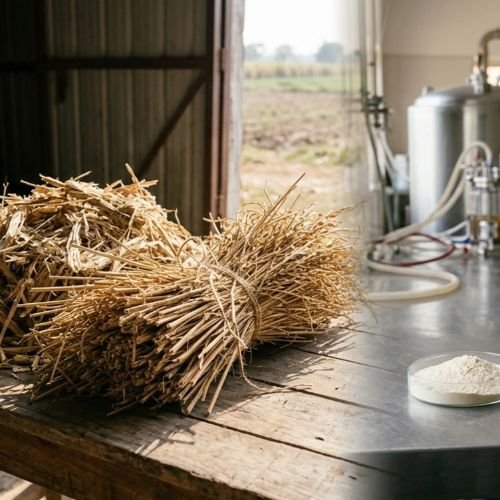
The authors describe biomass fermentation as a potential “waste-to-nutrition” pathway. Rather than using crop residues only for energy or disposing of them through practices such as open-field burning, the process uses microorganisms to convert suitable biomass-derived feedstocks into protein-rich microbial material.
How biomass fermentation can produce protein from agricultural residues
Biomass fermentation uses microorganisms such as bacteria, yeasts, fungi and microalgae to grow protein-rich cellular biomass. The resulting material, commonly called microbial protein or single-cell protein, can be processed into ingredients for food and alternative-protein products.
The review distinguishes this approach from traditional fermentation, which changes the properties of an existing food, and precision fermentation, which uses microorganisms to produce specific target compounds. Biomass fermentation instead harvests the microbial cells themselves.
Depending on the organism, the resulting biomass can contain between 30% and more than 80% crude protein on a dry-weight basis, alongside other components such as lipids, carbohydrates, vitamins and minerals. The review notes that fungal and yeast biomass can offer useful amino-acid profiles, although nutritional composition varies by species and processing method.
Rice straw, wheat straw and bagasse among potential feedstocks
India’s agricultural system generates a wide range of crop residues and agro-industrial by-products. The review identifies wheat straw, rice straw, cotton stalks and sugarcane bagasse as particularly important sources of surplus biomass.
It estimates that cereals generate approximately 325 million tonnes of agricultural side-streams annually, followed by fibre crops at 66 million tonnes, oilseeds at 29 million tonnes, pulses at 13 million tonnes and sugarcane at 12 million tonnes. These figures underline the potential scale of agricultural biomass available for different forms of resource recovery.
However, the residues cannot necessarily be fed directly into fermentation systems. Their cellulose, hemicellulose and lignin structures often require physical, chemical or enzymatic pre-treatment to release sugars that microorganisms can use. The choice of process depends on the feedstock, microorganism and intended product.
Processing costs and scale-up remain key challenges
Despite the availability of low-cost agricultural feedstocks, converting them into microbial protein is not automatically economical. Pre-treatment, enzymes, energy consumption, fermentation equipment and downstream processing can add substantially to production costs.
The review cites a techno-economic assessment by Upcraft and colleagues that modelled mycoprotein production from rice straw using ionic-liquid and enzymatic pre-treatment. The model estimated a production cost of US$40.04 per kilogram of protein. The authors note that this was higher than the model’s comparison costs for conventional beef, chicken and existing commercial mycoprotein products. This is a modelled estimate, not the reported cost of an operating Indian production facility.
Food safety is another consideration. Microbial biomass can contain relatively high levels of nucleic acids, which need to be reduced during processing to address potential health risks associated with excess purine intake. The review also identifies the need for better methods to manage pre-treatment by-products that can inhibit microbial growth.
Environmental performance will depend on the energy used across the process. One life-cycle assessment cited in the review found that electricity use accounted for approximately 72.9% of the global warming potential in a rice-straw-to-mycoprotein pathway. The authors therefore identify renewable electricity as important to improving the environmental case for the technology.
BioE3 policy could support a crop residue-to-protein value chain
The review links biomass fermentation to India’s BioE3 policy, which promotes biotechnology-led manufacturing, circular bioeconomy development and employment generation. It argues that existing crop-residue programmes largely focus on burning reduction, fodder, composting, bioenergy and biofuels, while fermentation-derived proteins could create another higher-value use for suitable surplus residues.
The authors recommend a coordinated approach involving agriculture, biotechnology, food processing and state-level agencies. Their proposals include regional biomass aggregation and pre-processing hubs, standardised feedstock quality specifications, improved access to pilot and demonstration facilities, targeted financial support and clearer food-safety guidance from the Food Safety and Standards Authority of India (FSSAI).
The review also cites an earlier market assessment projecting India’s domestic market for fermentation-derived smart proteins at US$40 million to US$131 million by 2030, with export potential of US$44 million to US$103 million. These are projections from research published in 2022, not current market-size measurements.
The authors conclude that biomass fermentation could connect agricultural residue management with protein production, but commercial adoption will depend on improvements in pre-treatment, process efficiency, feedstock logistics, food-grade separation and regulatory pathways. For India, the opportunity lies in developing an integrated value chain that can turn suitable agricultural side-streams into higher-value products while supporting the country’s circular bioeconomy ambitions.