

California Bioenergy LLC (CalBio) has increased its ownership in a portfolio of dairy renewable natural gas (RNG) projects in South Dakota after completing the acquisition of Sevana Bioenergy’s interest in South Dakota Biogas LLC.
The transaction, completed in August 2026, gives CalBio a larger role in MBL Bioenergy, the joint venture with UGI Energy Services (UGIES) that develops and operates eight dairy RNG projects across South Dakota. CalBio has also acquired sole ownership of SD OpCo LLC, the entity responsible for operating the digester projects.
The move expands CalBio’s operational presence beyond California and strengthens its position in dairy manure-to-RNG projects in the Upper Midwest.
Eight South Dakota dairy projects across three clusters
The MBL Bioenergy portfolio consists of eight dairy projects grouped into three clusters: Moody, Brookings and Lakeside.
Moody Cluster
The Moody Cluster comprises three dairies near Dell Rapids, South Dakota.
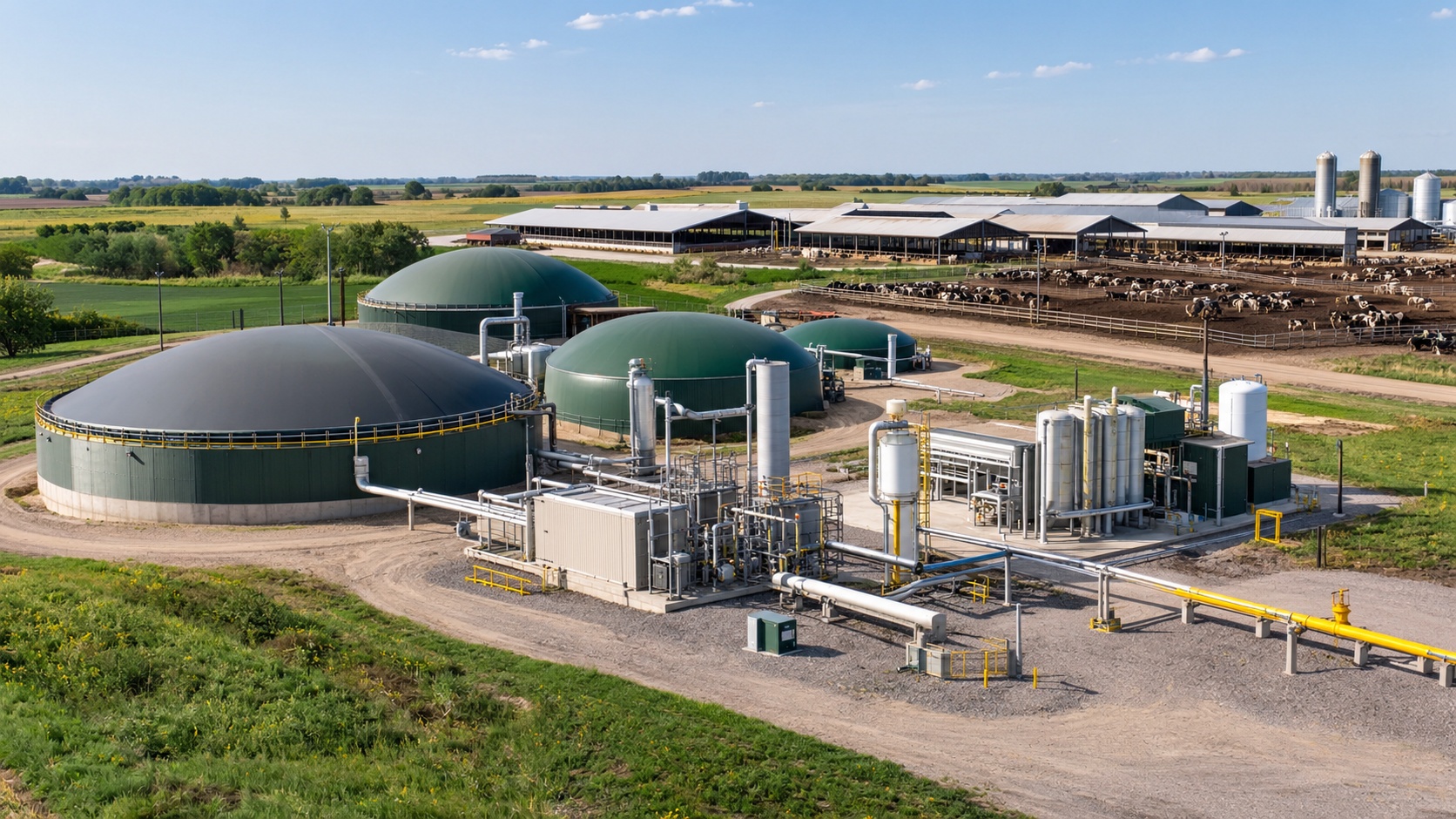
At these facilities, conditioned biogas is transported through a gathering pipeline to a central upgrading facility before being delivered to an interconnection with the Northern Natural Gas system.
UGI previously committed more than $70 million to fund the Moody cluster, which was expected to produce approximately 300 million cubic feet of RNG annually once operational.
Brookings Cluster
The Brookings Cluster consists of three dairies near Estelline.
Conditioned biogas from the individual farms is collected through a gathering system and transported to a central upgrader. The resulting RNG is connected to NorthWestern Energy’s gas network.
UGI announced in 2023 that the Brookings project was expected to produce approximately 300 million cubic feet of RNG annually.
Lakeside Cluster
The Lakeside Cluster includes two dairies near Summit.
Unlike the other clusters, the project uses a virtual pipeline arrangement. Conditioned and upgraded biogas is transported in high-compression tube trailers to a NorthWestern Energy interconnection.
UGI’s 2023 announcement projected approximately 225 million cubic feet of annual RNG production from the Lakeside cluster.
Together, the three clusters comprise eight dairy projects, consistent with CalBio’s current description of its South Dakota portfolio.
Dairy manure converted into vehicle-ready renewable gas
The projects use continuously stirred tank reactor (CSTR) digesters to process dairy manure.
Inside the digesters, microorganisms break down the organic material under anaerobic conditions, producing biogas containing methane and other gases. The biogas is subsequently conditioned and upgraded to produce RNG.
CalBio says the combined projects are currently producing approximately 2 million standard cubic feet of renewable compressed natural gas (R-CNG) per day.
That output is equivalent to approximately 15,000 gasoline gallon equivalents (GGEs) of vehicle fuel per day, or about 5.5 million GGEs annually.
CalBio’s current project information also lists the South Dakota portfolio as eight dairy digester projects developed in partnership with UGI Energy Services.
CalBio takes full operating control of SD OpCo
In addition to increasing its interest through South Dakota Biogas LLC, CalBio has acquired 100% ownership of SD OpCo LLC, which operates the digesters.
The change gives CalBio a more direct operational role across the South Dakota portfolio while UGI Energy Services remains a partner in MBL Bioenergy.
The original MBL Bioenergy partnership was established in 2021 between UGI Energy Services, CalBio and Sevana Bioenergy to develop multiple dairy digester clusters in South Dakota. At the time, the partners projected approximately 650 million cubic feet of annual RNG production from the initial portfolio and more than $100 million of investment.
UGI subsequently announced additional investment in the Brookings and Lakeside clusters, bringing its projected annual production from those two projects to approximately 525 million cubic feet.
CalBio expands its dairy RNG footprint
N. Ross Buckenham, Chairman and CEO of CalBio, said the company was pleased to increase its participation in the South Dakota projects and would continue working with UGI Energy Services and local dairy farmers.
“We look forward to expanding our role in these projects, continuing our partnership with UGI Energy Services, and supporting the local dairy farmers who make this domestic renewable energy production possible.”
The transaction builds on CalBio’s existing dairy-digester business in California. The company has also expanded its development activities into other US regions through affiliates and partnerships. UGI’s original announcement described CalBio as a developer of dairy digesters producing renewable vehicle fuel and electricity, with projects extending beyond California.
CalBio’s current project portfolio lists South Dakota separately, with the eight projects estimated by the company to reduce approximately 248,000 metric tonnes of CO₂e annually.
UGI remains a key partner
The acquisition does not remove UGI Energy Services from the South Dakota platform. UGIES remains an ownership partner in MBL Bioenergy.
UGI has been involved in funding and developing the South Dakota projects since the formation of MBL Bioenergy. Its subsidiary GHI Energy was identified as the exclusive marketer for the original MBL projects.
The partnership provides CalBio with continued access to an established energy-market participant while allowing the company to increase its direct involvement in project operations.
Bioenergy Business Analysis
CalBio’s increased ownership marks a shift in the structure of the South Dakota dairy RNG platform rather than the launch of a new project portfolio. The eight-digester network was originally developed through a three-party partnership involving CalBio, Sevana and UGI; CalBio’s acquisition of Sevana’s interest and full ownership of SD OpCo now gives it greater control over development and operations.
The project configuration also demonstrates several approaches to integrating dairy digesters with existing gas infrastructure. The Moody and Brookings clusters use centralised upgrading and pipeline interconnections, while Lakeside relies on compressed-gas transport through a virtual pipeline. Such configurations can allow dairy farms that are not immediately adjacent to suitable gas infrastructure to participate in an RNG network.
The principal commercial significance will depend on the portfolio’s sustained production, operating performance and access to renewable-fuel markets. CalBio’s continued partnership with UGI also provides an established route for marketing the resulting renewable gas. The expansion demonstrates how dairy RNG developers are increasingly building multi-farm networks rather than treating individual digesters as standalone projects.