


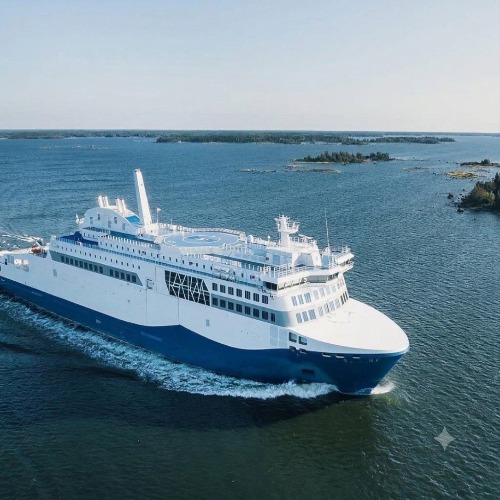
Finnish-Swedish ferry operator Wasaline has signed a two-year supply agreement with St1 Biokraft for 42 gigawatt-hours (GWh) of liquefied biogas annually to fuel its Aurora Botnia vessel on the route between Vaasa, Finland, and Umeå, Sweden. Deliveries are scheduled to begin in January 2028, with the fuel to be bunkered at the Port of Vaasa.
The agreement is intended to secure a longer-term supply of renewable fuel for the Baltic Sea crossing while increasing the use of locally produced biogas. Wasaline plans to source most of the fuel from a new biogas plant in Nurmo, Finland, approximately 80 kilometres from Vaasa, operated by Suomen Lantakaasu, a joint venture between St1 Biokraft and Finnish dairy cooperative Valio.
The deal establishes a supply arrangement linking regional biogas production with maritime fuel demand. It also marks St1 Biokraft’s first major marine biogas agreement, according to the company’s head of business development.
Two-Year Contract Connects Finnish Biogas Production With Maritime Demand
Under the agreement, St1 Biokraft will supply Wasaline with 42 GWh of liquefied biogas per year over two years. The stated annual volume amounts to 84 GWh across the contract period, assuming deliveries proceed at the agreed rate for both years.
The fuel will be transported by tanker truck from St1 Biokraft’s production facilities to the Port of Vaasa, where it will be bunkered onto the Aurora Botnia. Although the Nurmo plant is expected to be the primary source, the agreement does not establish that all contracted fuel will originate from that facility.
The arrangement brings together fuel production, road transport and port-side bunkering to supply a vessel operating on a regular regional route. Deliveries are scheduled to start in January 2028; the announcement does not specify a precise contract end date.
Nurmo Plant Could Supply a Significant Share of the Contracted Fuel
The planned sourcing arrangement is linked to Suomen Lantakaasu’s industrial-scale liquefied biogas plant in Nurmo, which processes manure and other agricultural and food-industry residual streams into renewable fuel and fertiliser products.
Suomen Lantakaasu’s project information lists a planned annual production capacity of 125 GWh for the Nurmo facility. Valio reported the plant’s inauguration in August 2026 and described expected annual production of approximately 100 GWh. These figures reflect different published descriptions of the facility’s output and should not be treated as confirmed actual production.
At 42 GWh annually, Wasaline’s contracted volume would represent roughly one-third of the plant’s stated 125 GWh capacity, if that capacity is achieved and the fuel can be allocated as intended. This is an indicative comparison, not confirmation that the entire supply will come from Nurmo.
The plant’s use of manure and other residual feedstocks also links the maritime fuel contract to agricultural waste management. Digesting organic residues can produce biogas while allowing nutrients to be recovered in digestate and processed fertiliser products.
Hybrid Propulsion Supports Ferry Decarbonisation
Wasaline’s Aurora Botnia already combines liquefied biogas, battery power and shore-side electricity as part of its energy system. The new contract is intended to support the vessel’s existing use of renewable fuel rather than introduce biogas for the first time.
Technical Director Jonas Teir said access to locally produced biogas would strengthen energy supply security and support the regional circular economy by creating better conditions for using manure and other organic residual streams.
St1 Biokraft’s Head of Business Development, Johan Zakrisson, described the agreement as the company’s first major marine biogas contract and said the fuel could contribute to emissions reductions in shipping.
The agreement does not disclose a quantified emissions-saving estimate. Actual reductions will depend on the fuel’s lifecycle emissions, the feedstocks used, methane leakage, processing energy and the fossil fuel it displaces.
The contract also reflects a broader opportunity for liquefied biogas (LBG), also referred to as bio-LNG or liquefied biomethane, to serve vessels that can use liquefied methane fuels. Its commercial potential will depend on reliable production, competitive delivered costs, bunkering logistics and the regulatory treatment of renewable fuels.
Bioenergy Business Analysis
The Wasaline–St1 Biokraft agreement illustrates how renewable gas producers can build demand beyond road transport by supplying maritime operators with a contracted fuel volume. It also connects agricultural residual streams, industrial-scale biogas production and port infrastructure within a regional supply chain.
The annual commitment of 42 GWh gives St1 Biokraft a defined maritime customer for a two-year period beginning in January 2028. For Wasaline, the agreement provides greater visibility over future fuel supply and supports the continued use of biogas aboard Aurora Botnia.
The contract’s importance extends beyond its volume: it is St1 Biokraft’s first major marine biogas agreement, according to the company. Its performance could help inform how renewable gas producers structure supply arrangements with shipping operators.
The key industry takeaway is that contracted demand can help connect biogas production capacity with real fuel consumption in hard-to-abate sectors. Whether this agreement becomes a model for wider maritime adoption will depend on dependable supply, delivered fuel costs, verifiable emissions performance and the economics of scaling similar contracts.
Related coverage: Finland’s biogas plant carbon dioxide capture projects provide more context on Suomen Lantakaasu’s renewable gas development at Nurmo and Kiuruvesi.


