


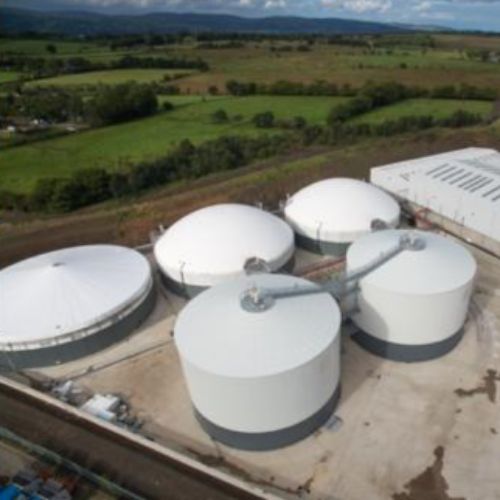
A proposed €80 million biomethane facility in The Downs, County Westmeath, Ireland, could process up to 99,000 tonnes of organic material annually and produce approximately 80 GWh of renewable gas for injection into the national gas network, according to a planning application submitted to Westmeath County Council.
The application was lodged by planning consultants McCutcheon Halley on behalf of Stream BioEnergy Ireland Limited. The project is proposed on a 4.63-hectare site within the planned Flynn Renewable Energy Park at Newdown, The Downs, with a request for 10-year planning permission.
If approved and developed as proposed, the facility would convert source-separated food waste, organic residues from the agri-food sector and agricultural manure into biomethane. The project could contribute to Ireland’s efforts to expand domestic renewable gas production and reduce dependence on imported natural gas.
Stream BioEnergy chief operating officer Morgan Burke said the investment would create 75 jobs during construction and 16 permanent positions once the facility becomes operational.
Proposed facility would process 99,000 tonnes of organic material annually
The planning documents outline an anaerobic digestion facility designed to convert organic feedstocks into biogas, which would then be upgraded to biomethane suitable for injection into Ireland’s gas network.
The application identifies an annual processing capacity of up to 99,000 tonnes and projected biomethane production of approximately 80 GWh.
According to the project proponents, the output could replace fossil natural gas equivalent to the annual energy needs of up to 7,000 Irish homes. They also estimate that the facility could reduce greenhouse gas emissions by up to 33,000 tonnes of carbon dioxide equivalent (CO₂e) annually.
These figures are project estimates; the final output and emissions savings would depend on plant performance, feedstock composition, operational conditions and the methodology used to calculate avoided emissions.
Project builds on earlier anaerobic digestion plans
The proposal is linked to an earlier anaerobic digestion development in The Downs that received planning permission from Westmeath County Council in 2020.
Thomas Flynn of The Downs, through his company Bio Agrigas, had previously outlined plans to source organic waste locally and produce biomethane and digestate as the facility’s principal outputs.
Flynn said the current proposal was larger and included a connection to the gas grid rather than focusing on electricity generation. He also highlighted the potential value of gas network infrastructure for the surrounding area.
According to Flynn, the proposed pipeline could support the supply of renewable gas to households and businesses in The Downs, subject to the final design, approvals and arrangements for connecting consumers.
The relationship between the earlier permitted development and the latest application will be relevant to understanding the project’s planning history and delivery arrangements. The submitted material does not, by itself, establish the precise status of the earlier permission or whether the new application replaces, modifies or operates separately from it.
Ireland’s biomethane target provides policy context
The planning application comes as Ireland advances measures to expand its biomethane industry. The source report states that Minister Darragh O’Brien opened an expression-of-interest process for a €200 million Biomethane Capital Grant Scheme during the same week.
The scheme is intended to support progress towards Ireland’s target of producing 5.7 TWh of biomethane. The proposed Westmeath facility would add to the potential domestic supply of renewable gas if it secures the necessary approvals, obtains financing and reaches commercial operation.
Biomethane is produced by upgrading biogas generated through the anaerobic digestion of organic materials. Removing carbon dioxide and other unwanted components allows the resulting gas to meet the quality requirements for injection into a compatible gas network.
Using existing gas infrastructure can provide a route for renewable gas to reach industrial, commercial and residential users. However, the contribution of any individual project to national targets depends on its final production capacity, commissioning date and actual annual output.
Organic waste and digestate are central to the project’s value
The proposed facility would use source-separated food waste, agri-food residues and agricultural manure, linking waste management with renewable energy production.
Anaerobic digestion breaks down biodegradable material in the absence of oxygen, generating biogas and a nutrient-containing residual material known as digestate. Subject to appropriate treatment and compliance with applicable standards, digestate can be used as an organic fertiliser or soil amendment.
For agricultural communities, this creates a potential dual benefit: converting suitable organic residues into energy while returning nutrients to farmland. The actual environmental benefits depend on feedstock sourcing, transport distances, digestate quality, storage and application practices, and the management of methane emissions throughout the process.
The proposed carbon dioxide liquefaction unit is another notable element of the development. The application lists the equipment as part of the planned infrastructure, although the available source material does not specify the intended destination, end use or commercial arrangements for the recovered carbon dioxide.
Planning decision expected after statutory process
Westmeath County Council received the application in the week preceding the source report. The report anticipates a planning decision towards the end of November, following the statutory process.
That timetable is an expectation reported in the source, rather than confirmation of a final decision date. The application remains a proposal in the material provided, and the facility should not be described as approved, under construction or operational without further verification.
Stream BioEnergy’s proposed investment would combine organic waste processing, biomethane production and gas-grid infrastructure in a single development. Its progression will depend on the planning outcome and subsequent project-delivery requirements.
Bioenergy Business Analysis
The proposed Westmeath facility illustrates how Ireland’s biomethane strategy could connect organic waste management, agricultural resource recovery and domestic energy production. Its significance lies not only in the projected 80 GWh of annual biomethane output, but also in the planned connection to the national gas network.
Ireland’s target is to produce up to 5.7 TWh of domestically sourced biomethane annually by 2030. At its proposed output, the Westmeath facility would represent approximately 1.4% of that target, assuming the plant achieves its full projected annual production.
That comparison provides useful scale, but it is not a forecast of the project’s contribution. Actual production, commissioning timelines and eligibility under government support schemes remain to be established.
The project is still at the application stage in the source material. Planning approval, financing, detailed engineering, grid connection arrangements and a dependable feedstock supply will all matter to its eventual delivery. The proposed 75 construction jobs and 16 permanent positions should likewise be treated as estimates rather than confirmed employment outcomes.
The Westmeath proposal is a relevant development to track as Ireland builds its domestic biomethane project pipeline. Its progress will offer a useful test of whether policy support, agricultural feedstock availability and gas-network infrastructure can be brought together in a commercially viable project. The next material developments to monitor are the planning decision, confirmation of project financing and grant support, and evidence of progress towards construction and commissioning.


