


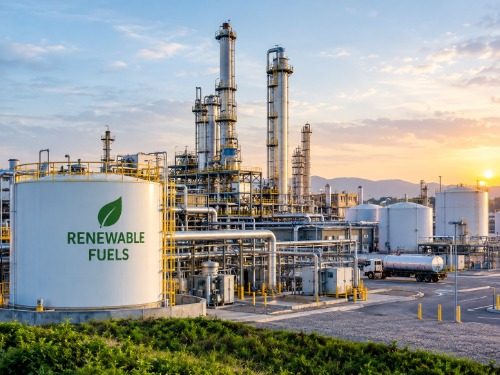
XCF Global Inc. has signed a definitive agreement to acquire a renewable fuels production facility in Paramount, California, that could add approximately 50 million gallons per year of sustainable aviation fuel (SAF), renewable diesel and renewable naphtha capacity to its portfolio. The proposed acquisition would expand the company’s US renewable fuels operations near Los Angeles International Airport (LAX), a major aviation market for potential SAF supply.
The Nasdaq-listed company plans to acquire the facility through its newly formed subsidiary, New Rise Renewables Paramount LLC. Completion is expected before the end of 2026, subject to agreed closing conditions. XCF expects to invest approximately $30 million during a planned nine-to-12-month restart period, with spending primarily directed towards workforce training and operational readiness.
The company has also outlined annual financial targets following the restart, including $600 million in gross product sales, $100 million in net revenue and $40 million in earnings before interest, taxes, depreciation and amortisation (EBITDA). These are management targets, not reported results or guaranteed outcomes.
Paramount Facility Adds Renewable Fuels Capacity Near LAX
Located less than 20 miles south of downtown Los Angeles, the Paramount site has a history of fuel production and conversion from conventional fossil fuels to renewable fuels. According to XCF, the facility was the first refinery conversion in the United States from fossil fuels to renewable fuels and has an established record of renewable fuel production.
The site’s infrastructure includes refining, blending, storage, logistics, rail and truck terminal facilities, as well as interests in more than 65 miles of pipeline assets. These assets could support feedstock handling, fuel processing, storage and distribution as the facility prepares to resume operations.
Its proximity to LAX is a strategic consideration for the planned expansion. The airport serves more than 76 million passengers annually, according to the company announcement, making Southern California a significant location for the aviation industry’s transition towards lower-carbon fuels.
XCF Plans $30 Million Restart Investment and Workforce Expansion
XCF intends to retain the Paramount facility’s experienced personnel following the transaction’s completion and more than double the size of the team as it prepares to restart operations.
The planned investment of approximately $30 million will primarily support workforce training and operational readiness. The company expects the restart to take nine to 12 months, although the announcement does not provide a specific date for commercial production to resume.
Feedstock supply and product marketing are also part of the proposed operating model. XCF plans to use its strategic partnership with BGN to supply feedstock to the Paramount facility and arrange offtake for the renewable fuels produced there.
The announcement refers to domestic agricultural waste-to-energy processing technology as part of the site’s development. However, it does not identify the specific feedstocks intended for the restarted facility, explain the precise conversion pathway or disclose the anticipated feedstock volumes.
These details will be important in assessing the facility’s operating economics, particularly its ability to secure consistent feedstock supplies and produce fuels that meet the applicable specifications for aviation and road transport.
Acquisition Could Strengthen XCF’s Integrated Fuel Platform
XCF Chief Executive Officer Chris Cooper described the acquisition as an opportunity to expand the company’s alternative fuels platform by adding refinery infrastructure and an established operational team.
The proposed transaction combines existing industrial assets with plans for renewed production, feedstock supply and fuel offtake. If completed and successfully restarted, the facility could give XCF additional capacity across multiple renewable fuel markets rather than relying exclusively on a single product.
The company said the acquisition is expected to be accretive to shareholder value. That assessment remains forward-looking: the announcement does not disclose the purchase price, transaction financing arrangements, detailed operating-cost assumptions or a projected return on the restart investment.
XCF has been advised on the transaction by BTIG, Paul Hastings LLP, Marsh, Alvarez & Marsal and AECOM.
Bioenergy Business Analysis
The proposed Paramount acquisition highlights the importance of existing refinery infrastructure in scaling renewable fuel production. For XCF Global, the opportunity is not simply to add nameplate capacity; it is to bring an established industrial site back into operation and connect its production with feedstock supply and downstream fuel markets.
The acquisition’s financial targets also warrant careful interpretation. XCF’s $600 million gross product sales target is a management-defined measure that incorporates end-customer fuel prices and government incentives, alongside the company’s stated calculation methodology. It should not be confused with net revenue, profit or cash flow. The $100 million net revenue and $40 million EBITDA targets are likewise forward-looking estimates rather than demonstrated operating performance.
For the wider renewable fuels sector, the transaction illustrates a potential route to expanding production through the redevelopment of existing industrial assets. Its eventual contribution will depend on closing the acquisition, completing the restart, achieving reliable output and securing commercially viable fuel sales.
The key milestones to monitor are the transaction’s completion, disclosure of the production and feedstock plans, progress towards commissioning, and evidence of sustained commercial production. Until these are established, the approximately 50-million-gallon annual capacity should be treated as proposed capacity associated with the acquisition, not as current operating output.


