


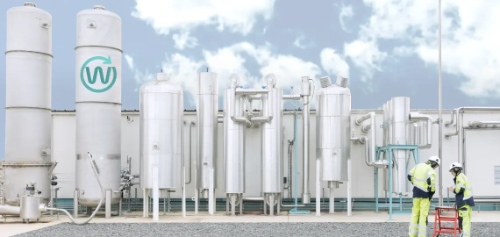
Waga Energy and Casella Waste Systems have brought a new landfill-gas-to-biomethane facility into commercial operation in Mount Jewett, Pennsylvania, marking the completion of a three-project development programme launched by the companies in 2023.
The McKean biomethane facility captures biogas generated at the landfill and upgrades it into renewable natural gas (RNG) for injection into the National Fuel Gas distribution network. The project adds a new source of renewable gas to Pennsylvania while demonstrating how existing landfill infrastructure can be used to produce pipeline-quality fuel.
McKean biomethane facility targets 120 GWh of annual output
The facility uses Waga Energy’s WAGABOX technology, which is designed to separate and purify landfill gas before converting it into renewable natural gas that meets distribution-network specifications.
The McKean installation can process up to 2,000 standard cubic feet of biogas per minute. Waga Energy expects the facility to produce as much as 407,000 MMBtu of biomethane annually, equivalent to approximately 120 GWh of energy.
Production is expected to ramp up progressively as additional biogas becomes available from the landfill.
Once produced, the renewable gas is injected directly into the National Fuel Gas network, allowing it to enter an existing gas distribution system rather than requiring the development of dedicated delivery infrastructure.
Landfill methane becomes a renewable gas resource
Landfills continue to generate methane-rich biogas as organic material decomposes. Capturing this gas and upgrading it into biomethane provides an alternative to simply flaring or otherwise managing the landfill gas.
The McKean project is expected to avoid approximately 31,000 tonnes of carbon dioxide equivalent emissions each year, based on the US Environmental Protection Agency’s methodology, according to Waga Energy.
The emissions benefit is linked to the recovery and use of landfill-derived methane as renewable natural gas. The figure is a project estimate and should therefore be understood in the context of the methodology used to calculate avoided emissions.
The project also illustrates the potential for landfill operators and renewable-gas developers to generate additional value from waste-management assets by recovering energy from gases produced naturally during decomposition.
Third facility under Casella-Waga Energy programme
McKean is the third biomethane facility developed by Casella and Waga Energy under their joint programme.
The companies previously commissioned the Chemung County and Hyland facilities, with those projects entering operation in 2026. The McKean start-up therefore completes the three-facility development programme announced in 2023.
The projects provide Casella with a route to further utilise landfill gas while giving Waga Energy a platform for deploying its biomethane upgrading technology in the US market.
Partnership combines project financing and operations
The companies have adopted a partnership model in which Waga Energy finances, constructs and operates the facilities, while Waga Energy and Casella share revenue generated from biomethane sales.
This structure allows the landfill operator to participate in renewable-gas revenues without taking sole responsibility for financing and operating the upgrading infrastructure.
For Waga Energy, meanwhile, the arrangement provides a model for expanding its landfill biomethane business while maintaining an operating role after project construction.
According to Waga Energy, the company currently operates 32 biomethane production units across France, Spain, Canada and the United States, representing combined installed production capacity of more than 1.5 TWh per year. It also said a further 18 units are under construction globally.
US landfill gas market gains another biomethane project
The McKean project comes as developers increasingly look at landfill gas as a feedstock for renewable natural gas production. Unlike conventional natural gas projects, landfill biomethane facilities rely on methane generated from existing waste streams and can connect production to established gas infrastructure where suitable networks are available.
For Casella, the project forms part of a broader effort to increase the value recovered from materials managed through its waste operations.
Casella CEO Ned Coletta described the McKean commissioning as an “important new step” in the company’s efforts to further valorise the materials it manages.
Waga Energy Inc. Managing Director Guénaël Prince said the start-up demonstrated the execution capabilities of the two companies’ teams and argued that their partnership model could create long-term value by converting waste-derived gas into renewable energy.
With McKean now commercially operational, the immediate focus shifts from project development to sustained production and the gradual increase in biomethane output as landfill gas availability grows
Bioenergy Business Analysis
The McKean project highlights the commercial potential of landfill gas as a feedstock for biomethane production, turning an existing waste-management by-product into pipeline-quality renewable gas.
With up to 120 GWh of annual output and an estimated 31,000 tonnes of CO₂e in avoided emissions, the facility adds meaningful renewable-gas capacity while using existing gas infrastructure for distribution.
More importantly, the three-project Waga Energy–Casella model combines project financing, technology, construction and long-term operations, offering a scalable approach to monetising landfill gas while creating an additional revenue stream from waste assets.
Read also: Indonesia’s B60 biodiesel push unlikely to cause major supply shock for India