


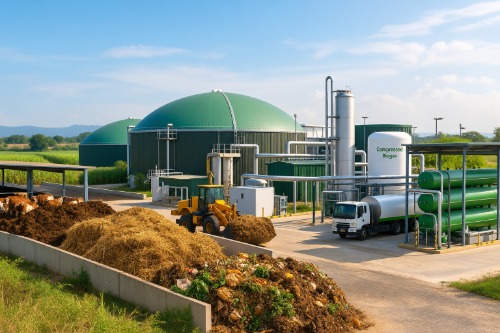
India could produce around 62 million metric tonnes (MMT) of compressed biogas (CBG) annually from animal waste, crop residues, municipal waste, sewage-related biomass and sugar-industry by-products, according to an Equirus report.
The assessment identifies an estimated 472 MMT of annual feedstock across the country, highlighting the scale of India’s organic waste resource and its potential role in domestic gas production. The report also points to a key constraint: converting theoretical feedstock availability into commercially viable CBG production depends heavily on collection, aggregation and logistics.
Animal waste accounts for the largest CBG opportunity
Animal waste represents the largest feedstock category in the assessment. Around 190 MMT of animal waste could potentially produce nearly 25 MMT of CBG, equivalent to about 41% of the estimated national CBG potential.
However, the report said only around 15% of total dung generated in India is collectable. This makes the geographical concentration of livestock and the availability of sufficiently dense rural feedstock clusters important considerations when developing CBG plants.
For project developers, the distinction between total waste generation and practically collectable feedstock is significant. A large theoretical resource does not automatically translate into a reliable plant supply.
Crop residues offer another major feedstock base
Agricultural residues constitute the second-largest source in the report’s assessment. Around 150 MMT of paddy and wheat straw, cane trash and other crop residues could potentially generate nearly 20 MMT of CBG each year.
The main challenge is the timing and logistics of collection. Crop residues need to be aggregated relatively soon after harvesting, with the report identifying a collection window of about 45 days.
This places greater importance on local aggregation systems, transportation and storage infrastructure. The economics of projects using agricultural residues can therefore depend as much on supply-chain execution as on the availability of the underlying biomass.
Municipal and sewage waste expand the opportunity
Municipal solid waste is another potential source of CBG. The report estimates that approximately 62 MMT of municipal solid waste could generate nearly 5 MMT of CBG.
The usable fraction is constrained by the composition of urban waste. According to the assessment, only around 50–55% of urban wet and food waste is biodegradable, limiting the amount suitable for biogas production.
Sewage treatment plant biomass could provide a further 50 MMT of feedstock, with potential CBG production of nearly 10 MMT, according to Equirus.
The report also identifies press mud from sugar mills as a potential feedstock. Around 20 MMT of press mud could produce approximately 2 MMT of CBG.
Press mud has an operational advantage in the report’s assessment because it can be sourced at a single location and does not require pre-treatment. This could simplify feedstock handling compared with more dispersed agricultural and animal-waste resources.
Feedstock availability remains central to CBG economics
The figures point to a substantial theoretical resource base, but they also underline the practical barriers to developing India’s CBG potential at scale.
Animal waste is widely distributed and only a fraction is considered collectable, while crop residues must be gathered within a limited post-harvest period. Municipal waste, meanwhile, requires sufficient segregation and access to the biodegradable fraction.
These factors mean that plant location, feedstock aggregation and transportation can be critical components of project economics. Developers must assess not simply how much waste exists in a region, but how much can be consistently delivered to a facility.
Implications for India’s domestic gas supply
The scale of the resource could also have implications for domestic gas availability. The report cites estimates from the Petroleum and Natural Gas Regulatory Board indicating that the country’s 472 MMT feedstock base could support around 230 million metric standard cubic metres per day (MMSCMD) of biogas.
The assessment places CBG within a broader opportunity to convert organic waste streams into a usable gaseous fuel while addressing waste-management challenges.
For the sector, however, the central issue is moving from resource potential to dependable feedstock supply. The availability of suitable waste, collection rates, aggregation infrastructure and plant-level logistics will determine how much of the estimated resource can ultimately support commercial CBG production.
Bioenergy Business Analysis
Equirus’ assessment highlights that India’s CBG opportunity is fundamentally a feedstock logistics challenge as well as a resource-availability opportunity. The headline potential of 62 MMT is substantial, but the figures for collectable dung and the short collection period for crop residues demonstrate why project developers need to distinguish between theoretical and commercially accessible feedstock.
The diversity of feedstocks also creates different project models. Press mud offers concentrated sourcing at sugar mills, while agricultural residues and animal waste require more extensive aggregation. This suggests that the success of India’s CBG build-out will depend on matching plant design and location with the characteristics of locally available feedstock.
The report’s figures therefore reinforce the importance of collection networks, waste segregation and reliable supply chains alongside CBG plant capacity. For investors, operators and policymakers, converting India’s large organic waste base into dependable gas production will require attention to the entire feedstock-to-fuel chain.
The Equirus assessment puts India’s estimated annual CBG potential at around 62 MMT, based on the country’s reported 472 MMT feedstock base.
Read also: Bengal Panchayat Department, CMERI partner on mass biogas projects