


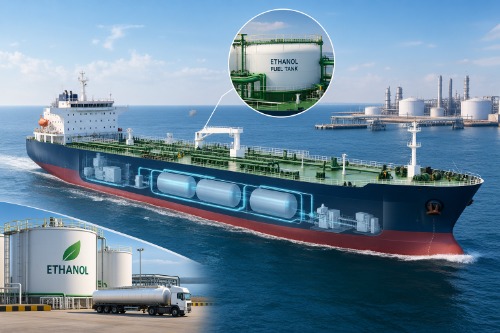
Lloyd’s Register (LR) and South Korean shipbuilder K Shipbuilding are working on an ethanol-capable tanker designed for the global product tanker market, with the partners targeting a 50,000 dwt medium-range (MR) vessel.
The joint development project will assess the vessel’s technical feasibility, safety requirements and regulatory compliance as the partners work towards securing Approval in Principle (AiP) from LR.
The project brings together LR’s classification and technical expertise with K Shipbuilding’s ship design and development capabilities. The companies said the objective is to develop a commercially competitive MR tanker design capable of operating on ethanol.
Technical development will focus on ethanol fuel integration
Under the agreement, LR will carry out technical reviews covering several core aspects of the proposed vessel. These include the tanker’s general arrangement, stability, structural requirements and the integration of ethanol fuel tanks.
K Shipbuilding will take responsibility for the vessel’s overall design and development.
The division of responsibilities places the technical assessment and classification requirements with LR while K Shipbuilding leads the engineering work needed to develop the vessel design.
The proposed tanker would have a deadweight capacity of 50,000 tonnes and fall within the medium-range segment of the product tanker market.
For the project, ethanol is being assessed not only as a cargo associated with product tanker operations but also as a potential marine fuel. This creates specific requirements for integrating ethanol fuel storage into the vessel while addressing safety and regulatory considerations.
Project targets Approval in Principle
A key milestone for the collaboration is securing Approval in Principle from LR.
The AiP process will involve reviewing the proposed vessel concept against relevant technical and regulatory requirements. According to the source, the partners intend to use the development process to establish the feasibility of the ethanol-capable tanker concept before advancing the design further.
The technical review will cover the vessel’s overall arrangement, stability and structural requirements, alongside the integration of dedicated ethanol fuel tanks.
No construction schedule, vessel delivery date or confirmed commercial order was specified in the source.
Ethanol’s dual role in tanker operations
The project is centred on the use of ethanol as a marine fuel while recognising its established role in product tanker trades.
Theo Kourmpelis, LR’s global business director for tankers, said ethanol is already a familiar cargo within product tanker operations, making the MR segment a practical area in which to assess its use as a fuel.
The distinction is important for the project because the proposed vessel is being developed around ethanol-fuel capability rather than simply ethanol transportation.
The collaboration therefore links an existing product tanker cargo stream with the technical requirements associated with using ethanol for vessel propulsion.
Bioenergy Business Analysis
The LR-K Shipbuilding project highlights the growing intersection between renewable fuels and maritime vessel design. Rather than treating ethanol solely as a commodity transported by tankers, the partners are examining how it could be incorporated directly into the fuel system of an MR vessel.
For shipbuilders and classification societies, the development also underscores the importance of resolving fuel-storage, structural, stability, safety and regulatory requirements at the design stage. Securing AiP would provide a formal technical milestone for the concept, although the supplied source does not indicate whether the vessel will subsequently enter construction or commercial operation.
The project’s commercial relevance will ultimately depend on whether an ethanol-capable tanker design can meet technical and regulatory requirements while remaining commercially competitive in the product tanker segment.
Read also: BSR and SDIC Biotech explore cooperation on ethanol and biofuels