


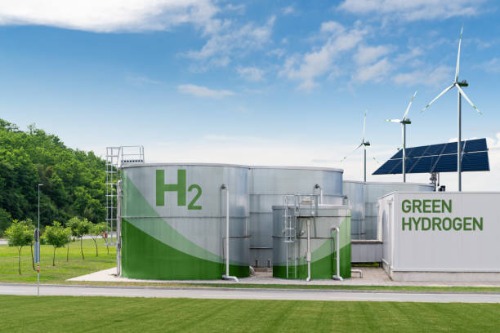
Bihar’s proposed Green Hydrogen Policy-2026 could attract investments of around ₹16,000 crore and generate nearly 12,000 employment opportunities, according to officials following a review of the draft policy in Patna. The state government is seeking to build a framework for green hydrogen production, consumption, investment and supporting infrastructure.
As per Times of India report, the policy was reviewed at a high-level meeting chaired by Bihar Chief Minister Samrat Choudhary on September 21. Officials from Bihar State Power Holding Company Ltd presented proposals covering targets, incentives, implementation measures and infrastructure requirements for developing a green hydrogen economy in the state.
Bihar reviews roadmap for green hydrogen development
The proposed policy is intended to accelerate Bihar’s entry into the green hydrogen sector by encouraging both production and industrial use.
During the review, Choudhary directed state power-sector officials to examine opportunities for establishing hydrogen plants in additional locations. The officials were asked to coordinate with Barauni Refinery and Hindustan Urvarak & Rasayan Ltd (HURL) as part of that assessment.
The chief minister also called for a further action plan to be prepared in consultation with industries and institutions, taking account of Bihar’s potential for producing and using green hydrogen.
Draft policy links Bihar with national hydrogen targets
Bihar’s proposed framework is being developed in alignment with the National Green Hydrogen Mission, whose national target is to establish at least 5 million tonnes per year of green hydrogen production capacity by 2030.
Earlier reporting on the draft Bihar policy indicated a target of 100,000 tonnes per year of green hydrogen or green ammonia production by 2031, supported by approximately 1 GW of electrolyser capacity and 2.5 GW of renewable energy capacity. The same draft-policy reporting linked these targets with the ₹16,000 crore investment potential and 12,000 jobs cited by officials.
These figures are targets and projections associated with the proposed policy rather than evidence of operating capacity or investment already deployed.
Industrial hydrogen demand could provide an initial market
The policy discussions are also focused on developing hydrogen consumption alongside production.
The state government has identified existing industrial activity as a potential starting point for hydrogen deployment. Coordination with Barauni Refinery and HURL is intended to examine the feasibility of hydrogen plants in other parts of Bihar, although the supplied report does not specify the proposed plant capacities, technology configuration or potential hydrogen offtake arrangements.
The broader draft policy has also been reported as seeking to encourage hydrogen use in sectors such as fertiliser and refining before potentially expanding applications to other industrial and transport segments.
Infrastructure and investment framework remain important
Developing a hydrogen economy will require more than electrolyser capacity. Renewable electricity supply, water availability, grid infrastructure, hydrogen handling and storage, industrial offtake and project approvals will all influence the development of individual projects.
The proposed Bihar policy is therefore intended to address both production and the infrastructure needed to support hydrogen use. Officials have been asked to accelerate planning and coordinate with relevant industries and institutions as the state develops its implementation roadmap.
The draft-policy reporting has also highlighted measures such as single-window clearances, support for land and water availability, research and development, and incentives for emerging hydrogen businesses. These provisions should be treated as proposals until the final policy is formally notified.
Bihar’s green hydrogen opportunity depends on policy execution
For Bihar, the proposed policy represents an attempt to create an investment framework around a sector that requires coordinated development of renewable power, electrolysers, hydrogen production and industrial demand.
The headline investment and employment projections provide an indication of the scale the state hopes to achieve, but converting those projections into operating projects will depend on final policy provisions, project economics, infrastructure availability and actual investor participation.
Bioenergy Business Analysis
Bihar’s proposed green hydrogen policy illustrates the increasing role of state-level frameworks in supporting India’s national hydrogen ambitions. The proposed ₹16,000 crore investment potential is significant as a policy objective, but it should not yet be interpreted as a committed project pipeline.
The emphasis on linking hydrogen production with existing industrial facilities is particularly relevant because reliable offtake is an important consideration for early hydrogen projects. The next stage for Bihar will be turning the draft framework into a notified policy and translating its proposed incentives and targets into bankable projects, infrastructure and commercial hydrogen demand.
The state’s proposed production, electrolyser and renewable-energy targets also indicate that green hydrogen development would need to be supported by substantial clean-power capacity. The effectiveness of the policy will therefore depend on coordination across energy, industrial and infrastructure planning rather than hydrogen production alone.
The immediate next step is the preparation of a further action plan and continued development of the proposed Bihar Green Hydrogen Policy-2026.