


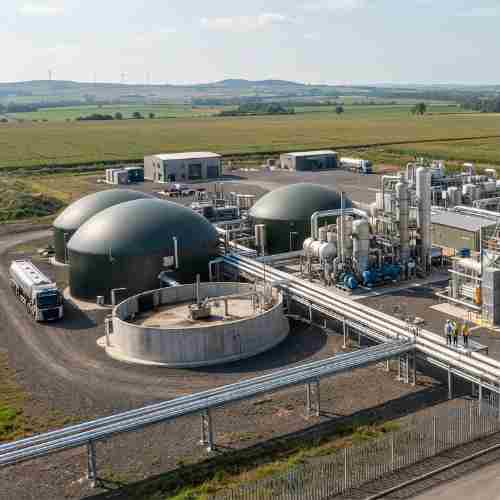
Nord Gas Solutions has secured a contract to develop a 35-ton-per-day bioLNG plant in Poland, a project expected to become the country’s first production facility for liquefied biomethane.
The project will convert manure-based biogas into bioLNG using Nord Gas Solutions’ Puregas CA75 LBG and Puregas MR35 technologies. Construction and project execution are set to begin immediately, according to the company.
Brownfield project to convert existing biogas into bioLNG
The facility is being developed as a brownfield conversion project, allowing existing biogas production infrastructure to be used as the basis for renewable fuel production.
The approach provides a route for existing biogas assets to move beyond conventional applications by adding liquefaction capability. Instead of injecting biomethane into a gas grid, the upgraded facility will produce a transportable renewable fuel in liquefied form.
The plant will process biogas generated from manure and convert it into bioLNG with a low carbon intensity. A significant portion of the resulting fuel is expected to serve the transport market.
Nord Gas Solutions said the project demonstrates how existing biogas infrastructure can be upgraded to create additional value from agricultural resources while supporting renewable fuel production.
BioLNG targets Poland’s transport fuel market
The project comes as Poland’s biomethane sector remains at an early stage of development, despite the country’s substantial agricultural resources and potential for biomethane production.
Agricultural feedstocks, including manure, provide an opportunity to expand renewable gas production while creating additional value from residues. The liquefaction of biomethane can also enable renewable gas to reach transport applications without depending on gas-grid injection infrastructure.
This can be particularly relevant in locations where access to suitable gas-grid infrastructure is limited.
The planned 35-ton-per-day facility is therefore positioned at the intersection of biogas production, renewable gas processing and low-carbon transport fuels. Its expected use of manure-based biogas also links bioLNG production with agricultural waste management.
Poland’s biomethane infrastructure begins to expand
Poland has significant agricultural activity that could support future biomethane development. However, the domestic market is still developing, creating a need for infrastructure capable of converting biogas into commercially usable renewable fuels.
The Nord Gas Solutions project adds liquefaction capacity to that emerging infrastructure. By producing bioLNG rather than relying solely on grid-based biomethane distribution, the project provides an alternative route for bringing renewable gas into the transport fuel market.
Demand for lower-carbon fuels is also increasing across Europe, creating potential markets for renewable gas-based transport fuels.
The project’s expected supply to the transport sector could therefore provide a direct end use for the bioLNG produced from agricultural feedstocks.
Nord Gas Solutions to deploy Puregas technologies
Nord Gas Solutions will use its Puregas CA75 LBG and Puregas MR35 technologies for the liquefaction plant.
The company said the contract represents a milestone for both the Polish bioLNG market and its own involvement in the country’s developing biomethane sector.
“This project highlights the role bioLNG can play in supporting the energy transition while creating value from agricultural resources,” said Magnus Folkelid, Sales Manager, Biogas at Nord Gas Solutions.
“We are pleased to contribute to the establishment of bioLNG production capacity in Poland and to support the continued development of the country’s biomethane sector,” he added.
Project execution is commencing immediately.
Bioenergy Business Analysis
The project illustrates one route for expanding renewable gas markets by adding liquefaction to existing biogas infrastructure. A brownfield model can potentially reduce the need to develop an entirely new biogas production base, while enabling agricultural feedstocks such as manure to serve the transport fuel market.
For Poland, the project is significant because it is expected to establish the country’s first bioLNG production plant. Its development also highlights the role that liquefied biomethane can play where renewable gas producers face limitations in accessing gas-grid infrastructure. The project’s eventual impact will depend on successful execution, operation and uptake of the resulting fuel in the transport market.