


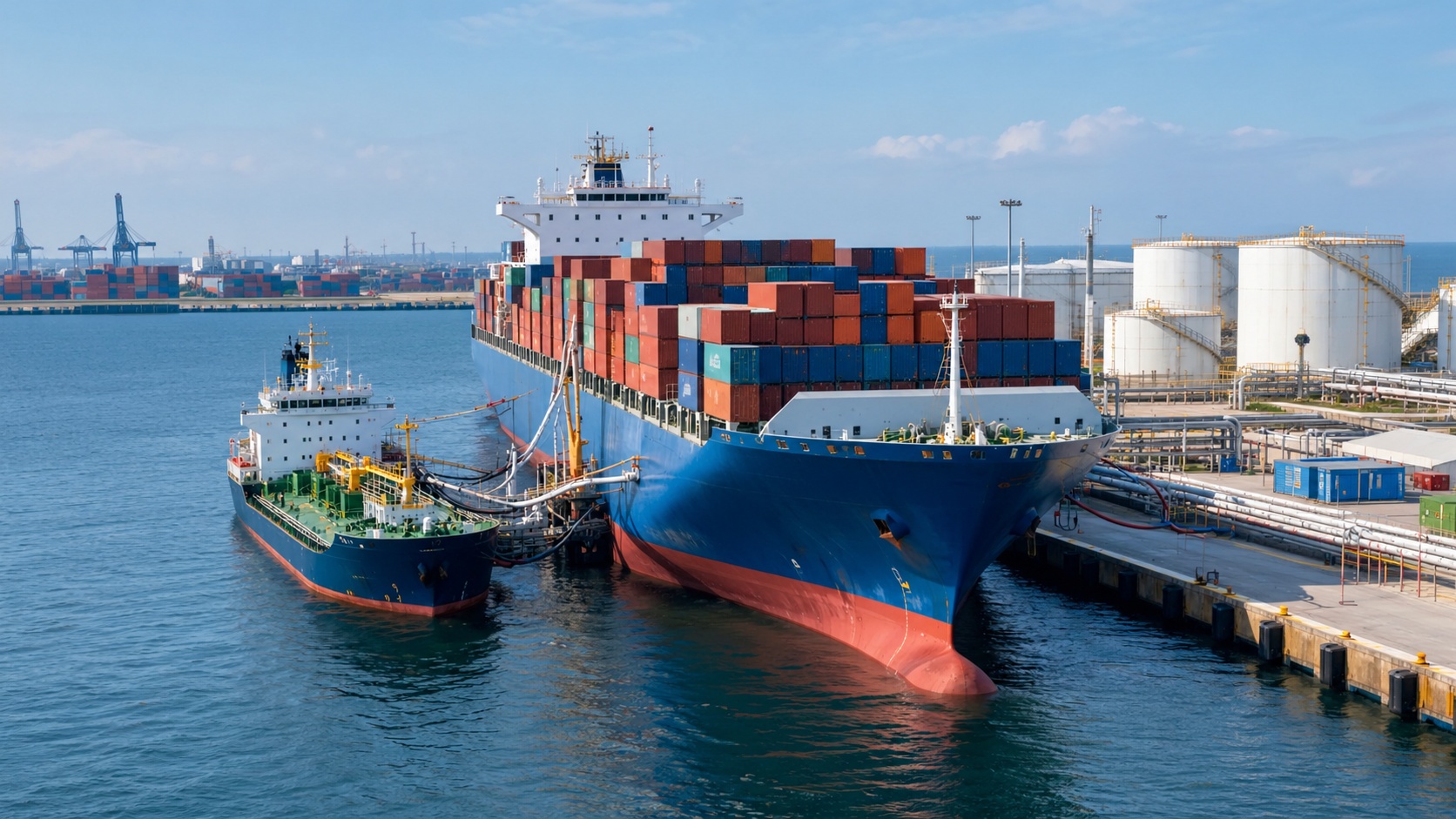
Maersk has completed what it says is the first ship-to-ship commercial ethanol bunkering of a deep-sea container vessel in the United States, supplying the dual-fuel alcohol-enabled Tangier Maersk with 100% US-produced corn ethanol.
The operation adds ethanol to Maersk’s portfolio of alternative marine-fuel pathways under evaluation as the shipping industry works to reduce greenhouse gas emissions and develop commercially scalable alternatives to conventional marine fuels.
The bunkering provided operational experience across fuel sourcing, infrastructure, vessel operations and supply-chain requirements associated with using ethanol in commercial deep-sea shipping.
Tangier Maersk bunkered with US-produced corn ethanol
The Tangier Maersk is an alcohol-enabled container vessel capable of operating on alternative alcohol-based fuels alongside conventional marine fuel.
For the latest operation, the vessel received 100% US-produced corn ethanol through a ship-to-ship commercial bunkering operation in the United States.
The milestone follows earlier ethanol-fuel trials involving Maersk’s Laura Maersk and Antonia Maersk, extending the company’s experience with alcohol-based marine fuels into another commercial vessel operation.
Maersk said the latest bunkering was intended to generate practical experience with the operational and infrastructure requirements associated with ethanol as a marine fuel.
Ethanol offers an established fuel and infrastructure base
Unlike some emerging marine fuels that require entirely new production and distribution systems, ethanol benefits from an established global production industry and existing handling infrastructure.
For shipping, however, the availability of suitable fuel at scale remains an important consideration.
Maersk said the ability to develop scalable future-fuel pathways will depend on factors including fuel availability, regulation and operational readiness across the maritime value chain.
The latest US operation therefore provides experience not only at the vessel level but also across the wider bunkering and fuel-supply chain.
Maersk continues to evaluate multiple fuel pathways
Ditlev Blicher, Regional President for North America at Maersk, said the bunkering operation provides real-world experience with alternative fuels in commercial shipping and could contribute to the development of more sustainable supply chains.
The company has been evaluating several potential pathways for reducing emissions from ocean freight rather than relying on a single alternative fuel.
Maersk has already begun introducing dual-fuel vessels capable of operating on methanol, while its broader fuel strategy includes continued investigation of different technologies, feedstocks and fuel-production routes.
The ethanol operation adds another data point to this broader technology and fuel assessment.
Ethanol’s role in maritime decarbonisation
Ethanol is an alcohol fuel that can be produced from agricultural feedstocks, including corn, sugarcane and other biomass resources.
Its potential role in shipping depends partly on how the fuel is produced. The lifecycle emissions profile of ethanol can vary substantially according to feedstock, agricultural practices, processing technology, energy inputs and associated land-use impacts.
For this reason, the use of ethanol in an alcohol-enabled vessel does not by itself establish a specific level of lifecycle greenhouse-gas reduction.
The latest Maersk operation is instead significant as a commercial demonstration of the fuel-handling and vessel-compatibility aspects of ethanol bunkering in deep-sea shipping.
US ethanol sector gains another potential maritime application
The operation also highlights a possible additional market for the US ethanol industry beyond road transportation and conventional fuel blending.
The United States is one of the world’s largest ethanol producers, with corn serving as the dominant feedstock. Applying ethanol in marine transport could potentially broaden demand for the fuel if technical, regulatory, sustainability and supply-chain requirements can be met at commercial scale.
However, expansion into shipping would require reliable bunkering infrastructure and fuel supply at relevant ports, alongside appropriate sustainability standards and commercial economics.
Bioenergy Business Analysis
Maersk’s US ethanol bunkering demonstrates that ethanol can be incorporated into the fuel system of an alcohol-enabled deep-sea container vessel using a commercial ship-to-ship bunkering operation. The significance lies primarily in the operational experience generated across vessel, bunkering and supply-chain interfaces.
For the biofuels sector, the development is also relevant because it illustrates how established renewable fuels could potentially find applications beyond road transport. Whether ethanol develops into a significant marine-fuel pathway will depend on availability, lifecycle emissions performance, regulation, bunkering infrastructure and the economics of competing low-emission marine fuels.