


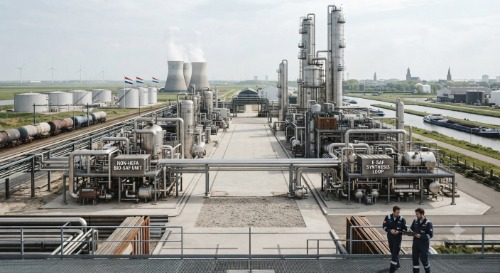
The European Commission has approved two Dutch state-aid schemes with a combined budget of €290 million to support the development and production of sustainable aviation fuel (SAF), with funding targeted at advanced bio-SAF and synthetic aviation fuel (e-SAF).
Approved under EU State aid rules on 31 July 2026, the schemes are designed to support SAF projects at different stages of development and are expected to underpin projects with combined production potential of around 285,000 tonnes of SAF a year. This is equivalent to approximately 350 million litres of kerosene, or fuel for around 3,500 intercontinental flights, according to the European Commission.
The funding forms part of the Netherlands’ effort to accelerate SAF production in line with the EU’s Clean Industrial Deal and the ReFuelEU Aviation framework.
Two Dutch schemes target SAF production and project development
The €290 million budget will be shared between two support schemes.
One scheme will provide investment aid for SAF production projects, while the second will finance preparatory activities for SAF projects, including front-end engineering design (FEED) studies.
The distinction is significant for emerging SAF technologies, as project developers often require substantial expenditure before construction and commercial production can begin.
The approved schemes will provide support through direct grants linked to the completion of project milestones. Funding is scheduled to run from 2027 until 2031 at the latest, with up to five funding rounds planned depending on the availability of funds.
Aid will be awarded on a first-come-first-served basis, subject to objective, transparent and non-discriminatory procedures.
Non-HEFA advanced bio-SAF and e-SAF in focus
The Dutch schemes specifically target two SAF technology pathways: advanced bio-SAF produced without hydroprocessed esters and fatty acids (HEFA) and synthetic aviation fuels, or e-SAF.
The focus excludes conventional HEFA-based SAF from the targeted advanced bio-SAF pathway.
For projects receiving production-related support, beneficiaries will need to demonstrate compliance with the EU’s sustainability requirements for advanced biofuels or the criteria governing renewable fuels of non-biological origin (RFNBOs), depending on the production pathway.
The Netherlands has argued that supporting these pathways at their current development stage can help advance their commercialisation while maintaining diversity among future SAF technologies.
EU links funding to Clean Industrial Deal and ReFuelEU Aviation
The Commission assessed the Dutch schemes under Article 107(3)(c) of the Treaty on the Functioning of the European Union, together with the 2022 Climate, Environment and Energy Aid Guidelines (CEEAG) and the 2025 Clean Industrial Deal State Aid Framework (CISAF).
The Commission concluded that the schemes were necessary and appropriate to facilitate SAF production and that they would have an incentive effect because the supported investments and preparatory studies would not otherwise be undertaken at the same level.
It also found that safeguards had been included to limit potential effects on competition and trade within the EU.
The approval comes as European policy increasingly combines regulatory demand for SAF with financial mechanisms intended to address the high cost and capital requirements associated with new production capacity.
285,000 tonnes of potential annual SAF production
The scale of the projects expected to benefit from the Dutch schemes is notable.
At approximately 285 kilotonnes per year, the estimated production capacity would represent around 350 million litres of kerosene equivalent annually.
The European Commission equates this volume to approximately 3,500 intercontinental flights, providing an indication of the potential aviation-fuel impact of the supported projects.
However, the figure represents the estimated production capacity of projects that could be supported by the schemes rather than confirmed operational SAF output. The actual volume will depend on which projects secure funding and subsequently reach construction and production milestones.
Dutch support addresses early-stage SAF development
The inclusion of preparatory costs alongside production investment reflects two different financing challenges facing SAF developers.
FEED and related development work can require significant capital before a project reaches a final investment decision. Investment support at the production stage, meanwhile, can help address the high upfront costs associated with building commercial-scale SAF facilities.
The Dutch approach therefore creates a funding mechanism covering both project preparation and production investment, although the €290 million remains a shared budget across the two schemes.
The Commission’s approval also establishes the regulatory basis for the Netherlands to implement the measures without breaching EU State aid rules.
SAF support expands beyond production incentives
The Dutch schemes form part of a wider European effort to accelerate the SAF market.
The EU’s ReFuelEU Aviation framework is intended to increase the availability and use of SAF, while the Commission has also established other mechanisms to support SAF uptake. In September 2026, the Commission said around 5.2 million EU Emissions Trading System allowances, worth approximately €430 million, had been allocated to 130 operators for SAF use in 2025.
Together, these measures address different parts of the SAF market: production capacity, project development and fuel uptake.
For advanced bio-SAF and e-SAF developers, the Dutch schemes could therefore provide an additional route to financing projects that are still moving towards commercial deployment.
Bioenergy Business Analysis
The Netherlands’ €290 million package is notable because it targets non-HEFA advanced bio-SAF and e-SAF, rather than concentrating support on the more established HEFA pathway. This places public funding behind technology routes that require further commercial development while aligning project support with EU sustainability and RFNBO requirements.
The more immediate significance for the SAF industry will be how quickly projects move from engineering and development into investment and construction. The combination of FEED support and milestone-based production grants addresses two separate financing stages, but the €290 million package does not itself guarantee that the projected 285,000 tonnes of annual SAF production will materialise. Actual deployment will depend on project selection, financing, construction and compliance with the relevant EU sustainability criteria.