


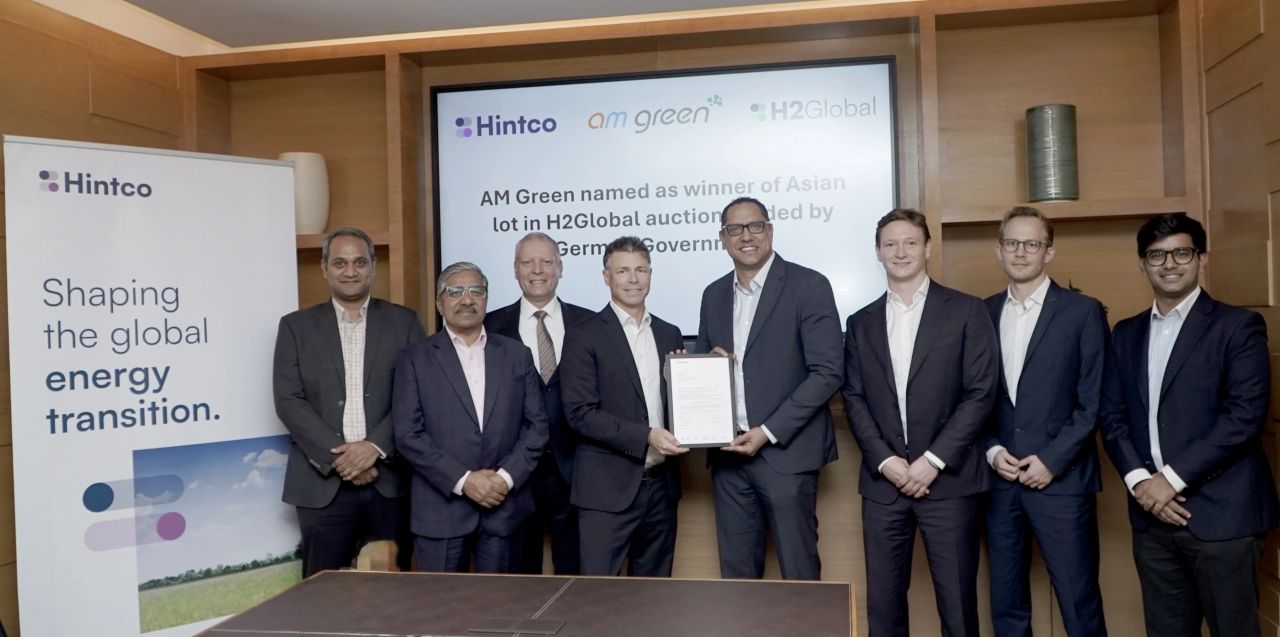
AM Green (India) has been selected as the sole winner of the Asian lot in the H2Global auction, securing a 10-year purchase agreement for the supply of RFNBO-compliant renewable ammonia to Germany.
The agreement, awarded through a competitive bidding process run by HINT.CO GmbH (Hintco), carries a minimum purchase value of €585 million over 10 years. Hintco may also purchase additional quoted volumes from AM Green using proceeds generated through the resale of green ammonia in the European market.
The renewable ammonia will be produced at AM Green’s Kakinada project Phase 2 in Andhra Pradesh, where the company is converting an existing natural gas-based ammonia and urea complex into a renewable-ammonia production facility.
First deliveries to Germany are expected in 2029.
AM Green wins Asian lot in H2Global auction
AM Green said its offer was ranked first among the submissions received during the competitive bidding process, making the company the sole winner of the Asian lot.
The H2Global mechanism is designed to support the development of international markets for renewable hydrogen and its derivatives by combining long-term purchase agreements with subsequent resale to European buyers.
Under the arrangement, Hintco purchases renewable molecules from producers through long-term contracts and resells them in the European market. The structure is intended to provide producers with greater certainty over future demand and revenues while helping European buyers access renewable hydrogen-derived products.
Hintco CEO and H2Global co-founder Timo Bollerhey said long-term contracts provide producers such as AM Green with greater certainty to invest while helping secure reliable supplies for European buyers.
€585 million minimum value over 10 years
The H2Global agreement covers a minimum ammonia purchase value of €585 million over a 10-year period.
The contract also allows Hintco to purchase additional volumes quoted by AM Green using proceeds generated from the resale of green ammonia in Europe.
This gives the Kakinada project a long-term route towards the European market while retaining the possibility of additional volumes being sold through the H2Global mechanism.
The award is therefore not simply an ammonia supply contract; it also provides a market framework connecting an Indian renewable-ammonia production project with European demand for RFNBO-compliant fuels.
Kakinada Phase 2 to convert existing ammonia complex
The ammonia will be produced at Kakinada Phase 2, where AM Green plans to repurpose an existing natural gas-based ammonia and urea production complex.
Instead of continuing to rely on natural gas as the primary hydrogen source, the upgraded facility will use alkaline electrolysis to produce hydrogen from water.
The hydrogen will then be used to produce renewable ammonia.
The project therefore combines an existing industrial ammonia and urea site with new renewable-hydrogen production infrastructure, potentially allowing some existing industrial and logistics infrastructure to be retained as the facility transitions towards renewable-ammonia production.
Round-the-clock renewable electricity backed by pumped hydro
A central element of the Kakinada project is AM Green’s renewable-power architecture.
The company plans to supply electricity to the electrolysers through a round-the-clock renewable power system backed by pumped-hydro storage.
This is intended to provide a more consistent electricity supply for hydrogen production than relying directly on intermittent solar or wind generation.
AM Green says the power architecture has been designed in line with European Union RFNBO requirements, which are central to qualifying the ammonia for renewable-fuel markets in Europe.
For the Kakinada project, the ability to demonstrate compliant renewable electricity supply will be critical to maintaining the RFNBO status of the exported ammonia.
Direct access to Kakinada Seaports
The project also has a logistical advantage: Kakinada Seaports is located directly alongside the production complex.
This proximity is expected to allow renewable ammonia produced at the facility to be transferred directly to export infrastructure before being shipped to international customers.
For an export-oriented renewable-ammonia project, the integration of production and port infrastructure can reduce the need for long-distance domestic transportation between the production facility and export terminal.
AM Green expects the first shipments covered by the H2Global agreement to reach Germany from 2029.
AM Green targets European and Asian customers
AM Green Group President and Joint Managing Director Mahesh Kolli said the successful competitive bid validates the readiness of the company’s platform.
“Winning through a binding competitive process is a strong validation of the readiness of our platform,” Kolli said.
He added that AM Green intends to supply renewable ammonia from Kakinada to European and Asian customers, with the objective of translating industrial decarbonisation targets into emissions reductions.
The H2Global award gives the Kakinada platform an initial long-term European market while AM Green continues to develop its wider renewable-molecules strategy.
India strengthens renewable-ammonia export position
The agreement adds to India’s emerging role as a potential supplier of renewable hydrogen derivatives to international markets.
Renewable ammonia is particularly relevant to international hydrogen trade because ammonia can be transported using established maritime infrastructure and can serve as both an industrial feedstock and a hydrogen carrier.
For India, projects such as Kakinada are being developed around the country’s significant renewable-energy potential, while European procurement mechanisms such as H2Global are creating potential long-term demand outside the domestic market.
The combination of renewable power, electrolysis, ammonia production and direct port access is intended to create an integrated export platform.
Bioenergy Business Analysis
The H2Global award provides AM Green’s Kakinada Phase 2 project with something that has been difficult for many early renewable-hydrogen projects to secure: long-term, structured demand from an international market. The €585 million minimum purchase value does not eliminate execution risks, but it provides an important commercial anchor for a project transitioning an existing natural gas-based ammonia and urea complex towards renewable production.
The project is also notable for its infrastructure configuration. Converting an existing ammonia complex, using alkaline electrolysis and locating production next to Kakinada Seaports could reduce some of the infrastructure requirements associated with building a completely new export facility. The next milestones will be project execution, renewable-power availability, RFNBO compliance, commissioning and the ability to begin deliveries to Germany from 2029.